
The oldest castle in Ireland depends on what you count. Trim Castle in County Meath, fortified by Hugh de Lacy from 1172–73 with its stone keep begun in 1176, is the oldest and largest Anglo-Norman castle in Ireland — but it is a ruin. Killyleagh Castle in County Down, first fortified around 1180, is generally regarded as the oldest castle in Ireland that is still lived in. And Carrickfergus Castle, begun in 1177, is one of the oldest and best-preserved.
Almost all of Ireland’s stone castles date from after the Anglo-Norman invasion of 1169–1171, when the Normans brought castle-building with them. Here is how the oldest compare, and which ones you can visit.
| Castle | County | Begun | Its claim | Visit? |
|---|---|---|---|---|
| Trim Castle | Meath | 1172–73; stone keep 1176 | Oldest and largest Anglo-Norman castle | Yes, guided tours |
| Leixlip Castle | Kildare | 1172 | One of the oldest buildings in Ireland still lived in | No, private |
| Carrickfergus Castle | Antrim | 1177 | One of the best-preserved Norman castles | Yes |
| Killyleagh Castle | Down | c. 1180 | Oldest inhabited castle in Ireland | Exterior only |
| Dublin Castle | Dublin | 1204 | Seat of English rule for 700 years | Yes |
| Cahir Castle | Tipperary | Site from 1142; Butler castle from the 1300s | One of the largest and best-preserved castles | Yes |
| Roscommon Castle | Roscommon | 1269 | Classic Norman courtyard castle | Yes, free |
| Dunluce Castle | Antrim | 13th century | Ireland’s most dramatic clifftop ruin | Yes |
What is the oldest castle in Ireland?
Trim Castle is the usual answer. Hugh de Lacy, granted the kingdom of Meath by Henry II, fortified the site on the River Boyne in 1172–73, and after that first timber castle was burned, began the great stone keep in 1176. He and his son Walter spent around 30 years building it. The keep has an unusual cross-shaped plan with 20 corners, and the castle as a whole is the largest Anglo-Norman castle in Ireland.
If you are asking about the oldest castle still lived in, the answer is Killyleagh Castle. And if you want the oldest that still looks like a complete medieval castle from the outside, many people would choose Carrickfergus.
Trim Castle, County Meath
Trim is the best place in Ireland to understand what a Norman castle was: a huge keep, a curtain wall with towers and gates, and a river crossing it controlled. Movie fans will recognize it as “York” in Braveheart. The Office of Public Works runs guided tours of the keep, which climb to the roof for views over the Boyne. It is about an hour from Dublin and pairs well with the ruins of Bective Abbey, a few miles away.
Killyleagh Castle, County Down — the oldest inhabited castle
Where Trim is a ruin to walk through, Killyleagh is a home someone still locks up at night. The Norman knight John de Courcy fortified the site around 1180, above the village on the western shore of Strangford Lough, and it is widely described as the oldest inhabited castle in Ireland. The Hamilton family have lived here since the early 17th century, and its fairytale towers come from a 19th-century remodeling.
Worth knowing before you go: Killyleagh is a private family residence, not a ticketed heritage site, so there is no general public tour of the interior. The gatehouse towers have been let as self-catering accommodation, and the exterior, gates and village are freely accessible — it is a stop to admire and photograph rather than a castle to tour. Pair it with a drive along the Strangford Lough shore.
Carrickfergus Castle, County Antrim
John de Courcy began Carrickfergus in 1177 as his headquarters after conquering eastern Ulster. Standing on a rock at the edge of Belfast Lough, it was besieged by the Scots, the Irish, the English and the French, and was garrisoned for nearly 750 years. Its keep and walls survive almost complete, which is why it looks the way most people imagine a castle should. It is about 30 minutes from Belfast.
Leixlip Castle, County Kildare
Leixlip Castle was begun in 1172 by Adam de Hereford, one of Strongbow’s followers, above the confluence of the Liffey and the Rye Water just west of Dublin. Its core is one of the oldest continuously inhabited buildings in Ireland. It is a private home and not open to visitors.
Dublin Castle
King John ordered Dublin Castle built in 1204 to defend the city and serve as the center of English government in Ireland, which it remained until 1922. Most of what you see today is 18th-century, but the Record Tower, completed around 1228, is the oldest surviving part of the medieval castle. Tours include the State Apartments and the excavated medieval undercroft.
Cahir Castle, County Tipperary
Set on a rocky island in the River Suir, Cahir is one of the largest and best-preserved castles in Ireland. A fortress is recorded here from 1142, built by Conor O’Brien, Prince of Thomond, but the castle you see is largely the work of the Butler family, who were granted it in 1375 and held it for nearly six centuries. Its keep, walls and portcullis are still intact, and it is run by the Office of Public Works.
Roscommon Castle, County Roscommon
Robert de Ufford, the king’s Justiciar in Ireland, built Roscommon Castle in 1269 — and the Irish king of Connacht attacked it almost at once. Its four corner towers and massive gatehouse make it a textbook Norman courtyard castle. The ruins stand in a public park on the edge of town and are free to explore.
Dunluce Castle, County Antrim
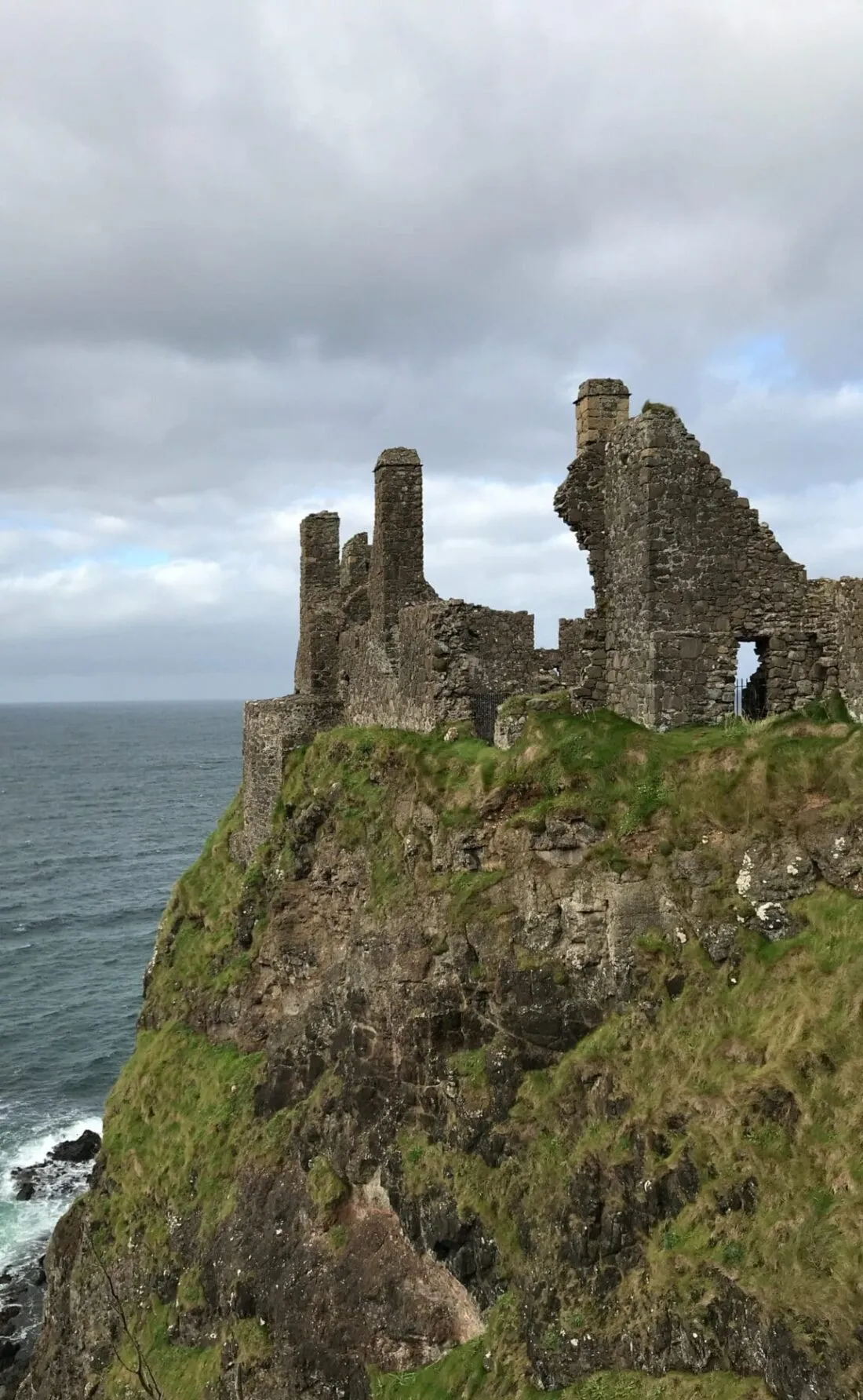
Perched on a sheer basalt cliff above the North Atlantic, Dunluce is the most dramatic castle ruin in Ireland. Richard Óg de Burgh, Earl of Ulster, built the first castle here in the 13th century; it later passed to the MacQuillans and then the MacDonnells, who held it in the 16th and 17th centuries. Legend says part of the kitchen fell into the sea during a storm. It is a short drive from the Giant’s Causeway, and the two make an easy day together.
How can you visit Ireland’s oldest castles?
The oldest castles fall into three easy clusters:
- Around Dublin: Dublin Castle in the city, then Trim Castle and Bective Abbey in County Meath, about an hour away.
- Northern Ireland: Carrickfergus near Belfast, Killyleagh on Strangford Lough, and Dunluce on the Causeway Coast — two or three days from Belfast.
- The south and west: Cahir Castle in Tipperary, on the way between Dublin and Cork or Kerry, and Roscommon in the Midlands.
For a trip built around castles, our Irish Castle Hotels & Whiskey Tour lets you sleep in them as well as visit them, and our guides to Ireland castle tours, the best castle hotels in Ireland and how many castles there are in Ireland go further. Most castles are open year-round, with the longest hours from May to September — see the best time to visit Ireland.
For the oldest castles elsewhere, see our guides to England’s oldest castle and Scotland’s oldest castle.
Frequently asked questions
What is the oldest castle in Ireland?
Trim Castle in County Meath, begun in 1172–73 with its stone keep from 1176, is the oldest and largest Anglo-Norman castle in Ireland.
What is the oldest inhabited castle in Ireland?
Killyleagh Castle in County Down, first fortified around 1180 and home to the Hamilton family since the early 17th century.
What is the oldest castle in Northern Ireland?
Carrickfergus Castle, begun by John de Courcy in 1177, is one of the oldest and best-preserved. Killyleagh, begun around 1180, is the oldest still lived in.
Can you visit Trim Castle?
Yes. The Office of Public Works runs guided tours of the keep, and the grounds are open to visitors. It is about an hour’s drive from Dublin.
Are there castles in Ireland older than the Normans?
Not in the sense most people mean. Before 1169 the Irish built ringforts, crannogs and stone forts such as Dún Aonghasa on the Aran Islands, which are far older, but stone castles in Ireland begin with the Anglo-Normans.
Planning a trip to Ireland
Juniper Tours designs private, custom Ireland itineraries — never group tours, never fixed departures. Most run 9–14 days and fall between about $4,000 and $15,000 per person for the land arrangements; across more than 250 Ireland trips we have booked, the median is about $4,200 per person. Your itinerary is built by a named specialist — Taryn Harrison has made 85+ personal visits to Ireland. The 30-minute consultation is free; a $100 planning deposit begins your itinerary. See Ireland trips →
Ireland trips are designed by Taryn Harrison — book a call.