
Ireland’s most famous landmarks are the Cliffs of Moher, the Giant’s Causeway, Newgrange, the Book of Kells at Trinity College, the Rock of Cashel and Blarney Castle. Add Dublin Castle, Kilmainham Gaol, the Ring of Kerry, Connemara National Park and the Burren, and you have the eleven sites most first-time visitors build a trip around.
They are spread across the whole island, from County Antrim in the north to County Cork in the south. This guide covers what each one is, where it is, how long to allow, and how to fit them into one trip.
| Landmark | Where | What it is | Time to allow |
|---|---|---|---|
| Cliffs of Moher | County Clare | Atlantic sea cliffs | 2–3 hours |
| Giant’s Causeway | County Antrim, Northern Ireland | Basalt columns, UNESCO site | 2–3 hours |
| Newgrange | County Meath | Neolithic passage tomb, UNESCO site | Half a day |
| Book of Kells, Trinity College | Dublin | Illuminated manuscript and Old Library | 1–2 hours |
| Dublin Castle | Dublin | Seat of British rule until 1922 | 1–2 hours |
| Kilmainham Gaol | Dublin | Former prison and museum | About 1.5 hours |
| Rock of Cashel | County Tipperary | Medieval church complex on a hill | 1–2 hours |
| Blarney Castle | County Cork | 15th-century tower house and gardens | 2–3 hours |
| Ring of Kerry | County Kerry | 179 km scenic loop | A full day |
| The Burren | County Clare | Limestone landscape and ancient tombs | Half a day |
| Connemara National Park | County Galway | Mountains, bog and walking trails | Half a day |
What are the most famous landmarks in Ireland?
The eleven landmarks most visitors put on their list are the Cliffs of Moher, the Giant’s Causeway, Newgrange, the Book of Kells, Dublin Castle, Kilmainham Gaol, the Rock of Cashel, Blarney Castle, the Ring of Kerry, the Burren and Connemara National Park. Four are in or near Dublin, six are in the south and west, and the Giant’s Causeway is in Northern Ireland.
1. Cliffs of Moher
The Cliffs of Moher run for about 14 kilometers along the Atlantic coast of County Clare and rise to 214 meters (702 feet) at their highest point. O’Brien’s Tower, built in 1835, marks the best-known viewpoint.
Most visitors walk the paved paths either side of the visitor center. For quieter views, follow the coastal trail south toward Hag’s Head. The cliffs sit next to the Burren, so the two make an easy pair in one day.
2. Giant’s Causeway
On the north coast of County Antrim, in Northern Ireland, about 40,000 interlocking basalt columns step down into the sea. They formed when lava cooled and cracked roughly 50 to 60 million years ago. Legend credits the giant Finn McCool, who built a causeway to Scotland.
It became a UNESCO World Heritage Site in 1986. The stones are free to walk; the National Trust visitor center charges for its exhibition and parking. Dunluce Castle and the Carrick-a-Rede rope bridge are both a short drive along the same coast.
3. Newgrange
Newgrange is a passage tomb in the Boyne Valley, County Meath, built around 3200 BC. That makes it older than Stonehenge’s stone circle and the Great Pyramid of Giza. It is part of Brú na Bóinne, a UNESCO World Heritage Site since 1993.
At dawn around the winter solstice, sunlight enters a roof-box above the entrance and lights the inner chamber. Visits are by guided tour only, starting at the Brú na Bóinne Visitor Centre, about 50 minutes north of Dublin.
4. Trinity College and the Book of Kells
Trinity College Dublin, founded in 1592, holds the Book of Kells, a Latin gospel book illuminated by monks around 800 AD. The same ticket covers the Long Room, the main hall of the college’s 18th-century Old Library.
Book a timed entry in advance, especially in summer. The Old Library is in the middle of a long-term conservation project, so what you see in the Long Room can change from one season to the next.
5. Dublin Castle
King John ordered a castle built on this site in 1204. Today it is mostly an 18th-century Georgian complex, though the medieval Record Tower survives. For more than 700 years it was the seat of British rule in Ireland, until it was handed over to the new Irish government in 1922.
The courtyards are free to walk through; the State Apartments are ticketed. The Chester Beatty library and museum sits in the castle grounds. Our post on when Dublin Castle was built covers its history in more detail.
6. Kilmainham Gaol
Kilmainham Gaol opened in 1796 and held generations of Irish rebels. Fourteen leaders of the 1916 Easter Rising were executed in its Stonebreakers’ Yard. The prison closed in 1924 and is now a museum.
Visits are by guided tour only, and tickets regularly sell out, so book as soon as your Dublin dates are fixed.
7. Rock of Cashel
The Rock of Cashel, also called St. Patrick’s Rock, rises above the plains of County Tipperary. It was the seat of the kings of Munster until 1101, when it was given to the Church.
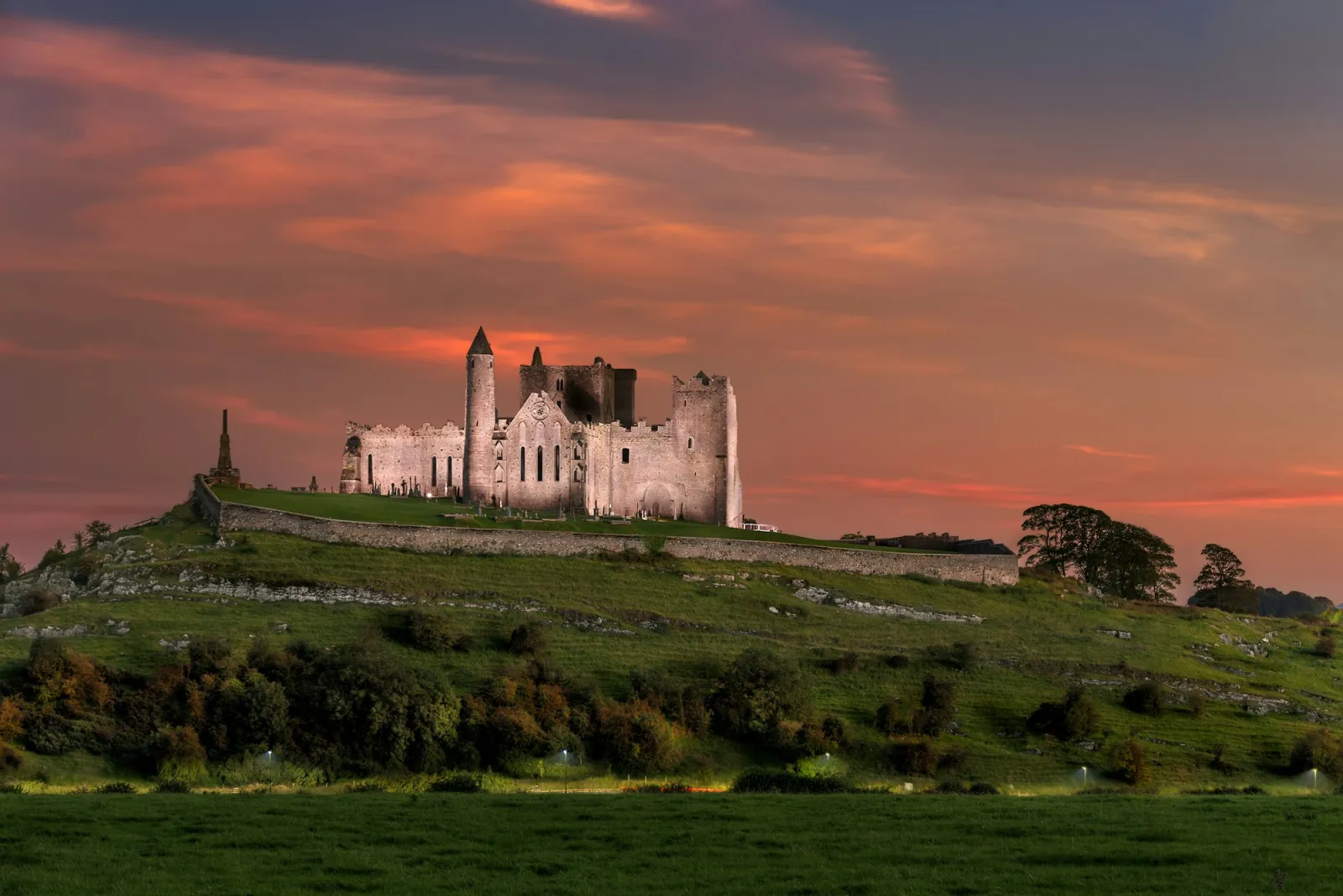
The hilltop holds a round tower, a roofless 13th-century cathedral and Cormac’s Chapel, consecrated in 1134 and one of Ireland’s finest Romanesque buildings. Cashel sits just off the Dublin–Cork motorway, so it breaks up the drive south.
8. Blarney Castle and the Blarney Stone
Blarney Castle, about 8 kilometers northwest of Cork city, is a tower house built by the MacCarthy clan in the 15th century. The Blarney Stone is set into the battlements at the top. Kissing it is said to give you the “gift of the gab”.

To kiss the stone you climb a narrow spiral staircase, lie back and lean over a drop while holding an iron rail. The large gardens, including a Poison Garden, are worth as much time as the castle. Arrive early in summer to avoid the queue for the stairs.
9. The Ring of Kerry
The Ring of Kerry is a 179-kilometer (111-mile) loop around the Iveragh Peninsula in County Kerry, usually started from Killarney. It passes mountains, lakes, beaches and villages such as Kenmare and Sneem.
Allow a full day so there is time to stop. The Skellig Ring, a detour off the main route near Portmagee, has some of the best coastal views and looks out toward Skellig Michael, an island monastery and UNESCO World Heritage Site.
10. The Burren
The Burren in north County Clare is a wide limestone landscape that looks almost bare from a distance. Up close, its cracks hold Arctic, Alpine and Mediterranean plants growing side by side, at their best in May.

It is also full of ancient sites. The best known is Poulnabrone, a portal tomb more than 5,000 years old. The Burren and the Cliffs of Moher are next to each other, so most visitors see both in one day.
11. Connemara National Park
Connemara National Park, near Letterfrack in County Galway, covers mountains, bog and woodland below the Twelve Bens range. Entry is free.
The Diamond Hill upper loop, about 7 kilometers, takes two and a half to three hours and gives wide views over the coast and islands. Kylemore Abbey is a short drive away. For more of Ireland’s scenery, see our guide to Ireland’s natural landmarks.
Which Irish landmarks are UNESCO World Heritage Sites?
Three places on the island of Ireland are on UNESCO’s World Heritage List:
- Brú na Bóinne, County Meath, which includes Newgrange (listed 1993)
- Skellig Michael, County Kerry, an island monastery off the Iveragh Peninsula (listed 1996)
- Giant’s Causeway and Causeway Coast, County Antrim, Northern Ireland (listed 1986)
The Cliffs of Moher and the Burren are not World Heritage Sites, but both sit inside the Burren and Cliffs of Moher UNESCO Global Geopark.
How many days do you need to see Ireland’s main landmarks?
Plan on 10 to 14 days to see all eleven without rushing. They are spread around the island, and Irish country roads are slower than the distances suggest.
Approximate drive times from Dublin:
- Newgrange: about 50 minutes
- Rock of Cashel: about 1 hour 45 minutes
- Blarney Castle: about 2 hours 45 minutes
- Giant’s Causeway: about 3 hours
- Cliffs of Moher: about 3 hours
- Killarney, for the Ring of Kerry: about 3 hours 30 minutes
- Connemara National Park: about 3 hours 45 minutes
A loop that works well: two or three nights in Dublin for Trinity, Dublin Castle, Kilmainham and a day trip to Newgrange. Then head south via Cashel to Cork and Blarney. Continue to Kerry, north to Clare for the Cliffs and the Burren, and on to Galway and Connemara.
Add two or three days if you also want the Giant’s Causeway. It is easiest from Belfast, or as the final leg back to Dublin. With a week, focus on Dublin and the south and west, and leave the Causeway for a later trip.
When is the best time to visit Ireland’s landmarks?
May, June and September are the best months. Days are long, gardens are in bloom, and the big sites are less crowded than in July and August. In June it stays light until after 10 pm, which leaves time for evening visits to the Cliffs or the Causeway after the coaches have gone.
In winter, opening hours are shorter and some sites cut back their tours. The one winter-only event is the solstice dawn at Newgrange. Places in the chamber for the solstice sunrise are given out by an annual lottery.
Book Kilmainham Gaol, the Book of Kells and Newgrange ahead in any season. If castles are part of your plan, see our guide to Ireland’s oldest castles.
Planning a trip to Ireland
Juniper Tours designs private, custom Ireland itineraries — never group tours, never fixed departures. Most run 9–14 days and fall between about $4,000 and $15,000 per person for the land arrangements; across more than 250 Ireland trips we have booked, the median is about $4,200 per person. Your itinerary is built by a named specialist — Taryn Harrison has made 85+ personal visits to Ireland. The 30-minute consultation is free; a $100 planning deposit begins your itinerary. See our private Ireland tours →


