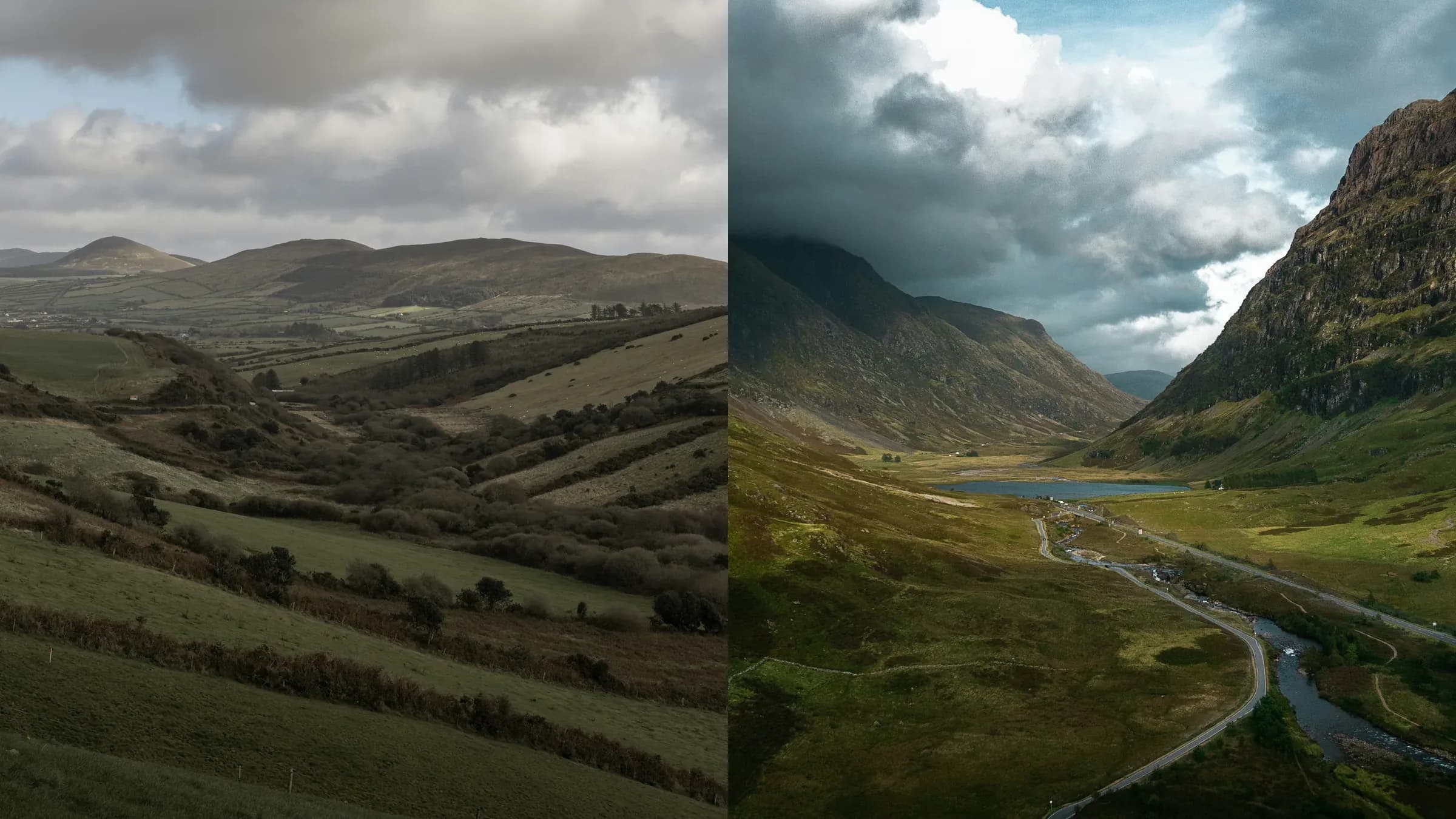

Braveheart was filmed mostly in Ireland, with key scenes in the Scottish Highlands. Mel Gibson’s 1995 epic shot its Scottish village and mountain scenes in Glen Nevis, near Fort William, and around Glencoe and Loch Leven. But the big battles, the castles and most of the rest were filmed in Ireland: the Battle of Stirling Bridge on the Curragh in County Kildare, and English “York” at Trim Castle in County Meath.
Most of the Irish locations are within about an hour of Dublin, and the Scottish ones are a day’s drive from Edinburgh or Glasgow, so you can see both on one trip. Here is every location you can visit, and what each one played in the film.
| Location | Country | In the film | Can you visit? |
|---|---|---|---|
| Glen Nevis | Scotland | Wallace’s village, “Lanark” | Yes |
| The Mamores, Loch Leven and Glencoe | Scotland | Highland mountains and journeys | Yes |
| The Curragh, Co. Kildare | Ireland | Battle of Stirling Bridge | Yes, open grassland |
| Ballymore Eustace, Co. Kildare | Ireland | Battle of Falkirk | Farmland, seen from the road |
| Trim Castle, Co. Meath | Ireland | The English town of “York” and the London execution square | Yes, guided tours |
| Bective Abbey, Co. Meath | Ireland | Longshanks’ castle courtyard and dungeons | Yes, free |
| Dunsany, Co. Meath | Ireland | “Westminster Abbey” | Private estate |
| Dunsoghly Castle, Co. Dublin | Ireland | “Edinburgh Castle” | No, private |
| Coronation Plantation, Co. Wicklow | Ireland | The English stockade | Yes, in the Wicklow Mountains |
| Blessington Lakes, Co. Wicklow | Ireland | Wallace’s escape on horseback | Yes |
Where was Braveheart filmed in Scotland?
Glen Nevis — Wallace’s village
The village of “Lanark”, where young William Wallace grows up and later marries Murron, was built in Glen Nevis, below Ben Nevis, Britain’s highest mountain. Its cottages were modeled on the old stone houses of St Kilda. The set was taken down after filming, but the car park built for the production is still there and still known as the “Braveheart car park”. Glen Nevis is about ten minutes’ drive from Fort William and has walks for every level, from riverside paths to the climb toward Steall Falls.
The Mamores, Loch Leven and Glencoe
The sweeping mountain shots — including Wallace’s ride through the hills after Mornay’s betrayal — were filmed in the Mamores, the range between Glen Nevis and Loch Leven, the sea loch at Kinlochleven (not the Loch Leven near Kinross). Nearby Glencoe, one of Scotland’s most dramatic valleys, also provided Highland scenery. The road through Glencoe is one of the great drives in Scotland, and the National Trust for Scotland visitor center explains the valley’s history, including the 1692 massacre.
Where was Braveheart filmed in Ireland?
Most of the film was shot in Ireland. The Irish government’s support for film production and the use of around 1,600 members of the Irish Defence Forces’ reserve as extras made it possible to stage the huge battle scenes, and most locations were within easy reach of Dublin and the Ardmore Studios in Bray, where interiors were filmed.
The Curragh — the Battle of Stirling Bridge
The Battle of Stirling Bridge was filmed on the Curragh, about 5,000 acres of open grassland between Newbridge and Kildare. Famously, there is no bridge in the film’s version of the battle — one of the most-discussed historical liberties in Braveheart. The Curragh is open common land, still grazed by sheep and used to train racehorses, and the Curragh Racecourse is on its edge.
Ballymore Eustace — the Battle of Falkirk
The Battle of Falkirk was filmed in fields near Ballymore Eustace, a village in County Kildare close to the Wicklow border. The fields are private farmland, so there is nothing to tour, but the village makes an easy stop between the Curragh and the Wicklow Mountains.
Trim Castle — “York”
Trim Castle, the largest Anglo-Norman castle in Ireland, played the English town of “York”, which Wallace’s army storms, and also the London square where Wallace is executed. For filming, the ruin was dressed with temporary wooden structures. The castle is about an hour from Dublin and open for guided tours of the keep, run by the Office of Public Works.
Bective Abbey — Longshanks’ castle
The ruins of Bective Abbey, a Cistercian abbey on the River Boyne a few miles from Trim, provided the courtyard of King Edward I’s castle and the dungeons where Wallace is held. It is free to visit and pairs perfectly with Trim.
Dunsany and Dunsoghly — “Westminster” and “Edinburgh”
Scenes set in “Westminster Abbey” were filmed on the Dunsany estate in County Meath, and Dunsoghly Castle, a 15th-century tower house north of Dublin, stood in for “Edinburgh Castle”. Both are private, so they are for fans who want to see them from the outside.
Wicklow — the stockade and Wallace’s escape
In the Wicklow Mountains, Coronation Plantation, near the Sally Gap, was the setting for the English stockade, and Blessington Lakes was used for Wallace’s escape on horseback. The Sally Gap road is one of the most beautiful drives near Dublin, and Blessington is popular for walking and water sports.
Can you visit the real William Wallace sites?
Yes — and they are worth combining with the filming locations, because the real story is just as dramatic:
- The National Wallace Monument, Stirling. A Victorian tower on the Abbey Craig, above the site of the real Battle of Stirling Bridge (1297). Inside is a sword traditionally said to be Wallace’s, and the top has one of the best views in central Scotland.
- Stirling Castle and Stirling Old Bridge. The castle overlooks the battlefield. The stone Old Bridge dates from the 15th century; Wallace’s battle was fought at an earlier wooden bridge nearby.
- Smithfield, London. A plaque on the wall of St Bartholomew’s Hospital marks where Wallace was executed in 1305.
How historically accurate is Braveheart?
Not very — and that is part of the fun of visiting the real places. The battle at Stirling had a bridge (it was the key to Wallace’s victory). Wallace’s men would not have worn belted plaids or kilts, which came centuries later. Isabella of France was a child at the time of the events shown, so the romance with Wallace is invented. And the nickname “Braveheart” historically belongs to Robert the Bruce, whose heart was carried on crusade after his death, not to Wallace. The film won five Academy Awards, including Best Picture and Best Director, and did more for tourism to Wallace country than any history book.
How do you plan a Braveheart trip to Scotland and Ireland?
The simplest route is to fly into one country and out of the other:
- Scotland (3–4 days): Stirling and the Wallace Monument, then north through Glencoe to Fort William for Glen Nevis and the Mamores.
- Ireland (3–4 days): Trim Castle and Bective Abbey in Meath, the Curragh and Ballymore Eustace in Kildare, and a day in the Wicklow Mountains for the Sally Gap and Blessington Lakes, staying in or near Dublin.
- Getting between them: a one-hour flight from Edinburgh or Glasgow to Dublin.
May to September brings the longest days for Highland drives and walks. A car is essential for Glen Nevis and the Irish countryside sites, or a private driver-guide if you would rather not drive on the left. Our Highlights of Scotland & Ireland itinerary combines both countries and can be built around the film, and our Best of Scotland route already passes through Glencoe. For more screen locations, see our guides to shows filmed in Scotland and movies filmed in Ireland.
Frequently asked questions
Where was Braveheart filmed?
Mostly in Ireland, with some scenes in Scotland. The Scottish locations are Glen Nevis, the Mamores, Loch Leven and Glencoe. The Irish locations include the Curragh and Ballymore Eustace in County Kildare, Trim Castle and Bective Abbey in County Meath, and the Wicklow Mountains.
Was Braveheart filmed in Scotland at all?
Yes. Wallace’s village and the Highland mountain scenes were filmed in Glen Nevis and the surrounding mountains near Fort William, plus Glencoe and Loch Leven.
Why was Braveheart filmed in Ireland?
Ireland offered government support for filmmaking and around 1,600 reserve soldiers as extras for the battle scenes, and its castles and countryside could stand in for medieval Scotland and England within easy reach of Dublin.
Where was the Battle of Stirling Bridge filmed?
On the Curragh, an open plain in County Kildare, Ireland. The film’s version of the battle leaves out the bridge.
Which castle was used in Braveheart?
Trim Castle in County Meath, Ireland, played the English town of “York”. Bective Abbey, Dunsany and Dunsoghly Castle were also used.
Planning a trip to Scotland
Juniper Tours, a luxury travel agency based in Middleton, Massachusetts, designs private, custom Scotland itineraries — never group tours, never fixed departures. Most run 7–12 days and fall between about $5,000 and $15,000+ per person, with hand-selected 4- and 5-star hotels, private guides and transfers arranged end to end. Planned by Taryn Harrison. The 30-minute consultation is free; a $100 planning deposit begins your itinerary. See our private Scotland tours →
Scotland and Ireland trips are designed by Taryn Harrison — book a call.