Health and wellness is the sixth biggest motivation for affluent travel in 2026 according to Virtuoso, and Costa Rica has a claim almost nowhere else can make: the Nicoya Peninsula is one of the world’s five original Blue Zones. That is a research designation, not a marketing one — and it is the reason a wellness trip here can be something more interesting than a spa with a view.
What actually counts as a wellness retreat?
There are three quite different products sold under the phrase, and the gap between them is enormous.
A hotel with a very good spa
You book treatments as you like. Nothing is programmed, nothing is prescribed. This is the majority of what is marketed as “wellness” and there is nothing wrong with it — provided that is what you wanted.
A structured retreat
A set programme over set dates: movement, treatments, food and rest built as a sequence, usually with practitioners attached and often with other guests on the same arc. Fixed departures, less flexibility, considerably more depth.
A private wellness itinerary
Your own trip, built around wellness rather than sightseeing — the properties chosen for their practitioners and their setting, days paced so there is genuinely nothing scheduled after lunch, and the country used as the backdrop rather than the checklist. This is what we build, and it suits couples who want to come back rested rather than to have completed something.
What is the Nicoya Blue Zone?
Blue Zones are the five regions identified by researchers, and popularised through National Geographic, where people live measurably longer than average and reach ninety in unusual numbers. Nicoya, on Costa Rica’s Pacific coast, is one of them, alongside Sardinia, Okinawa, Ikaria and Loma Linda.
What that means for a traveller is less mystical than the marketing suggests, and more interesting: a food culture built on beans, corn, squash and fruit; a pace of life that is genuinely unhurried; strong community and family structures; and a habit of physical activity woven into ordinary days rather than performed in a gym.
You cannot buy that in a week. But you can spend a week inside it, eating that food and moving at that pace, which is a more honest proposition than most wellness marketing manages.
Where are Costa Rica’s wellness regions?
| Region | The character | Best for |
|---|---|---|
| Nicoya & Santa Teresa | Blue Zone coast, surf, yoga, beach towns that grew up around it | Movement, sea, an unhurried rhythm |
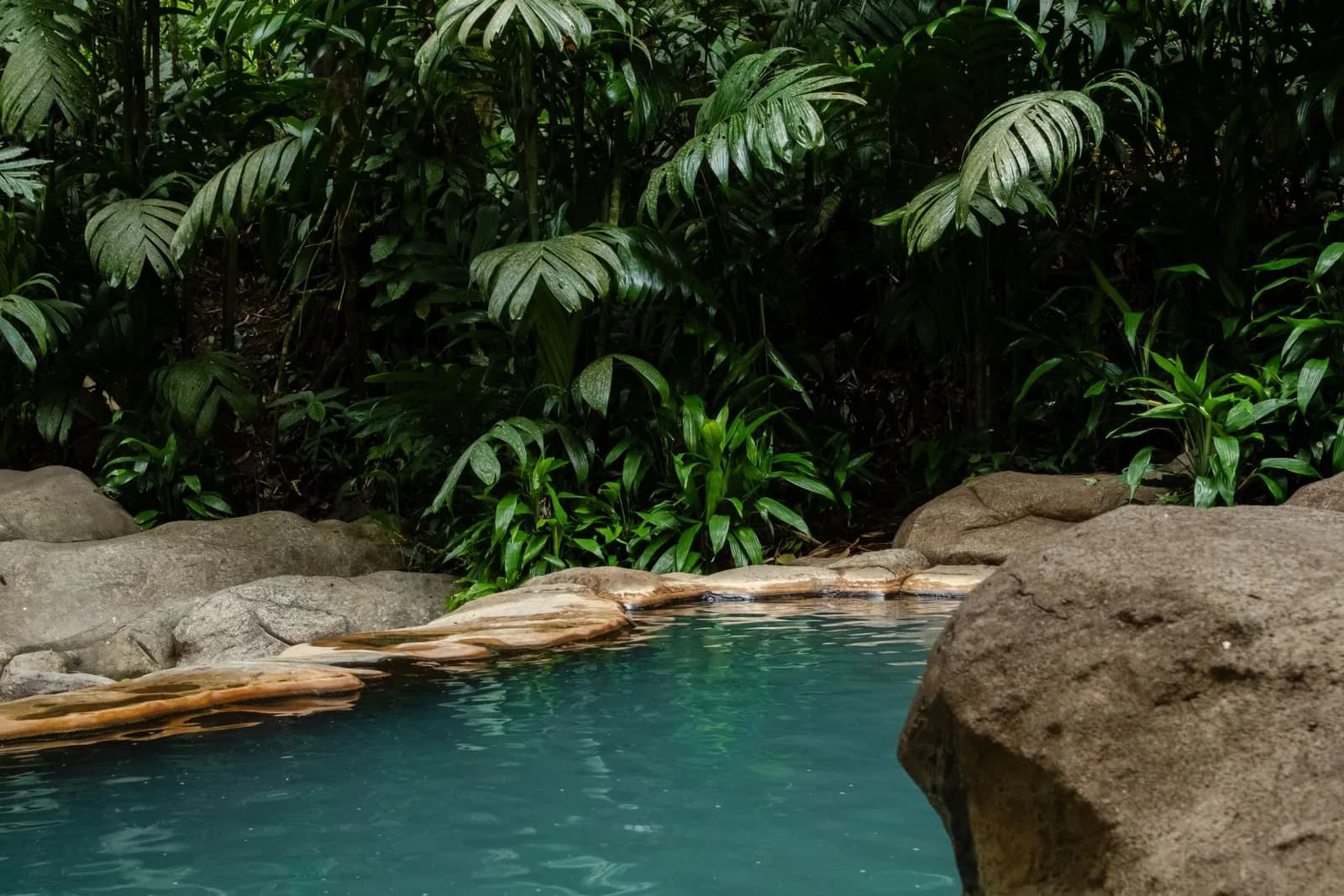
| Arenal & La Fortuna | Volcanic hot springs and rainforest, thermal waters at the centre of everything | Thermal soaking, gentler days, easy logistics |
| Guanacaste & Papagayo | Dry forest and calm Pacific bays, the most polished properties | Comfort and quiet; the easiest arrival |
| Osa Peninsula | Genuine remoteness, jungle meeting ocean, very few people | Disconnection in the literal sense |
Should you combine wellness with the rest of Costa Rica?
Usually yes, and in that order. The pattern that works is a few days of the country first — Arenal, a cloud forest, some wildlife — and then the wellness stay at the end, when you have stopped moving.
Doing it the other way round is a common mistake. A week of rest followed by five hours of winding mountain road undoes the week.
How long do you need?
Seven nights is the realistic floor for the wellness part to be more than a gesture, because the first two days are decompression whether you plan for them or not. Ten to twelve days lets you pair it with a genuine look at the country. Under a week, be honest with yourself that it is a good holiday rather than a reset.
When is the best time to go?
The dry season, mid-December through April, is the reliable choice. But the green season — May through November — deserves more consideration for a wellness trip specifically than it usually gets: the landscape is at its greenest, the properties are quieter, the rates are lower, and rain in the afternoon is not a problem when the afternoon plan was a hammock.
On availability, plainly: our Winter 2026–27 departures are fully booked. For December travel the practical horizon is Winter 2027–28. Our month-by-month guide covers the trade-offs in detail.
What does a Costa Rica wellness trip cost?
Most fully private, custom Costa Rica trips fall between about $5,000 and $15,000+ per person, with hand-selected four and five-star stays and private transfers arranged end to end. A wellness-led trip tends to sit in the middle of that range rather than the top, because the spend goes into fewer, longer stays and practitioner time rather than into moving around.
Planning yours
Our Costa Rica Wellness Escape is the built version of this — a route designed around rest rather than around sights. For the wider country, see Costa Rica, and if you want the active counterpoint, we wrote about the adventure regions worth your days.
Costa Rica is designed by Allison Tucker. The 30-minute consultation is complimentary and carries no obligation — book a call.