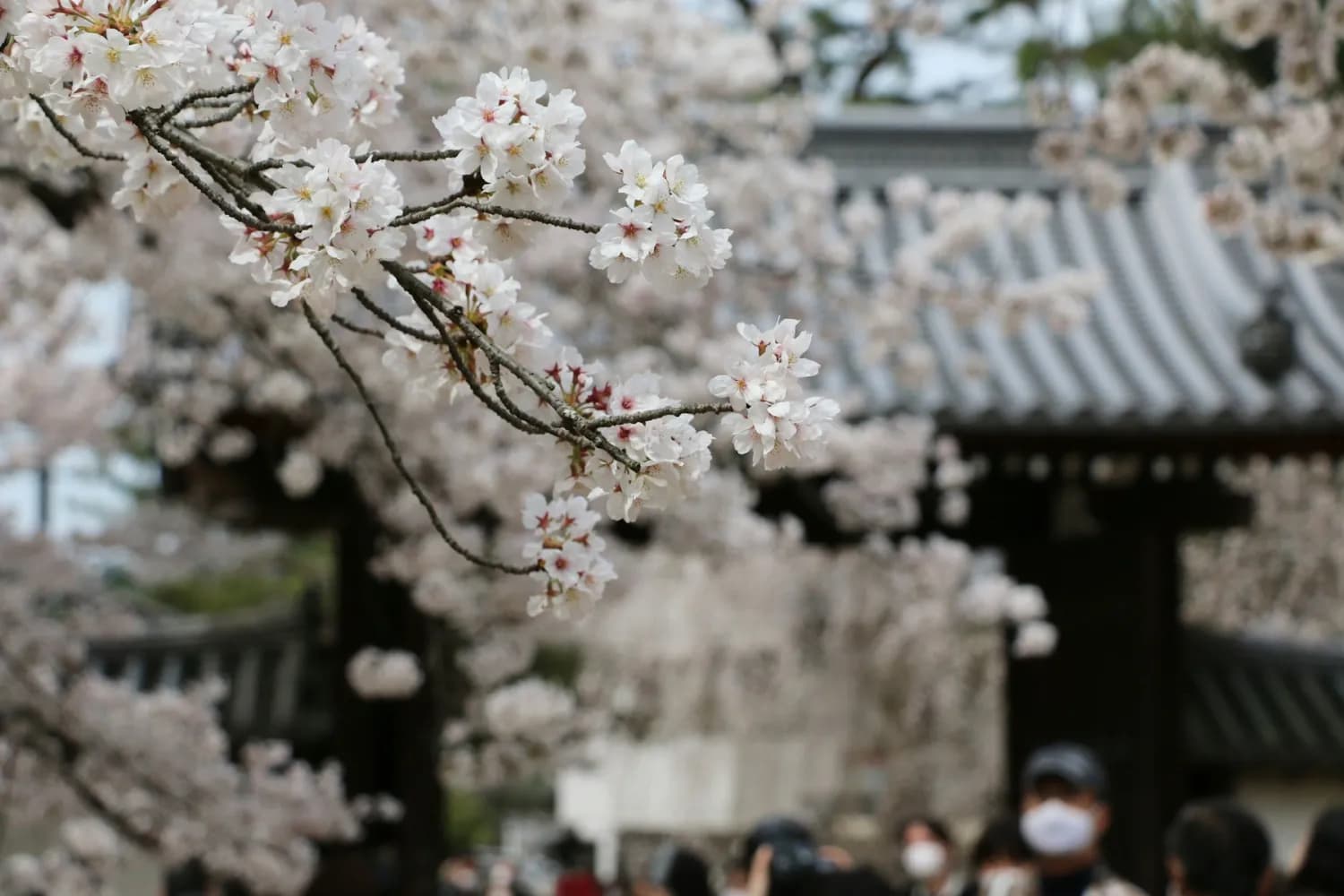
No one can tell you the exact dates yet: the first 2027 forecasts from Japan’s weather companies usually appear between late December and late January. What the records can tell you is the window. Over the 1991–2020 normals kept by the Japan Meteorological Agency (JMA), Tokyo’s cherry trees reach full bloom on average on March 31, and Kyoto, Osaka and Nara on April 4. Over the last four springs, Kyoto’s full bloom has fallen anywhere from March 24 to April 5. Plan around late March to early April, and build in flexibility.
Key takeaways
- Tokyo blooms first among the classic cities. JMA’s average is first flowers on March 24 and full bloom on March 31.
- Kyoto, Osaka and Nara follow a few days later. All three share an average full-bloom date of April 4.
- The spread between years is wide. Tokyo’s full bloom ran from March 22 (2023) to April 4 (2024) over the last four years.
- The trend is earlier. Nationally, first flowering has moved about 1.1 days earlier per decade since 1953, and Kyoto’s 2021 full bloom on March 26 was its earliest in roughly 1,200 years of records.
- The season doesn’t end at full bloom. Double-flowered varieties keep blooming into mid- and late April.
When will the cherry blossoms bloom in Japan in 2027?
The honest answer today is: most likely in the last week of March in Tokyo and around the first days of April in Kyoto, with a real chance of either side. The table below is the best guide available before the forecasts arrive. It shows JMA’s 30-year averages and what actually happened in each of the last four springs.
| Tokyo: first flowers | Tokyo: full bloom | Kyoto: first flowers | Kyoto: full bloom | |
|---|---|---|---|---|
| Average (1991–2020) | Mar 24 | Mar 31 | Mar 26 | Apr 4 |
| 2023 | Mar 14 | Mar 22 | Mar 17 | Mar 24 |
| 2024 | Mar 29 | Apr 4 | Mar 29 | Apr 5 |
| 2025 | Mar 24 | Mar 30 | Mar 27 | Apr 5 |
| 2026 | Mar 19 | Mar 28 | Mar 23 | Mar 30 |
Source: Japan Meteorological Agency observations of Somei-yoshino, the variety behind most of Japan’s blossom forecasts. Osaka and Nara average full bloom on April 4, and Yokohama on April 1.
What do “flowering” and “full bloom” mean?
Forecasts use two Japanese terms, and they are a week or more apart:
- Kaika (flowering) is the first day at least five or six blossoms are open on an official sample tree.
- Mankai (full bloom) is the first day about 80 percent of the blossoms on that tree are open.
On JMA’s averages, the gap between the two is 7 days in Tokyo and 9 days in Kyoto. When a forecast gives a single date, check which one it means. A trip timed to the flowering date arrives before the trees are full.
When will the 2027 forecasts come out?
For the 2026 season, the Japan Meteorological Corporation published its first forecast on December 18, 2025, Weathernews followed in early January, and the Japan Weather Association (tenki.jp) on January 29, 2026. Expect the 2027 forecasts on a similar timetable, then updated weekly as spring approaches. We will update this guide when they appear.
Are the blossoms getting earlier?
Yes. Across Japan, first flowering has moved about 1.1 days earlier per decade since 1953, according to JMA climate reporting cited by Japan’s Ministry of the Environment. In Kyoto, where court records of blossom viewing go back to the ninth century, the 2021 full bloom on March 26 was the earliest in roughly 1,200 years. The previous record dated from 1409. Recent springs have still varied a lot, though: 2023 was very early and 2024 close to the old average.
What if you miss full bloom?
You still see blossoms, just a different stage of them. In the days after full bloom, Somei-yoshino petals start to fall in drifts, which the Japanese call hanafubuki, a “blossom blizzard”. And several later varieties take over:
- Double-flowered cherries (yaezakura). At Tokyo’s Shinjuku Gyoen, the Ichiyo variety blooms in early to mid April and the Kanzan in mid to late April.
- Nara Park has about 1,700 cherry trees, including the Nara double cherry that is the prefecture’s official flower, and its season runs from late March to late April.
- Arashiyama in western Kyoto has about 1,500 trees, including mountain cherries, and is at its best in early to mid April.
- Ninna-ji’s Omuro cherries in Kyoto are a late-blooming dwarf variety, only 2–3 meters tall.
Our guide to the best places to see cherry blossoms in Kyoto and Tokyo sorts the famous spots into early and late.
How do you plan around a date nobody knows yet?
- Give yourself a long trip. Ten to twelve days spanning late March and early April covers most outcomes in at least one city.
- Go south to north, or follow the late varieties. If Kyoto is past its peak, Nara and Arashiyama’s later trees, or the double-flowered cherries, carry the season on.
- Book early. Blossom season is Japan’s busiest travel window, and the best ryokan and Kyoto hotels go first. Our Japan cost guide covers what a spring trip runs.
- Follow hanami etiquette. Japan’s tourism organization asks visitors never to break branches or pick flowers, to take only the picnic space they need, and to carry their trash home.
When does our cherry blossom small-group tour travel?
Our hosted cherry blossom small-group tour runs April 5–16, 2027. The group is in Tokyo from April 5, in Kyoto from April 8 (with days out to Nara and Osaka), and in Hakone near Mt Fuji before a final night in Tokyo. In an average year that falls just after full bloom in Tokyo and Kyoto. That means falling petals in the cities, and the later trees at Arashiyama, Nara Park and the Osaka Castle grounds coming into their own. In an early year the main bloom will be past; in a late one, like 2024 and 2025 in Kyoto, the group arrives close to it.
It is twelve days, fully guided, with no more than 20 guests, from $7,850 per person (double occupancy), with a $750 per person deposit to reserve.
Let our Japan specialists time your trip
Cherisse Liptzin and Liz Downey plan Juniper’s Japan trips. For a private trip, they can build the route around the forecasts as they come in. See custom Japan tours and our month-by-month guide to the best time to visit Japan, or book a free consultation.