Costa Rica is Virtuoso’s fourth most popular adventure destination for 2026, and the reason is density: rainforest, cloud forest, volcanoes, two coastlines and roughly five per cent of the planet’s known species inside a country smaller than West Virginia. What most itineraries get wrong is treating that as a checklist. The zip-line is not the adventure. The guide is.
What makes Costa Rica different from other adventure destinations?
You can be in cloud forest in the morning and on a Pacific beach by late afternoon. Almost nowhere else compresses that many ecosystems into that little driving, which is why Costa Rica rewards a two or three-region trip in a way that larger countries do not.
The trade is that everything is close but nothing is fast. Roads wind, mountains get in the way, and a 90-kilometre transfer can take three hours. Planning around that — rather than pretending it away — is most of the difference between a good Costa Rica trip and an exhausting one.
Is the zip-line worth it?
It is fun, and it is fifteen minutes, and it is not why you came. Canopy tours are the most heavily marketed thing in Costa Rica and among the least distinctive — they exist in a dozen countries.
What does not exist elsewhere is a naturalist guide who can find a well-camouflaged eyelash viper on a branch you have walked past twice, or hear a bellbird and tell you where to stand. Guiding is a licensed profession in Costa Rica and the good ones are genuinely expert. Booked well, they are the single highest-value line in the budget. Booked badly, you get a driver with a laminated card.
Where should you actually go?
Arenal and La Fortuna — the accessible one
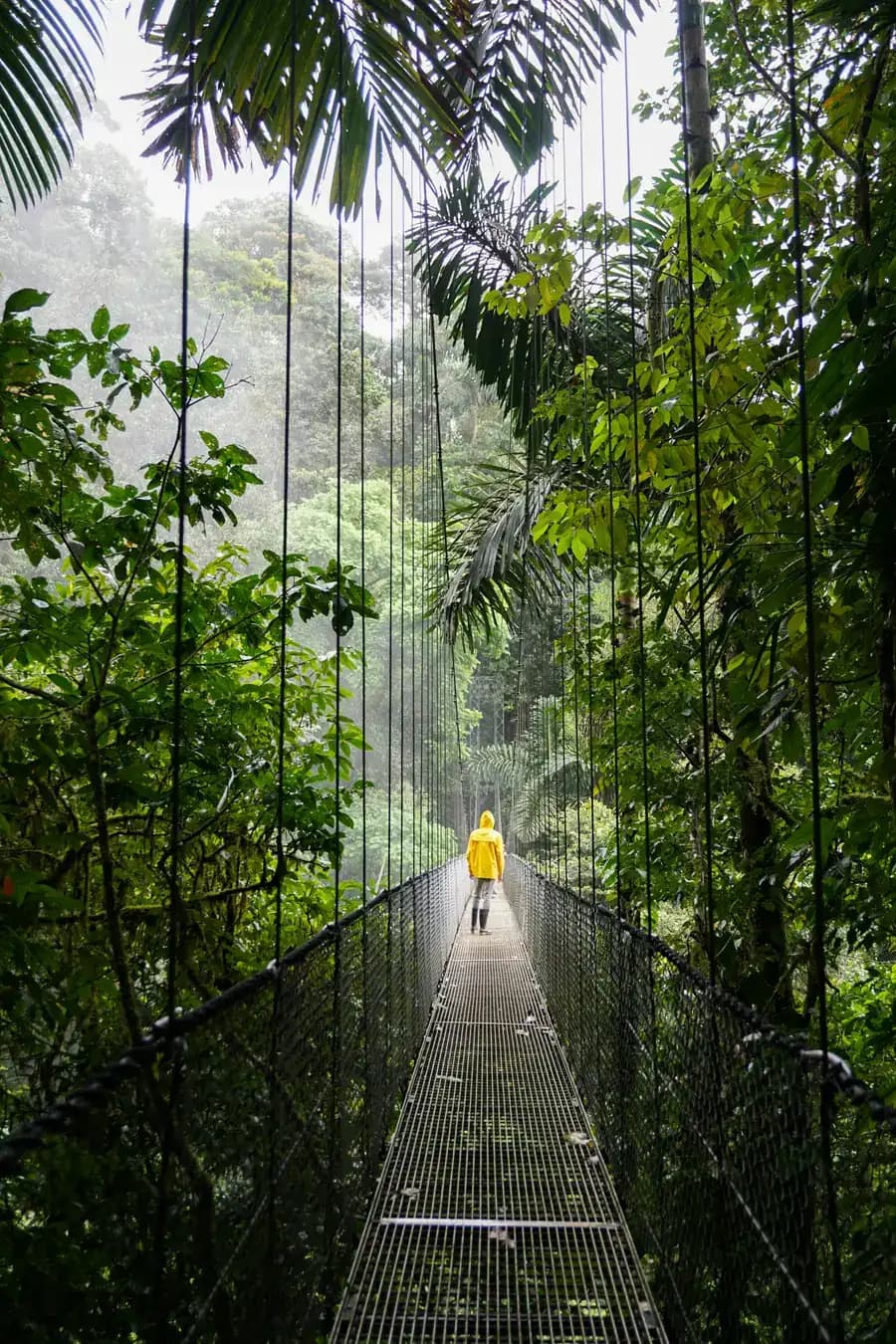
A near-perfect volcano cone, hot springs fed by it, hanging bridges through primary forest, and white water within easy reach. This is where most first trips start, and rightly: it delivers a great deal with the least logistical friction, and it works for a wide range of ages and fitness.
Monteverde — the cloud forest
A genuinely different biome, not just a higher one. Cloud forest is cooler, wetter and quieter, hung with moss and bromeliads, and it is where the resplendent quetzal lives. Come prepared for cool and damp; couples arrive in shorts expecting the tropics and are surprised. The approach roads are winding and slow, which is the price of admission.
Osa Peninsula and Corcovado — the genuinely wild one
Corcovado is the serious answer. National Geographic once described it as the most biologically intense place on Earth, and it is the part of Costa Rica where you have a real chance of tapirs, scarlet macaws in numbers, and all four of the country’s monkey species. Access is limited, entry requires a certified guide, and getting there is a flight or a long drive plus a boat.
It is the least convenient region in the country and the one adventure travellers most often say was worth the trouble.
Tortuguero — the canals
No road reaches Tortuguero; you arrive by boat or small plane, and you explore by boat through a lattice of freshwater canals. Green sea turtles nest here in numbers through the middle of the year, which is one of the few genuinely seasonal reasons to structure a trip around a date.
Guanacaste and Nicoya — dry forest and surf
Drier, hotter and browner in season than the Costa Rica of the postcards, with the country’s best-known beaches and surf, and tropical dry forest that is far rarer globally than rainforest. This is where most trips end, and it is the right place to end them.
How many regions should one trip cover?
| Trip length | Regions | Shape |
|---|---|---|
| 7–8 days | 2 | Arenal plus one coast. Anything more is spent in a car. |
| 10 days | 3 | Arenal, Monteverde or Osa, then a coast. The comfortable version. |
| 14 days | 3–4 | Adds Osa or Tortuguero properly rather than as a raid. |
The most common self-planned error is four regions in eight days. It produces a holiday that is mostly transfers.
When is the best time for adventure travel in Costa Rica?
The dry season, mid-December through April, is the straightforward answer for the Pacific side and for hiking. The green season, May through November, brings afternoon rain rather than all-day rain, a far greener landscape, better rates and dramatically fewer people — and for wildlife it is arguably better, not worse.
One piece of honesty on timing: our Winter 2026–27 departures are fully booked. If your heart is set on December or the New Year, the practical answer is to look at Winter 2027–28, or to consider the shoulder months either side, which are quieter and often better anyway. More detail sits in our month-by-month guide.
How hard is it, really?
Most of Costa Rica’s signature experiences are moderate rather than demanding — hanging bridges, guided forest walks, boat safaris, easy rafting. The country is unusually good at offering real wilderness without requiring real expedition fitness, which is why it works so well for mixed groups.
The genuinely strenuous options exist — multi-day Corcovado traverses, serious white water, summit hikes — and they need to be asked for. They are not the default.
Planning yours
The work in a Costa Rica adventure trip is choosing which two or three regions actually suit you, sequencing them so the driving does not eat the holiday, and securing guides who are worth the day. That is what a custom Costa Rica trip is for.
Our Best of Costa Rica shows one fully built route, and there is a longer 15-day version for travellers who want Osa or Tortuguero done properly.
Costa Rica is designed by Allison Tucker. The consultation is free and carries no obligation — book a call.