A fully private, custom 10-day Italy trip runs $5,000 to $15,000+ per person for 2027, land arrangements only — international airfare is not included. Most couples land between $8,000 and $12,500 each. Region does more to the number than tier does: a high-season night on the Amalfi Coast runs €840–€1,960 at the properties people actually want, against €310–€530 in Umbria or Puglia for a comparable standard.
Key takeaways
- Budget $8,000–$12,500 per person for a well-built 10-day trip in 2027, land only. That's where most Juniper Italy itineraries price.
- Where you go changes the cost more than how you travel. Positano's Villa Franca averages €1,140 a night in high season and Borgo Santandrea in Amalfi €1,960. Palazzo Tafuri in Puglia is €363. Same tier, three to five times the price.
- Amalfi private drivers are the line item that surprises people. Naples to Positano is €200 one way. A full day on the coast is €480–€520 for a sedan, €560–€600 for a van.
- Rome to the Amalfi Coast by private car is €650–€750. It's a real number people don't budget for, and the train to Naples plus a transfer costs roughly a third of it.
- Shoulder season saves 25–40% on the coastal and lake properties, and nothing on Rome or Florence, where the year is now flat.
- A licensed private guide is €180 for a half day and €320 for six hours in Tuscany — genuinely good value, and one of the few Italian line items that hasn't inflated.
- Venice, Rome, Florence and Milan are cheaper to sleep in than the Amalfi Coast. Palazzo Venart in Venice averages €545; Il Tornabuoni in Florence €263. The famous cities are not where the money goes.
How much does a 10-day Italy trip cost?
For a fully private trip built from scratch — hand-selected properties, private transfers between regions, licensed guides where they matter, museum and site entries pre-reserved — plan on $5,000 to $15,000+ per person for ten days on the ground, two people sharing. International airfare is separate.
What makes Italy hard to quote is that the country has three separate price economies running at once. There's the Amalfi–Capri–Portofino–Lake Como economy, which prices like the Caribbean in August. There's the big-city economy — Rome, Florence, Venice, Milan — which is expensive by European standards but not extreme. And there's Umbria, Puglia, Piedmont, Le Marche and inland Sicily, which are startlingly good value and where a very good hotel costs what a mid-range one costs in Positano.
A ten-day itinerary that touches only the first economy can run $18,000 a head. The same ten days, the same standard of property, weighted toward the third, comes in under $8,000. Shorter formats start from around $2,500 per person.
What do the price tiers actually buy?
Per person, based on two people sharing, ten days, land arrangements only. International airfare is excluded. Hotels, breakfast, all internal transport, transfers, guiding and pre-reserved entries are included.
| Tier | Per person, 10 days | Where you sleep | How you move | What you give up |
|---|---|---|---|---|
| Comfortable | $5,500–$7,500 | Excellent 4-star and boutique properties in Rome, Florence and a Tuscan or Umbrian estate | Fast trains between cities, one hire car for the countryside, arrival and departure transfers | The coast, mostly. Amalfi at this tier means a Sorrento base and day trips |
| Private-guided | $8,000–$12,500 | Upper-4-star and 5-star with the view you're paying for — a sea-facing room in Positano, a canal room in Venice | Private drivers on the coast and between regions, first-class rail on the long legs, licensed guides most days | Very little. This is where most Italy trips should sit |
| Top end | $13,000–$22,000+ | Le Sirenuse, Il San Pietro, Aman Venice, Passalacqua — the named suites, not the entry category | Private driver and vehicle throughout, chartered boat days off Capri and the coast, helicopter Rome–Amalfi where it saves half a day | Nothing except money |
How big is the regional cost spread?
Larger than almost anywhere else in Europe. These are average high-season rates for a standard double, from a 2026 survey of named properties, converted at €1 = $1.16 (September 3, 2026).
| Region | Property | Avg. high-season night | USD |
|---|---|---|---|
| Amalfi Coast | Borgo Santandrea, Amalfi | €1,960 | $2,272 |
| Amalfi Coast | Villa Franca, Positano | €1,140 | $1,322 |
| Amalfi Coast | Bellevue Syrene, Sorrento | €839 | $973 |
| Sicily | Country House Villadorata, Noto | €603 | $699 |
| Venice | Palazzo Venart | €545 | $632 |
| Puglia | Castle Elvira, Trepuzzi | €527 | $611 |
| Puglia | Palazzo De Noha, Lecce | €495 | $574 |
| Piedmont | Villa La Madonna | €475 | $551 |
| Rome | Palazzo Ripetta | €457 | $530 |
| Puglia | Palazzo Tafuri, Nardò | €363 | $421 |
| Tuscany | Locanda al Colle | €310 | $360 |
| Florence | Il Tornabuoni | €263 | $305 |
Read that table twice, because it inverts what most people assume. Venice and Rome are not the expensive part of Italy. The Amalfi Coast is, by a factor of three or four against Puglia and Tuscany at an equivalent standard, and by roughly the same against the historic cities.
The practical consequence: swapping four Amalfi nights for four Puglia nights on a ten-day trip saves a couple somewhere in the region of $4,000–$8,000, at no drop in the quality of the room. It's a different trip, not a worse one — and if the sea is the point, Puglia has sea. We make the case at length in how to plan an Italian vacation off the beaten path and in our guide to the parts of Italy most people miss.
Why are Amalfi Coast private drivers so expensive?
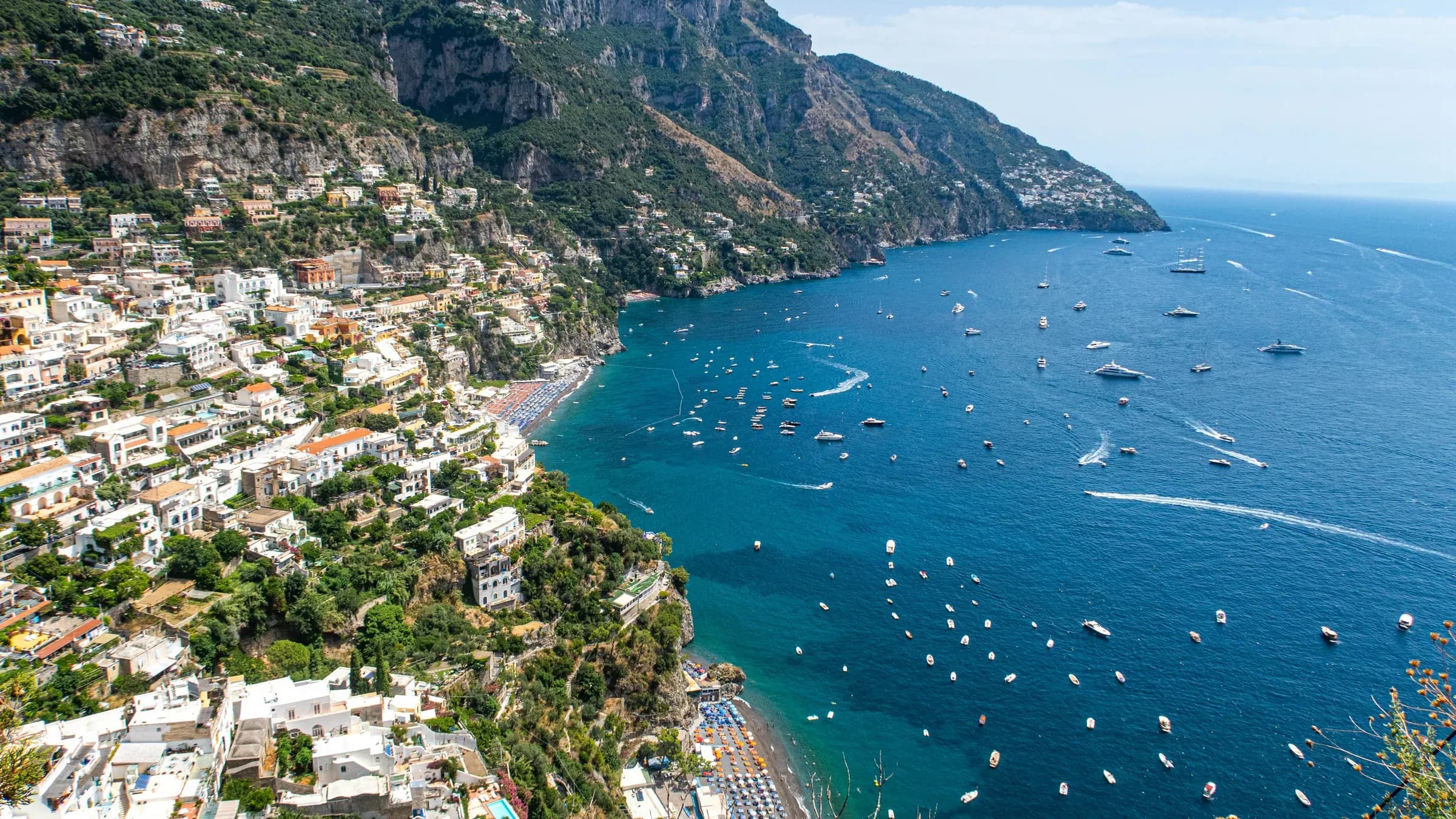
Because the road is the product, and the road is terrible. The SS163 is single-lane, cliff-edged, and in July and August it is stationary. Parking in Positano is effectively nonexistent and priced accordingly. Nobody sensible drives themselves here, which removes the cheap option entirely and leaves a market where every visitor needs the same scarce thing at the same eight weeks of the year.
Published rates, and they are consistent across operators:
| Service | Sedan | Van | USD (sedan) |
|---|---|---|---|
| Naples ↔ Positano transfer | €200 | €230 | $232 |
| Naples ↔ Amalfi transfer | €220 | €250 | $255 |
| Naples ↔ Ravello transfer | €190 | €220 | $220 |
| Naples ↔ Sorrento transfer | €170 | €200 | $197 |
| Rome ↔ Amalfi Coast / Sorrento | €650 | €750 | $754 |
| Naples ↔ Rome | €490 | €590 | $568 |
| Full day: Ravello, Amalfi, Positano (8–10 hrs) | €480–€520 | €560–€600 | $557–$603 |
| Full day: Pompeii, Amalfi, Positano, Sorrento | €590 | €690 | $684 |
| Transfer with a 2-hour Pompeii or winery stop | €320–€350 | €380–€400 | $371–$406 |
| Extra hour | €60 | €70 | $70 |
Two ways to spend less without walking. Take the train from Rome to Naples — around two hours on the Frecciarossa — and pick up a €200 transfer from there rather than paying €650 to be driven the whole way. And use the ferries between Positano, Amalfi, Sorrento and Capri in season: they're faster than the road in August, dramatically cheaper, and the coast looks better from the water anyway.
Where the driver genuinely earns the money is a full day inland — Ravello and the Valle delle Ferriere, the Pompeii and Vesuvius pairing, a winery on the Lattari hills. A €500 day split across two people is $290 each, which is fair for eight hours in a country where you cannot park. Our Amalfi Coast itinerary sequences it so you're paying for the days that need a car and not the ones that don't.
How much does high season cost you against shoulder season?
On the coast and the lakes, roughly 25–40%. In the cities, close to nothing.
That asymmetry matters. Rome, Florence and Venice have flattened their year — the Jubilee and sustained demand mean a March night in Rome costs close to a June night. So the season argument only works where the season still exists: Amalfi, Capri, Sardinia, Puglia's coast, Lake Como.
| Period | Coast and lakes | Cities | What it's actually like |
|---|---|---|---|
| April–mid-June | High, rising | High | The best combination in Italy. Warm, everything open, sea swimmable from late May |
| Mid-June–August | Peak, +25–40% | High | Hot, crowded, the SS163 gridlocked. Avoid unless the calendar forces it |
| September | High | High | Warmest sea of the year, harvest inland, crowds thinning after the first week |
| October | Shoulder, −25–35% | High | Excellent value on the coast. Some Amalfi properties close from late October |
| November–March | Low or closed | Steady | City trips only. The coastal hotels largely shut |
The single best-value fortnight in Italy is the first two weeks of October: sea still warm, coastal rates down by a quarter or more, Tuscany and Piedmont in harvest, and the cities no busier than they were in June. The best time for a honeymoon in Italy goes month by month.
What does a licensed guide cost, and is it worth it?
Less than you'd expect, and yes. A licensed private guide in Tuscany publishes at €75 an hour, €180 for a three-hour half day, and €320 for a six-hour full day — a total for the party, not per person. Multi-day rates come down further: €600 for two days, €870 for three.
Rome, Florence and Venice run above those figures — reckon on €250–€450 for a half day with a genuinely good licensed guide at the major sites, plus museum entries. Italy licenses its guides by region and enforces it, so you're paying for someone with an actual qualification rather than an app.
Where it pays for itself: the Vatican, the Uffizi, the Accademia, Pompeii, and Venice's less obvious churches. These are places where two hours with the right person is worth more than a full day alone, and where pre-reserved entry is the difference between walking in and standing in a queue for ninety minutes. Where it doesn't: walking a hill town, eating, or a day at the beach.
What actually moves the number?
Four decisions, in order.
1. Which regions you include. The biggest lever by a distance. Four Amalfi nights versus four Puglia nights is a $4,000–$8,000 swing for two at the same standard of property. If the budget is tight, the answer is not a worse hotel — it's a different region.
2. How much of the trip needs a private driver. €480–€650 a day adds up fast. Rail between cities is fast, cheap and genuinely pleasant; drivers are for the coast, the countryside and the airport runs.
3. Season, but only on the coast. October versus July saves 25–35% on Amalfi and the lakes, and roughly nothing in Rome.
4. Room category, not hotel category. On the Amalfi Coast the sea-view supplement at the same property is often larger than the gap between two different hotels. Decide whether you actually want the view or just want to be in Positano — they cost very different amounts.
Compared with Switzerland, where transport is the dominant line, Italy's cost is almost entirely accommodation and drivers. The comparison is instructive if you're weighing the two: see how much a luxury Switzerland trip costs.
Who this suits — and who it doesn't
Italy is the wrong choice if your budget is fixed and you're set on the Amalfi Coast in July. That combination produces a bad trip: an inland room with no view, a hotel in the wrong town, and three hours a day in traffic on a road you can't get off. Go in October, go to Puglia, or go somewhere else — but don't buy a compromised version of Amalfi in high summer.
It's also the wrong choice if you want to see the whole country in ten days. Rome, Florence, Venice, Tuscany and the Amalfi Coast in a single ten-day trip is four travel days and six real ones, and every one of those transfers costs money. Three regions is the ceiling; two is usually better.
It suits travelers who will trade the famous coastline for a better room somewhere less obvious, who understand that a licensed guide at the Uffizi is one of the best-value purchases in European travel, and who would rather stay four nights in one place than move every second morning.
How far ahead should you book?
Ten to twelve months for May, June and September on the Amalfi Coast, Capri or Lake Como. The properties worth going for have thirty to sixty rooms, sell direct to repeat guests, and are effectively full a year out for the sea-facing categories.
Eight to ten months for October on the coast, and for any trip that includes a specific Tuscan or Umbrian estate — those have twelve to twenty rooms and go the same way.
Four to six months is enough for a cities-only trip in the shoulder months, with one exception: Vatican and Uffizi slots with a licensed guide should be reserved as soon as your dates are fixed, regardless of how far out that is.
Book drivers when you book hotels. Amalfi's good English-speaking driver-guides are a small pool, and in August they're committed months ahead.
Let our Italy specialist price your trip properly
Most of what makes an Italy quote high or low is invisible from a website: whether that Positano room actually faces the sea or the hillside behind it, whether the €650 Rome transfer was necessary or whether a train and a €200 pickup would have done, whether the region you've chosen is the one your budget works best in. Lexi Blade designs Juniper's Italy itineraries from inside the country — she's based in Florence, with 10+ Italy trips behind her, and she knows which Amalfi property is worth the upgrade and which Uffizi time slot avoids the crowds. For the north — the Dolomites, Lake Como, the Italian Alps — Taryn Harrison handles it. Every Juniper trip to Italy is fully private and built from scratch around your dates: no group coaches, no fixed departures.
"Our trip to Italy was amazing all thanks to Juniper Tours. Their attention to detail made our trip a trip of a lifetime!" — Melissa C., verified Google review
Our Italy itineraries typically run 10–14 days and $5,000–$15,000+ per person, land only. See what that covers on our custom Italy trips, or, if you're pricing a trip for two, Italy honeymoons. If the coast is the point, start with our Amalfi Coast itinerary; if you're open to being talked out of it, read the parts of Italy most people miss and our best Italy trips. Then book a free consultation and we'll give you a real number rather than a range.