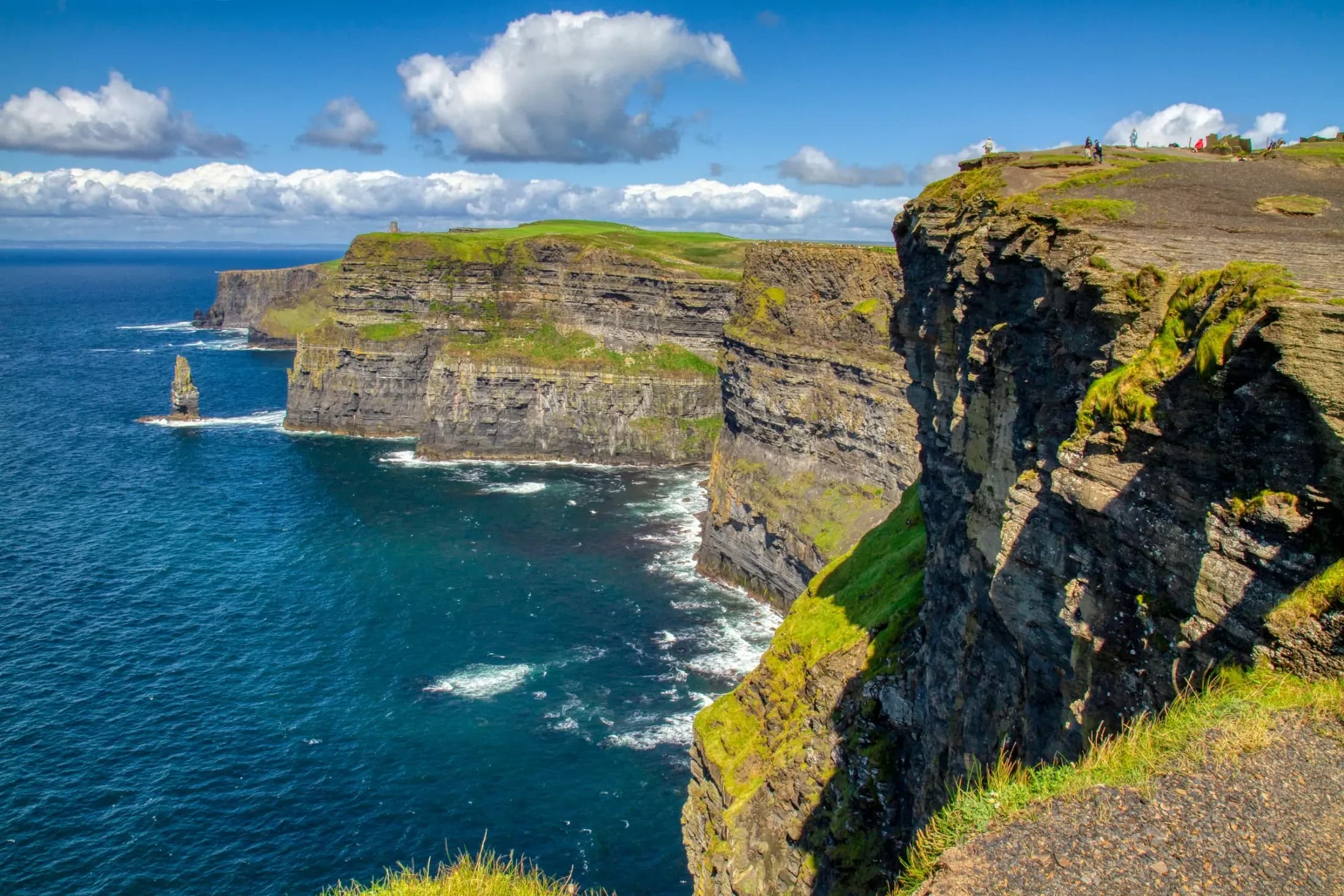
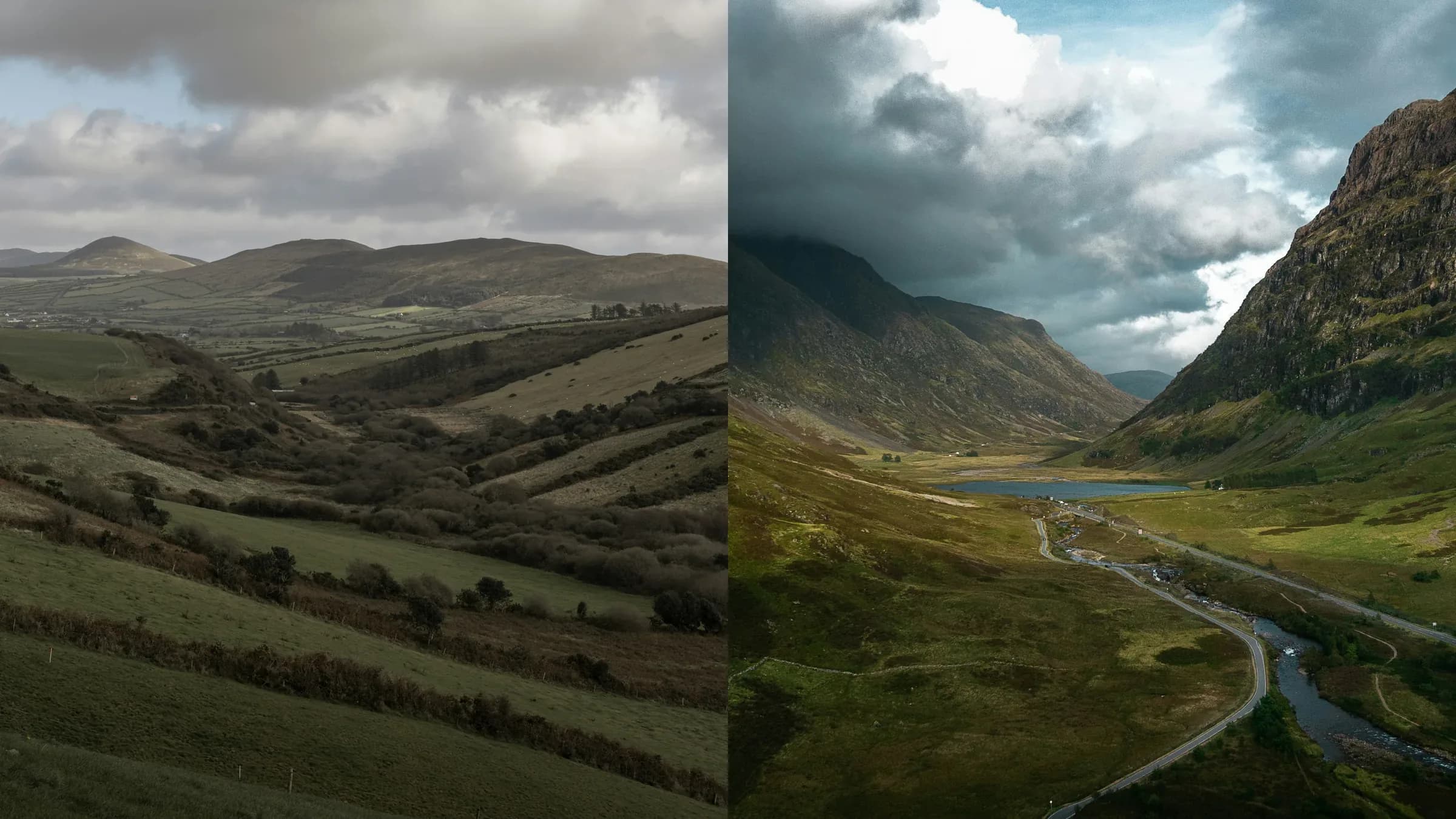
Ireland is the warmer, easier, more sociable trip; Scotland is the wilder, harder, more dramatic one. On paper they're near twins — 84,421 km² against Scotland's 77,933 km² — but Ireland's typical driving day runs 60 to 90 minutes and Scotland's runs two to three hours. Ireland works in seven nights. Scotland honestly needs ten. Choose on tolerance for driving and weather, not on which country is "better."
Key takeaways
- Ireland's driving days are roughly half as long. Plan 60–90 minutes between stops in Ireland versus 2–3 hours in Scotland, where the Highlands and islands stretch every route.
- Seven nights works in Ireland; Scotland wants ten. Below ten nights in Scotland you're choosing between the Highlands and the islands, not doing both.
- Western Scotland is genuinely wetter than anywhere in Ireland. Western Scotland gets at least 1,700 mm of rain a year and over 4,000 mm northwest of Fort William; western Ireland runs 1,000–1,400 mm and the east 750–1,000 mm.
- Ireland is the stronger ancestry trip for most Americans. 31.5 million Americans claimed Irish ancestry in the 2021 American Community Survey, against roughly 9.2 million claiming Scottish or Scotch-Irish descent in the 2000 census.
- Scotland has 154 operating whisky distilleries as of May 2026, drawing 2.7 million visitor-center visits in 2024. Ireland's distillery scene is a fraction of that size and much newer.
- Dublin is the easier arrival. About 6.5 hours nonstop from the US East Coast, with US preclearance on the way home. Dublin to Edinburgh is a 1-hour-15 hop if you want both.
- Costs run close, with Scotland slightly higher. Juniper's published guidance is about $4,000–$15,000 per person for Ireland and $5,000–$15,000 per person for Scotland.
Ireland or Scotland — which should you actually visit?
Most people asking this question already know which one they want and are looking for permission. Here is the honest version of the split.
Go to Ireland if what you're picturing involves people. Ireland's defining experience is social: a pub with music that started without anyone announcing it, a farmer who stops the car to talk, a guide who knows your surname's parish. The landscape is beautiful and the driving is manageable, but the country's real asset is that it is unusually easy to have a conversation in. It also has the deeper ancestry infrastructure for American visitors.
Go to Scotland if what you're picturing is empty. Glen Coe, Torridon, the Cuillin ridge on Skye, the road out to Applecross — Scotland has landscape at a scale Ireland does not, and it has castles that are still castles rather than ruins. It also has whisky as a serious, organized, visitable industry. The cost is that you will spend real hours in the car, on roads that are sometimes one lane wide, in weather that is worse.
How do Ireland and Scotland compare head to head?
| Criterion | Ireland | Scotland |
|---|---|---|
| Land area | 84,421 km² (whole island) | 77,933 km² |
| Typical daily drive | 60–90 minutes | 2–3 hours |
| Minimum trip that works | 7 nights | 10 nights |
| Driving difficulty | Left-hand traffic, narrow hedgerow lanes, but a good motorway spine out of Dublin | Left-hand traffic plus long single-track sections with passing places, especially on the NC500 and Skye |
| Rainfall | 750–1,000 mm east, 1,000–1,400 mm west | 700 mm on the Moray Firth, 1,700 mm+ in the west, over 4,000 mm northwest of Fort William |
| Flight from US East Coast | About 6h 30m nonstop to Dublin, plus US preclearance on return | Nonstop summer service to Edinburgh and Glasgow; otherwise a connection |
| The signature night out | Pub sessions, trad music, conversation | Whisky — 154 operating distilleries as of May 2026 |
| Ancestry research | 31.5M Americans claim Irish ancestry; free civil and parish records online | ~9.2M claim Scottish or Scotch-Irish descent; ScotlandsPeople Centre in Edinburgh, £15 per day |
| Landscape character | Green, intimate, coastal; the Wild Atlantic Way | Bigger, barer, more mountainous; the Highlands and the Hebrides |
| Juniper's published range | About $4,000–$15,000 per person | About $5,000–$15,000 per person |
Which is easier to drive?
Ireland, clearly — but not because Irish roads are wide. They aren't. The R-roads through Kerry and Connemara are hedged so tightly you can't see around a bend, and the stone walls do not move.
Ireland is easier because of distance. Your day is 60 to 90 minutes of driving with three stops in it. You are never more than a couple of hours from somewhere with a hotel and a restaurant. The motorway network radiating from Dublin means the long transits happen at speed.
Scotland is harder on both counts. Two to three hours is a normal driving day, and a meaningful share of the best routes are single-track with passing places — a system that requires you to read the road several hundred yards ahead and pull in for oncoming traffic. On the North Coast 500 and on Skye you will do this for hours. Most Americans adapt within a day. Some never enjoy it.
Both countries drive on the left in right-hand-drive cars, and in both the useful move is the same: pay for the automatic, take the full insurance, and choose the smallest car you can live with.
Which has better weather?
Neither, but Ireland's bad weather is milder and Scotland's is wetter.
Met Éireann puts eastern Ireland at 750–1,000 mm of rain a year and the west at 1,000–1,400 mm, with mountainous areas above 2,000 mm. The Met Office puts western Scotland at at least 1,700 mm, and the belt northwest of Fort William at over 4,000 mm — among the wettest inhabited places in Europe. Eastern Scotland is the exception: around the Moray Firth, annual rainfall is about 700 mm, drier than Dublin.
That eastern-Scotland fact is more useful than it looks. If rain is your main worry, a Scotland trip weighted toward Edinburgh, Speyside, Aberdeenshire and the Moray coast is a materially drier holiday than one weighted toward Skye and the west.
Best months in both: May, June and September. May and June give you the longest days and the least rain; September gives you the light and the empty roads. July and August are the wettest of the summer months in western Scotland and the busiest everywhere.
Which is better for tracing your ancestry?
Ireland, for most Americans, on numbers alone. 31.5 million Americans reported Irish ancestry in the 2021 American Community Survey. The 2000 census counted 4.8 million claiming Scottish ancestry and 4.3 million Scotch-Irish, for about 9.2 million total. If you're one of the 31.5 million, the odds that a specific parish record exists and is findable are simply higher.
The research infrastructure differs in character. Ireland's civil registration and parish records are substantially digitized and free to search online, and county heritage centers will do local lookups. The practical constraint is the 1922 Public Record Office fire, which destroyed most nineteenth-century census returns — which is why Irish research leans on church records, Griffith's Valuation and land records instead.
Scotland's records are, in the archival sense, better. Statutory registration began in 1855 and the surviving census and parish material is more complete. It is centralized at the ScotlandsPeople Centre at HM General Register House, 2 Princes Street, Edinburgh, where a full-day desk booking costs £15. The catch is that this is a research day in a reading room in a city, not a drive to a townland.
The practical version for a trip: Ireland rewards showing up at the place. Scotland rewards showing up at the archive. If your goal is to stand in the field your great-grandmother left, Ireland is the trip. If your goal is to build a documented tree, Scotland has the better paper. Our guide to ancestral travel in Ireland covers what to bring and what to have researched before you land.
Pubs or whisky — which is the better night out?
These aren't the same thing, which is the point.
An Irish pub night is unstructured and free. You walk in, musicians turn up around 9:30, and nothing is ticketed. It costs the price of two pints. It is the single most reliable good experience in Irish travel and it is available in towns of 800 people.
A Scottish whisky day is structured and paid. Scotland has 154 operating distilleries as of May 2026, and distillery visitor centers took 2.7 million visits in 2024, making them collectively Scotland's most popular attraction. Speyside, Islay and Campbeltown each have their own character, tastings are bookable, and a private day with a driver through three distilleries is a genuinely excellent use of a day.
Scotland has good pubs too, and Ireland's distillery scene has grown fast from a very low base — but if the pub is what you're picturing, Ireland does it better and does it everywhere.
What does each one cost?
Close, with Scotland slightly ahead. Juniper's published guidance is roughly $4,000–$15,000 per person for a custom Ireland itinerary and $5,000–$15,000 per person for Scotland, in both cases covering hand-selected four- and five-star stays, private guiding and transfers arranged end to end.
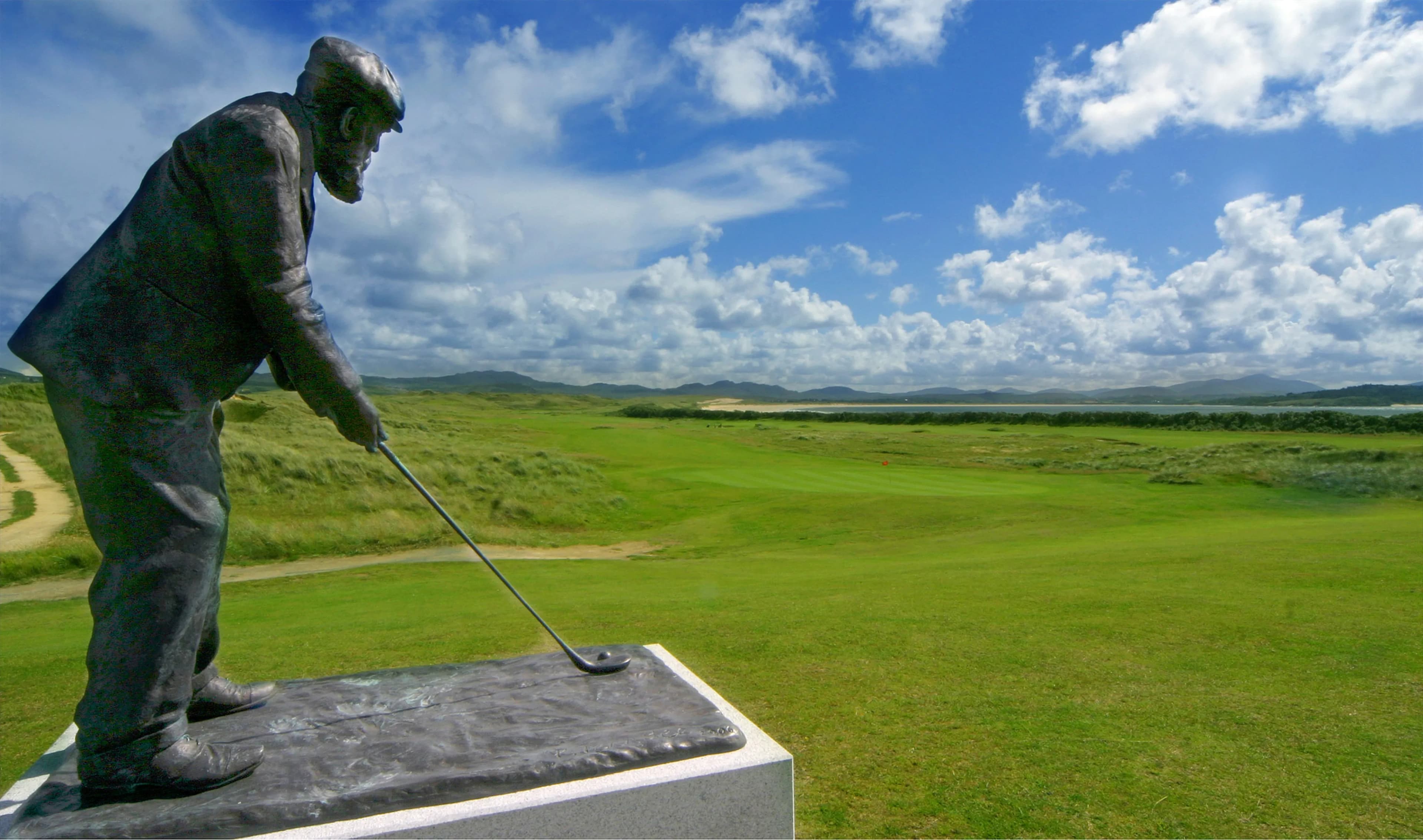
Where Scotland runs higher is at the top. Castle-hotel inventory in Scotland is smaller and more expensive per night, and the marquee golf is dearer — a peak-season round on the Old Course at St Andrews runs around £320, and Trump Turnberry closer to £600 , against roughly $200–$450 at Ireland's top links .
Where Scotland saves you money is the middle: mainland Scotland's four-star country-house inventory is deeper than Ireland's, and outside July and August it prices accordingly.
Can you do both in one trip?
Yes, and this is one of the genuinely easy pairings. Dublin to Edinburgh is about 1 hour 15 minutes in the air, with several flights a day, and the two countries' rhythms complement rather than repeat each other.
The version that works is 13 to 15 nights: six or seven in Ireland — Dublin, the southwest, the Wild Atlantic Way — then the hop to Edinburgh and six or seven in Scotland, with the Highlands weighted heavier than the cities. Fly home from Edinburgh or Glasgow.
What does not work is ten nights split five and five. You end up with two capital cities and a fast lap of each countryside, and you'll come home with the impression that both countries are mostly motorway. If you have ten nights, pick one. Our Scotland and Ireland combined tours guide walks through the routing in more detail.
Who this suits — and who it doesn't
Ireland is wrong for you if you want mountains at scale, or if your ideal day is a long solitary drive through empty country. Ireland is populated, farmed and hedged. The Wild Atlantic Way is spectacular, but it is spectacular in a domestic register, and the west's genuinely remote stretches are shorter than people expect.
Scotland is wrong for you if anyone in your party is an anxious driver, if you have fewer than eight nights, or if you need the trip to be reliably dry. It is also the harder trip with young children or with anyone who has limited mobility — the distances between good stops are longer and the best walking is rougher.
Neither is the right call if you want guaranteed sun in July. Both are Atlantic countries at 53–58°N. Book them for landscape, people and weather that changes four times a day, and they will deliver. Book them for a beach holiday and they won't.
How far ahead should you book?
For 2027 travel, nine to twelve months in both countries. May, June and September are the constraint — that's when the weather, light and crowds are all in balance, and it's when the good properties fill first.
Ireland has two calendar pinch points worth knowing. Castle-hotel inventory is genuinely finite, and the country's event calendar can consume a region's rooms overnight; the 2027 Ryder Cup at Adare Manor will do exactly that to Limerick and the southwest, so if your dates land near it, book at 12 to 18 months.
Scotland's pinch point is August, when the Edinburgh Festival and Fringe fill the city and push rates across the central belt. If Edinburgh in August matters to you, that's a 12-month booking. Skye's small hotels in June and July sell out similarly early.
Let our Ireland and Scotland specialists build your trip
Taryn Harrison covers both countries and is Juniper's most tenured specialist: 25 years planning travel, 85-plus visits to Ireland, and a Certified Master Specialist credential in the Celtic Countries. Every Juniper trip is fully private and built from scratch — no group coaches, no fixed departures, no set itinerary you're joining.
"Our Ireland trip was an absolute dream!! Taryn put together the most amazing itinerary for us!" — Makayla D., verified Google review
Start with the two destination pages side by side: custom Ireland tours and luxury Scotland tours. Couples should read Ireland honeymoons and Scotland honeymoons, which handle the pacing question differently and are worth comparing directly. If you're leaning toward driving yourself, our guides to self-drive honeymoons in Ireland and self-drive honeymoons in Scotland get specific about routes and daily distances. When you want a real answer for your dates, book a free consultation — and if the trip you describe is actually Scotland, we'll say so.