Ireland is the most forgiving country in Europe for a trip with kids and grandparents. Driving legs between good bases run 60 to 90 minutes, most signature experiences happen on level ground, and manor estates rent whole houses sleeping 10 to 16. Plan two bases across eight to ten nights and budget roughly $4,000 to $15,000 per person for land arrangements. Two things are off the table: Skellig Michael bars anyone under 14, and the Cliffs of Moher are exposed.
Key takeaways
- Short legs are why Ireland works. A typical driving day is 60 to 90 minutes between stops, against two to three hours in Scotland.
- Skellig Michael is impossible with a mixed-age group. The minimum age to land is 14, the climb is 618 steps with no handrails in places, and landings run only mid-May to end September at €145 per person.
- The Cliffs of Moher are workable. The cliffs rise to 214 m (702 ft) over 8 km, with 13 accessible parking spaces, loaner wheelchairs and a buggy service for reduced mobility. Wind is the limit, not walking.
- Newgrange is the one some of the group cannot do. The passage and chamber are low and narrow, and the Office of Public Works states that universal access at the monuments is limited. Knowth has no chamber access at all.
- A whole-house rental beats connecting rooms above six people. You get a kitchen for the 6 a.m. toddler and a sitting room for the 10 p.m. adults.
- The Ring of Kerry is 179 km (111 miles) and should be a full day or nothing. Split it: half drives the loop, half stays in Killarney with the jaunting cars.
- Ancestry research lands across all three generations. The Irish Family History Centre at EPIC in Dublin runs 50-minute and 1-hour-45 consultations and hands you a research plan to use later in the trip.
Is Ireland actually good for a trip with kids and grandparents?
Yes, for a structural reason: the distance between the good things is small. Multigenerational trips fail on transit, not on attractions. A four-year-old and a seventy-five-year-old have different tolerances for everything except sitting in a vehicle, where they are identically miserable after 90 minutes. Ireland is the rare European country where you can build a real itinerary without exceeding that. Its best experiences are also horizontal — a sheepdog demonstration, a boat on a lake, a pub with music, a falconry walk — and its difficult sites are a short, knowable list this guide names.
How should you handle driving and transfers for six to ten people?
Ninety minutes is the ceiling for a leg; sixty is better. The common mistake is four or five hotels in nine nights, and every change costs a family with a stroller and a walker roughly half a day. Two bases works: one in the southwest around Killarney or Adare, one in the west near Galway or Mayo, with Dublin at one end for arrival and the ancestry day.
| Leg | Approximate drive | Why it works for a mixed-age group |
|---|---|---|
| Dublin to Killarney, via Kilkenny | About 4h total | Split it over two days; break at Cahir Castle or the Rock of Cashel |
| Killarney to Dingle | About 1h15 | Spectacular and short; Slea Head Drive can be cut short at any point |
| Ring of Kerry loop | 179 km (111 miles), a full day with stops | The classic split day — half the group goes, half stays in Killarney |
| Adare to Galway | About 2h | Motorway for most of it; the Cliffs of Moher fit as a detour |
Two further rules. Drive in the morning — everyone in the car is better at 10 a.m. than at 4 p.m. And do not book one nine-seat van: it is a large vehicle on hedgerow roads with a back row a grandparent must climb into, and it forces the group to move as one unit, which kills the split day.
Two cars, family-driven is cheapest and needs two confident left-side drivers plus automatics booked well ahead, since manual is the Irish default. One private driver-guide plus one family car is our preferred shape for eight to ten: the driver takes the grandparents and young children on the narrow roads while the parents and teenagers keep a car for the flexible half of the day. Two private drivers is the premium version large groups land on. Book child seats by age and weight at reservation, and confirm the vehicle has a rear step if anyone has hip or knee limitations.
Which Irish sites are genuinely hard for grandparents or young children?
Skellig Michael is out. Not difficult — out. Children under 14 are not permitted to land under any circumstances. The climb is 618 steps of steep, uneven stone with no handrails in places and significant exposure to heights. Landings run mid-May to end September only, at €145 per person, and are routinely cancelled for sea conditions. The eco cruise circles without landing.
Newgrange needs a conversation before you book. The passage tomb is reached by shuttle bus, and the passage and chamber are low and narrow — the OPW states they may not suit visitors with claustrophobia or mobility issues, and that universal access at the monuments is limited. Knowth has no chamber access at all. Either email the site in advance about specific needs, or treat the visitor centre and the exterior mound as the visit.
Blarney Castle is a stair problem, not a castle problem. The route to the stone is a narrow one-way spiral staircase of roughly 100 steps, with people behind you. The gardens are large and level. Teenagers and parents climb, grandparents walk the poison garden, everyone meets at the café.
The Cliffs of Moher are about wind, not walking. The paved paths near the visitor centre are solid and wheelchair-usable, there are 13 accessible parking spaces (8 in the main lot, 5 near the centre), wheelchairs can be borrowed at the car park office and the visitor centre desk, and the Burren Buggy and Wild Atlantic Shuttle run tours suited to limited mobility. What is not manageable is exposure: at 214 m above the Atlantic, a gusty day makes the cliff-edge walk unpleasant for a small child and unsafe for anyone unsteady. Go in the morning and be willing to swap the day.
What kind of accommodation works for eight or ten people?
Connecting rooms work for four to six people and are the cheapest fix. The Irish catch is that genuinely connecting rooms — a door between them, not two doors facing each other — are scarce in older hotels and country houses, which were not designed that way. Request and confirm them by name at booking, and know they are rarely guaranteed. A suite solves the wrong problem: it gives one family a sitting room, not the group a shared space.
A whole-house or estate rental is the right default above six people. The kitchen matters most: the toddler eats at 5:30 and the adults at 8:00 without anyone compromising. You also get a sitting room where the grandparents can be present without being on duty.
A castle or manor hotel is the splurge, and it works when the grounds are the product. Ashford Castle sits on a 350-acre estate with falconry, horse riding, fishing, cycling and golf on site and a dedicated activity coordinator — somewhere the eight-year-old and the seventy-eight-year-old each have a good day without leaving. The best ten-night hybrid is one estate hotel and one house. Our guides to Ireland castle tours and Irish castle vacations cover which properties have real family infrastructure.
How do you build a day where the group splits and reconvenes?
The principle: the group does not have to do the same thing, only to start and end together. A group of nine that splits three ways from 10 to 5 and eats together twice has a better day than one that stayed together and compromised on everything.
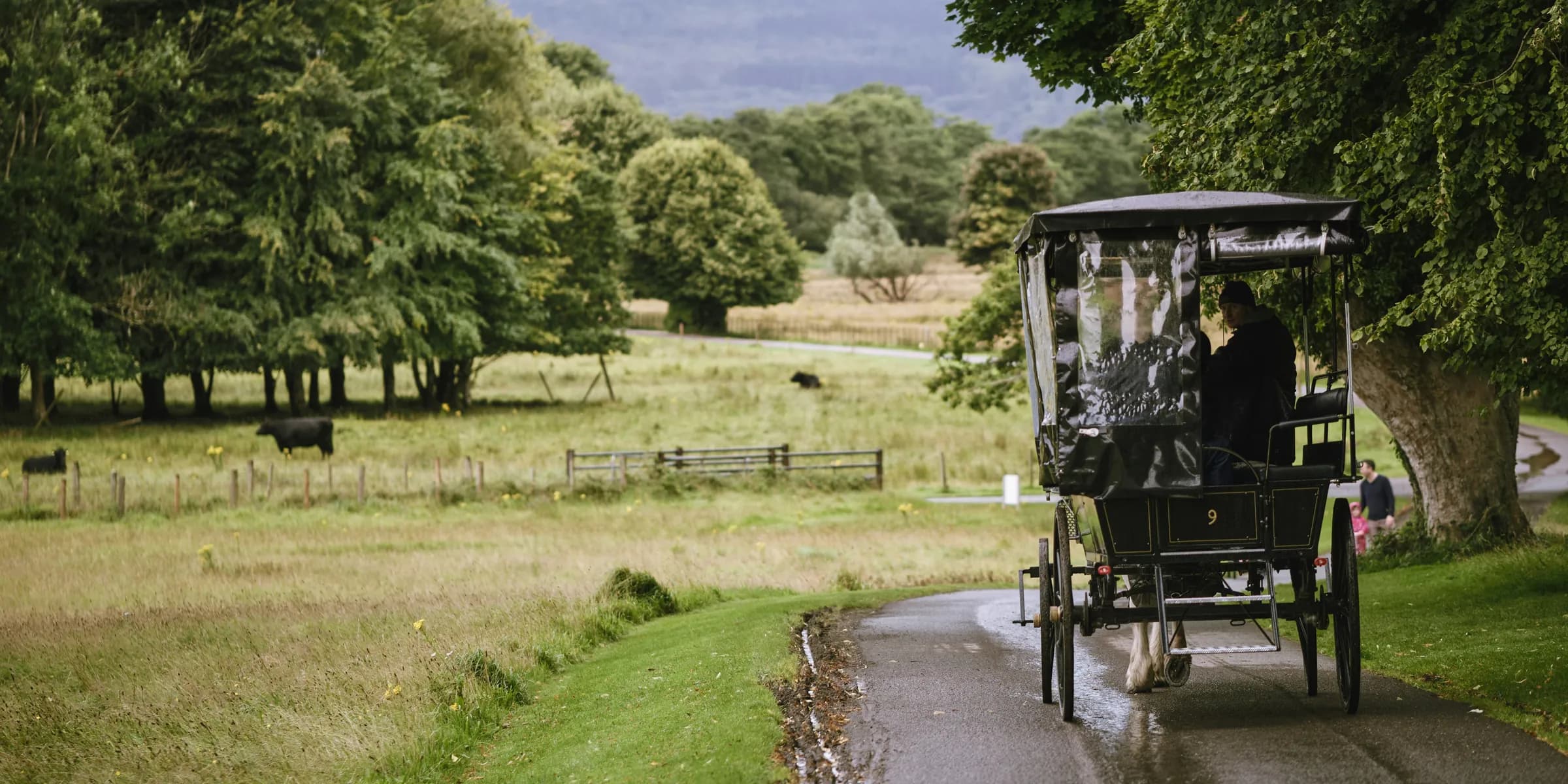
- Killarney. Teenagers and parents drive the Ring of Kerry (179 km, through Kenmare, Sneem, Waterville and Killorglin). Grandparents and small children take a jaunting car through Killarney National Park to Ross Castle and Muckross House — flat, short, and one of the best hours in Ireland for a five-year-old.
- Dingle. Half do the full Slea Head Drive; half stay in town for the boats and the shops. Reconvene for an early pub music session, which many pubs run in summer at a time children can be present.
- Dublin. Ancestry consultation for the adults and one interested teenager; the zoo for the young children; meet at four.
The requirement is a second vehicle or a second driver. That is the actual cost of the idea, and it is worth paying.
Does an ancestry day really work as a three-generation activity?
It is the best three-generation activity in Ireland and the most under-planned. It works because each generation has a different job. The grandparent has the names, the half-remembered county, the story about the ship. The parents have done the online research. The children have the question everyone else stopped asking: "so what happened to them?"
Book a consultation at the Irish Family History Centre at EPIC in Dublin early in the trip — a 50-minute session suits one family line, and 1 hour 45 covers two lines or a complex history, in person or online. Bring names, dates and places, or one specific research question, and you leave with a step-by-step plan.
Then use that plan later in the trip. If the consultation places the family in a specific parish, build a half-day around driving to it — that drive is the payoff, and it must happen after the research, not before. Our guide to ancestral travel in Ireland covers what to gather before you land. Be honest with the children about the odds: sometimes the answer is a field and a surname on a valuation record.
Which Irish activities suit which ages?
| Activity | Young kids (3–8) | Teens | Adults | Grandparents with limited mobility |
|---|---|---|---|---|
| Jaunting car, Killarney National Park | Excellent | Fine | Good | Excellent — seated, short, level |
| Falconry walk or sheepdog demonstration | Excellent | Excellent | Excellent | Good — short, flat, seated viewing at most farms |
| Cliffs of Moher | Good in calm weather; supervise closely | Excellent | Excellent | Workable — buggy and loaner wheelchairs; avoid windy days |
| Blarney Castle keep and stone | Poor — narrow spiral stairs | Excellent | Good | Not possible; the gardens are excellent instead |
| Newgrange passage and chamber | Mixed — dark and narrow | Good | Excellent | Often not possible; visitor centre works |
| Skellig Michael landing | Not permitted under 14 | 14+ only, and demanding | Excellent if fit | Not possible |
| Pub with live music, early session | Good until about 8 p.m. | Good | Excellent | Excellent |
How do meals work across three generations?
Ireland is easier than most of Europe here. Dinner service typically starts around 6 p.m. and country houses often seat until 9, wide enough that a 6:30 family dinner is normal rather than eccentric — a real advantage over Italy or Greece, where the kitchen may not open until 8. Three rules: book every dinner for a group over six, since there is often only one good restaurant in the village; use the pub for lunch, not dinner, when the food is fast and children are welcome; and use the house kitchen for at least three dinners, which is a pressure valve rather than a saving. Irish menus are unusually safe across generations, and dietary restrictions should be declared at booking rather than at the table.
Who this suits — and who it doesn't
Ireland with three generations is wrong for you if the point of the trip is the sights. If you have a list of twelve places and want all twelve, a mixed-age group will not get through it. This format covers roughly 60 percent of what a couple would cover in the same time — not a planning failure, but the format.
It is also wrong if the group has not agreed on the split-day principle before departure. The families that struggle are the ones where somebody believes travelling together means doing everything together, which produces a trip where the grandparents are exhausted and the teenagers bored, simultaneously.
And it is wrong on the west coast in a single week in July: narrow roads with coach traffic, towns with no parking, one good restaurant. If school holidays fix your dates, weight the trip toward the midlands, the southeast and the north. Our guide to the best time to visit Ireland covers the trade-off.
Who it does suit: the group that wants one really good hour a day together and is relaxed about the rest.
How far ahead should you book?
For 2027 travel with six or more people, ten to twelve months. The constraint is not flights but the small number of rooms of the right shape in each property. A country house with 24 rooms may have exactly two pairs that genuinely connect, and an estate house that sleeps 12 is a single unit — once gone for your week, it is gone. Private driver-guides for June through September book out before the hotels do. If school holidays tie you to July or August, move to twelve to fifteen months; for May, June or September, nine to ten is usually enough. Secure accommodation before flights: group airfare is flexible and rooms for nine are not.
Let our Ireland specialist plan your family's trip
Taryn Harrison is Juniper's most tenured specialist and plans most of our family Ireland trips: 25 years planning travel, 85-plus visits to Ireland, and a Certified Master Specialist credential in the Celtic Countries. She is the one who will tell you which castle hotel actually has connecting rooms rather than which has the best photographs. Every Juniper trip is fully private and built from scratch — no group coaches, no fixed departures.
"My family of 6, from a 4 year old to a 71 year old travelled through Ireland with 2 private drivers who were so accommodating and informative." — Kathleen W., Family Trip
Start with custom Ireland tours and our Best of Ireland itinerary. If you are weighing self-driving against private drivers, our 10-day Ireland self-drive itinerary shows the daily distances honestly. Parents taking nights alone at either end should see Ireland honeymoons. For the same problem elsewhere, read Costa Rica for multigenerational families and Italy with three generations. When you want a real answer for your dates, book a free consultation.