Italy works for three generations in exactly one shape: a villa in Tuscany or Umbria with day trips out, for seven to ten nights. It fails as a five-city train tour. Venice has 435 bridges and most are stepped; the Amalfi Coast is built on staircases; Pompeii's accessible route runs 3.5 km over ancient paving with ramps exceeding 8 percent; and Rome in August averages 95°F. Budget $5,000 to $15,000+ per person.
Key takeaways
- One base beats five cities. A Tuscan or Umbrian villa for seven to ten nights removes four hotel changes that each cost half a day with a stroller and a walker.
- Venice is 435 bridges and roughly 70 percent accessible. That depends on routing around vaporetto lines 1 and 2, which carry up to four wheelchairs at a time. Wandering is not the mode.
- The Amalfi Coast is the wrong choice with limited mobility. Positano is a village of staircases and the coast road is a two-lane switchback. Two nights from a hotel with a lift, or skip it.
- Pompeii is doable on the specific route only. "Pompeii for All" runs over 3.5 km from Piazza Anfiteatro to the Sanctuary of Venus for wheelchairs and buggies, but still crosses uneven ancient paving with ramps that may exceed 8 percent.
- Rome in August averages a 95°F high with days above 100°F, and much of the city closes around Ferragosto on August 15.
- Meal timing is the daily friction point. Italian kitchens often do not open for dinner until 7:30 or 8. A villa kitchen solves this; a hotel does not.
Does a multigenerational trip to Italy actually work?
Yes — in one shape, and badly in the shape most families first propose: Rome for three nights, Florence for three, Venice for two and the Amalfi Coast for three, by train, in twelve days. For two adults that is a demanding, excellent trip. For a group spanning a five-year-old and a seventy-eight-year-old the arithmetic kills it. Four hotel changes cost roughly half a day each once you count packing, checkout, the station, the wait for rooms and the redistribution of nine people's luggage — two of your twelve days in transit corridors, and the days that break the oldest and youngest.
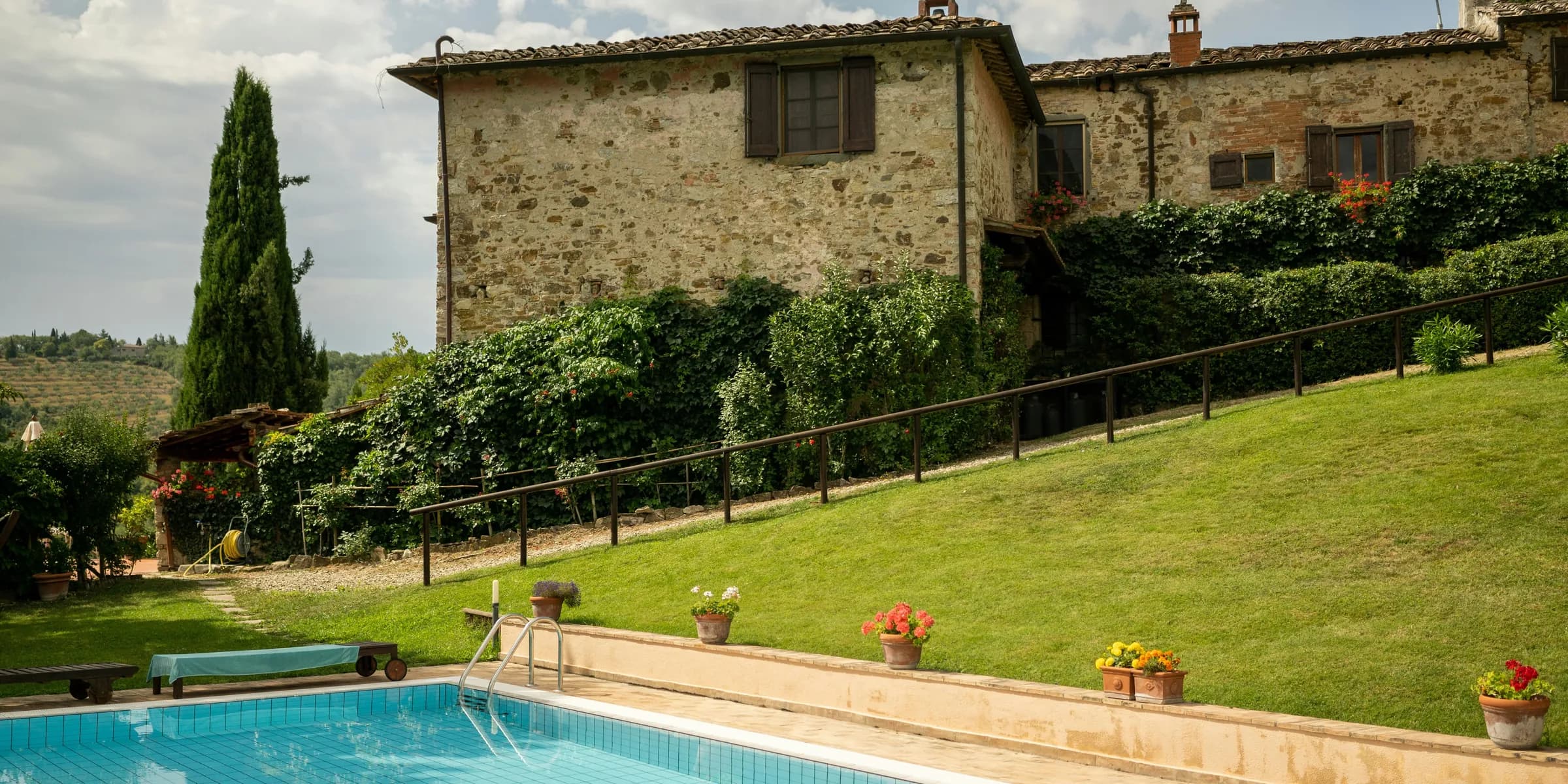
What works is a single base with a car. Rent a villa or farmhouse for seven to ten nights and treat everything else as a day trip you can cancel on the morning. The group unpacks once. There is a kitchen, a garden, a pool and a table. The eight-year-old has somewhere to be bored safely, which is a genuine requirement, and the grandparents can skip a day without missing the trip. If you want a city, add it as a bookend rather than a leg. Our guide to custom Italy vacations covers how that gets built.
Where should the villa be?
Central Tuscany or southern Umbria, chosen for driving radius rather than the view. The hunt goes wrong when families choose on photographs. What determines whether the week works is unglamorous: how far the property sits down an unpaved road, whether there are stairs to the bedrooms, whether the pool is fenced, and whether the day trips are inside 90 minutes.
| Base area | Why it works for three generations | Watch for |
|---|---|---|
| Chianti (Florence to Siena) | Both cities inside an hour; the densest concentration of easy day trips | Italy's most expensive villa market; narrow gravel roads to many properties |
| Val d'Orcia (Pienza, Montepulciano) | The landscape people picture; hill towns small enough to walk in 40 minutes | Every town is on a hill by definition — steep approaches and cobbles |
| Southern Umbria (Todi, Orvieto) | Cheaper, quieter, genuinely uncrowded; Rome inside two hours for the bookend | Fewer marquee sights; the group needs to want a slow week |
| Lucca and the northern coast | Flat. Lucca is a walled town you circle on level ground, and the beaches suit children | Busy and Italian-domestic in August; less "Tuscany" in character |
Two specifications to insist on in writing before booking: at least one full bedroom and bathroom on the ground floor, and a fenced or gated pool. Italian listings rarely volunteer either. A converted farmhouse where every bedroom is up a stone staircase is a beautiful property and the wrong one.
Which Italian places are genuinely hard with a mixed-age group?
Venice is possible planned and impossible improvised. It has 435 bridges and the great majority are stepped. The picture is better than the reputation — around 70 percent of the city is reachable combining ramped bridges with public water buses. The dark-green zones on the city's accessibility mapping are served by vaporetto lines 1 and 2, which carry up to four wheelchairs at a time; lighter zones only by smaller boats carrying one. Travelers with disabilities pay a reduced fare of €1.50 and a companion travels free. Venice becomes a boat trip with three or four fixed destinations rather than a city you wander. Take one full day, not three nights, arrive by water taxi, and use the vaporetto for every transition.
The Amalfi Coast is the one to skip. The problem is verticality plus the road. Positano is effectively a village built as a staircase down a cliff — no flat route through it, and the walk from an upper hotel to the beach is a long descent that must be reversed. Ravello sits high above the coast. Amalfi town is flattest and still climbs quickly behind a cathedral that is itself up a substantial flight of steps. The road is a two-lane switchback shared with coaches that makes people carsick who are not otherwise prone to it. If anyone uses a cane, walker or wheelchair, skipping it costs you nothing of Italy. If you go, take two nights in a hotel with a lift from road level and move between towns by ferry — the boats are the flattest way to see the coast and the best hour of the trip for children. Our Amalfi Coast tour with Capri shows that routing.
Rome in August is punishing. The average high is 95°F, days reach 100°F and above, and the city empties around Ferragosto on August 15, when many restaurants and small businesses close. If school holidays fix your dates: out by 8 a.m., indoors and air-conditioned from 1 to 5, out again after 6. Do not walk the Forum at noon. The Colosseum has lift access and step-free routes, and admission is reported as free for visitors with a certified disability plus a companion. The real constraint at Roman sites is the queue and the cobbles between the car and the entrance: book timed entries and arrange drop-offs.
Pompeii is more accessible than its reputation and still not easy. The "Pompeii for All" route runs over 3.5 km from Piazza Anfiteatro to the Sanctuary of Venus, reaching the most significant buildings, designed for mobility-impaired visitors and buggies. The site is candid about the limits: ancient uneven paving, sudden height changes under 5 cm, no wheel stoppers at crossings, ramps that may exceed 8 percent, and sections too narrow for two wheelchairs. Add full sun and no shade. Go at opening and plan two hours rather than four.
Florence is the easiest of the big cities — compact, flat, sights within a 20-minute walk. The catch is crowd density and a Duomo dome climb of 463 steps up a narrow spiral staircase with no lift: a teenager activity, not a group one.
How do you build a split day in Italy?
The split day is what makes a villa base work rather than merely comfortable. The group starts together at breakfast and reconvenes at dinner; the middle belongs to whoever wants it.
- Florence day. Teenagers and one parent take the Uffizi and the dome climb. Grandparents and young children go to Lucca instead — walled, flat and circleable on the ramparts — or stay at the villa pool.
- Siena day. The Piazza del Campo is flat and its shell shape is genuinely fun for children, but the approach from most car parks is steep. Drop off by the Campo, spend an hour together, then send whoever wants it up the Torre del Mangia while the rest sit in the piazza.
- Cooking class as the whole-group activity. The single best three-generation activity in Italy: everyone participates at their own level, it happens indoors on level ground, it takes four hours and it produces dinner. Book one at the villa rather than travelling to it.
What are the car and transfer logistics for eight to ten people?
Two vehicles, not one van, and a driver for the long legs. A nine-seat van is the wrong tool in Italy: it cannot enter most historic centers because of ZTL restricted-traffic zones, which are camera-enforced and issue fines by post months later; it is hard to park anywhere in Tuscany; and it forces the group to move as one unit, eliminating the split day.
What works for eight to ten is one private driver for day trips plus one family-rented car at the villa for supermarket runs, the pharmacy and the flexible half of each day. Rent the second car automatic and book it months out — automatics are a minority of the Italian fleet and disappear first.
- Child seats must be booked by age and weight at reservation. Italian agencies do not reliably stock them.
- Verify the villa's access road. "Strada bianca" means unpaved gravel and can run for two kilometers.
- Trains are excellent for one leg, not four. Rome to Florence in about 90 minutes is a great use of a train for a whole group. Four such legs with luggage is the trip that fails.
Which Italian activities suit which ages?
| Activity | Young kids (3–8) | Teens | Adults | Grandparents with limited mobility |
|---|---|---|---|---|
| Cooking class at the villa | Excellent | Good | Excellent | Excellent — seated, indoors, level |
| Florence Duomo dome climb | Not possible | Excellent | Good if fit | Not possible |
| Pompeii via the "Pompeii for All" route | Mixed — long and hot | Excellent | Excellent | Workable on the designated 3.5 km route only |
| Venice by vaporetto | Excellent — it is a boat | Good | Excellent | Workable on lines 1 and 2 with a planned route |
| Venice on foot, unplanned | Hard with a stroller | Excellent | Excellent | Not advisable |
| Positano and the Amalfi villages | Hard — steps and drop-offs | Excellent | Excellent | Not advisable |
| Boat from Amalfi to Capri | Excellent | Excellent | Excellent | Good — check boarding at both ends |
| Hill town on foot (Montepulciano, Pienza) | Good for 45 minutes | Fine | Excellent | Difficult — steep and cobbled |
| Rome Colosseum and Forum | Fine at the Colosseum, poor in the Forum | Excellent | Excellent | Colosseum has lifts; the Forum is gravel and slopes |
How do you handle meal timing across three generations?
This is the friction that surprises American families most, and the villa is the answer. Italian dinner service commonly begins at 7:30 or 8 p.m., and outside tourist centers a 6 p.m. dinner is unavailable. For a jet-lagged five-year-old and a grandparent who eats at 5:30 at home, eating at 8 every night for ten nights produces a genuinely bad trip.
- Make lunch the big meal. Italian lunch runs roughly 12:30 to 2:30, the food is the same and the restaurants are calmer.
- Use the villa kitchen for half the dinners. Pasta and salad at 6:30 for the children and grandparents, then the adults eat at 8:30 on the terrace.
- Hire a private chef for two or three nights. For eight to ten people this often costs less per head than a restaurant and removes the transfer, parking and timing constraint at once.
- Book restaurant dinners early in the service. A table for nine at 7:30 is possible; at 8:30 it is the same table with a queue behind it.
Italy is the easiest cuisine in Europe for fussy children and elderly eaters at once. Where it gets hard is genuine allergies — declare them at booking, in Italian if possible, and note that "senza glutine" is well understood in cities and less so in rural agriturismi.
Who this suits — and who it doesn't
A three-generation Italy trip is wrong for you if the group's ambition is a highlights tour. Rome, Florence, Venice and the Amalfi Coast in twelve days is a real trip, and it is a trip for adults. Attempting it with a five-year-old and a grandparent with a hip replacement produces not a compressed version but a worse one, spent mostly in stations and lobbies.
It is wrong if nobody will drive: Italy's multigenerational answer is a rural base, and a rural base without a car is a trap. The honest alternative is a single city with a hotel, not a villa.
It is wrong in August if you have any choice — Rome at 95°F, Ferragosto closures, domestic holiday crowds, and villa rates at their annual peak. September is the best month.
And it is wrong if someone has significant mobility limitation and the itinerary insists on Venice, the Amalfi Coast and the hill towns. No amount of planning makes steep cobbled gradients easy. The good news is that Italy has flat, beautiful alternatives — Lucca, Lake Garda, the Umbrian valley floors, Ravenna — that most itineraries never mention.
How far ahead should you book?
For 2027, twelve months for a villa in the June-to-September window and ten for the shoulder months. Villas are the constraint, not flights or hotels. A property that sleeps ten with ground-floor bedrooms, a fenced pool and a paved approach is a small subset of a small market, and the best rebook with returning families before reaching the open market. Saturday-to-Saturday changeover in peak season further limits what fits your dates. A private chef, a cooking class and a driver are bookable at three to six months, though the driver for July and August should be secured earlier. Book in this order: villa, flights, bookend hotel, driver, experiences. Reversing the first two is the most expensive mistake.
Let our Italy specialists build your family's trip
Taryn Harrison, CMSC certified with 25 years of European itinerary design, plans Italy for families and will tell you whether the villa you found actually has a ground-floor bedroom or just a very good photographer. Kaycee Shields specializes in Italy, honeymoons and family travel, and builds itineraries with logistics and dietary requirements arranged in advance rather than negotiated at the table. Every Juniper trip is fully private and built from scratch — no group coaches, no fixed departures.
"Our trip to Italy was amazing all thanks to Juniper Tours. Their attention to detail made our trip a trip of a lifetime!" — Melissa C., Custom Trip
Start with custom Italy tours and our Taste of Tuscany itinerary, the closest published shape to the villa-base trip described here. For quieter regions worth a family week, see hidden gems in Italy and the best Italy trips. Couples travelling either side of the group should look at Italy honeymoons. For the same problem in easier terrain, read Ireland with kids and grandparents and Costa Rica for multigenerational families. When you want a real answer, book a free consultation — and if what you described is a two-adult trip, we will say so.