Greece runs on two calendars. The Cyclades operate roughly May to October — hotels, ferries and restaurants on Santorini and Mykonos open around Orthodox Easter, which falls on May 2 in 2027, and close by early November. Athens, Crete and the Peloponnese work year-round: Heraklion averages 60°F in January. So the best time depends entirely on which Greece you've booked. For both at once, go mid-May to mid-June, or September.
Key takeaways
- The Cycladic season is roughly Orthodox Easter to late October. In 2027 Orthodox Easter is May 2, five weeks later than Western Easter, which pushes the island opening later than usual. An April 2027 trip to Santorini will find a lot of shutters down.
- Athens, Crete and the Peloponnese have no dead season. Athens averages 59°F in December; Heraklion 60°F in January. The sites, the food and the archaeology don't close.
- September is the best month for a combined trip. Athens drops to 84°F from August's 92°F, the Aegean is at its warmest at around 75°F, and the ferry network is still at full frequency.
- July and August are the hottest and windiest at once. Athens averages 92°F, heat waves push past 104°F, and the meltemi is at its strongest — which is when fast ferries get cancelled.
- The Acropolis is capped at 20,000 visitors a day, with one-hour timed entry slots and a €30 adult ticket. In peak summer it sells out five to seven days ahead, and can close mid-afternoon in extreme heat with little notice.
- Ferry frequency, not weather, ends the island season. Peak routes run several times daily from June to September; from October the schedule thins and smaller islands drop to a few sailings a week.
- Rain is seasonal and concentrated. Athens gets 5–6 mm across one rainy day in each of June, July and August, and 60 mm across eleven days in December.
When is the best time to visit Greece?
If you're doing islands and mainland on one trip — which is what most people mean by "Greece" — the answer is September, then mid-May to mid-June. Those are the only windows where the Cycladic infrastructure is fully running and the mainland isn't punishing.
September is the better of the two. The sea peaks at around 75°F in late August and September; in late May it's still 65°F, swimmable but bracing. Athens comes off its August high of 92°F to 84°F, the Italians and French have gone home, and ferries have not yet thinned.
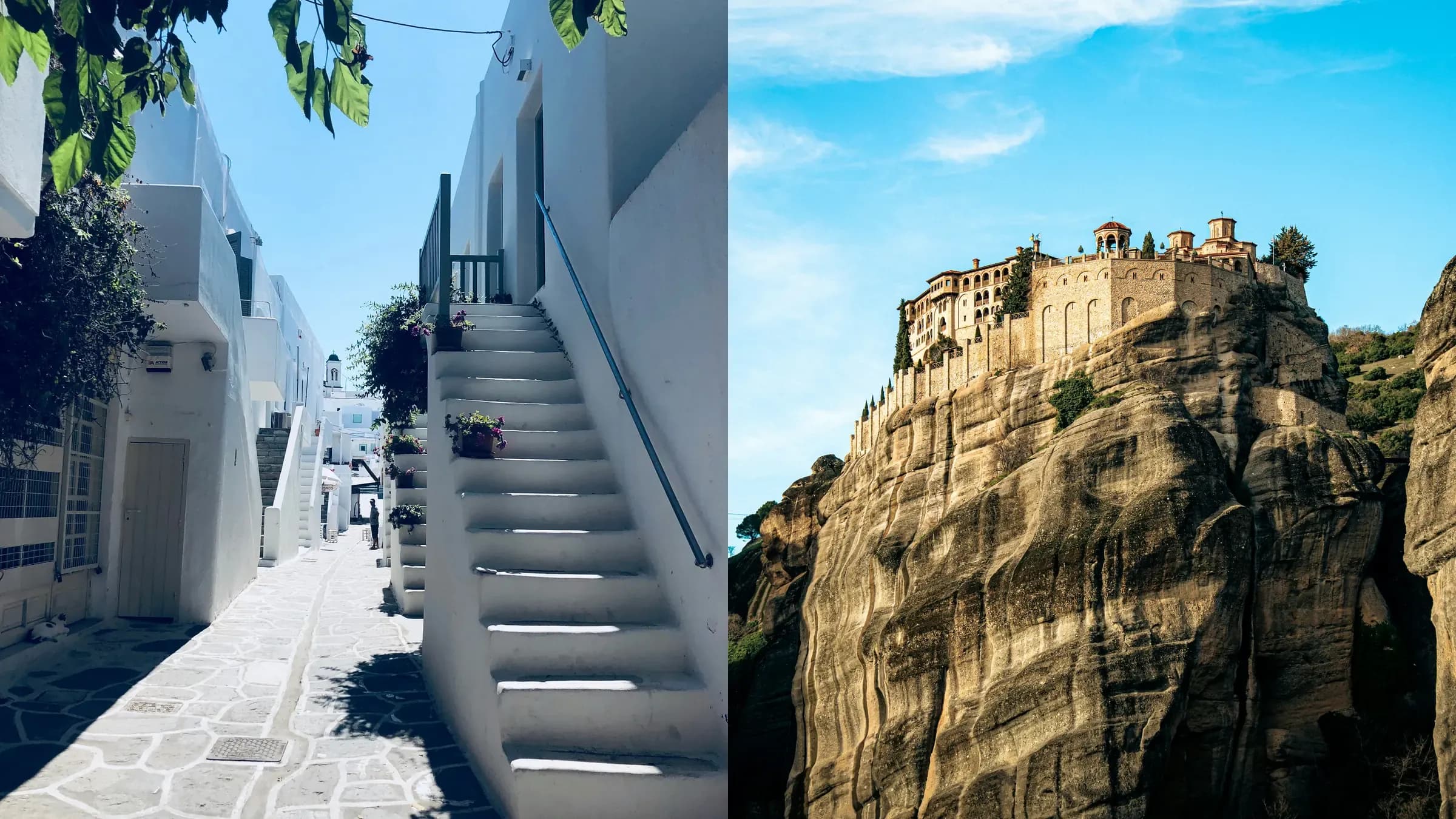
May's compensation is the mainland. The Peloponnese, Meteora and the Mani are green in May and brown by August, and Athens at 77°F is a far better city to walk. If your trip is weighted toward archaeology rather than beaches, May beats September outright.
One thing changes this for 2027 specifically: Orthodox Easter falls on May 2, and much of the island trade opens for it. A trip in the last week of April 2027 will arrive before the season starts. That constraint is real, checkable, and moves every year.
What does Greece look like month by month?
Athens temperatures are average daily highs. Sea temperature is Aegean, and applies to the islands.
| Month | Athens high / rain | Sea | Islands vs mainland | Crowds |
|---|---|---|---|---|
| January | 56°F / 50 mm | 59°F | Cyclades closed. Athens and Crete fully operating; Heraklion at 60°F. | Lowest |
| February | 57°F / 40 mm | 58°F | Same. Apokries carnival season builds toward Clean Monday. | Lowest |
| March | 62°F / 40 mm | 58°F | Wildflowers in the Peloponnese and Crete. Islands still shut. | Low |
| April | 68°F / 25 mm | 62°F | Best walking weather on the mainland. In 2027 the islands are still opening. | Low, spiking at Easter |
| May | 77°F / 14 mm | 65°F | Season opens; everything running by mid-month. Mainland at its greenest. | Moderate |
| June | 87°F / 5 mm | 72°F | Peak island conditions. Mainland archaeology getting hot by midday. | High |
| July | 92°F / 6 mm | 74°F | Meltemi at its strongest. Athens can hit 104°F in a heat wave. | Peak |
| August | 92°F / 6 mm | 76°F | Warmest sea and the busiest, most expensive weeks. Greek holidays around August 15. | Peak |
| September | 84°F / 12 mm | 75°F | Best month for a combined trip. Everything open, sea warm, crowds thinning after the first week. | High, easing |
| October | 75°F / 45 mm | 72°F | Islands winding down from mid-month; hotel closures by month's end. Mainland excellent. | Moderate to low |
| November | 66°F / 60 mm | 67°F | Cyclades closed. Athens, Crete and the Peloponnese quiet and still mild. | Low |
| December | 59°F / 60 mm | 63°F | Wettest month, eleven rainy days. Athens over the holidays is pleasant. | Low |
When does the island season actually open and close?
Later than the weather suggests, and earlier than you'd hope. On Santorini, Mykonos and the smaller Cyclades the trade is seasonal in a way that has nothing to do with whether it's warm enough: owners and staff leave, and the whole apparatus reopens together. The practical anchors:
- Opening: a wave through April, keyed to Orthodox Easter. Larger hotels open earlier; many of the smaller and better ones don't bother before Easter week. In 2027 that's May 2.
- Full operation: mid-May through September. Every ferry route, every restaurant, every boat.
- Closing: a wave through the second half of October, with most properties shut by the first days of November
- Winter: Santorini and Mykonos each retain a handful of year-round hotels and tavernas serving residents. That is not the same as the islands being open.
Ferry schedules follow the same shape and are the harder constraint. From June to September the busiest Piraeus routes run several times a day. From October sailings drop sharply and secondary islands can fall to a couple of crossings a week. An itinerary that hops three Cyclades in eight days is straightforward in July and close to impossible in November. If October is what you're weighing, that trade-off is the subject of Greece in October.
Why is the mainland a different calendar?
Because nothing on it depends on a boat. Athens, Delphi, Meteora, Nafplio, Olympia, the Mani and all of Crete are reachable by road, staffed year-round and warm enough to walk in every month. Athens averages 59°F in December; Heraklion 60°F in January.
What changes is not access but comfort. Peak summer is hostile to archaeology: the Acropolis, Delphi and Olympia have almost no shade, and Athens summer highs of 92°F routinely reach 95–97°F, with heat waves past 104°F. The Acropolis has closed during the hottest afternoon hours in past heat events, at short notice.
Which is why the mainland's best months are the opposite of the islands'. March through May, and October through November: green, cool and empty. A November week driving the Peloponnese is one of the most underrated trips in Europe and costs a fraction of a July one — see our mainland Greece itinerary.
What is the meltemi, and will it cancel your ferry?
A dry northerly wind that blows down the Aegean through the summer. It starts in May, peaks in July and August, and eases through September. It's why Greek summers are bearable at all, and also why island-hopping in August is riskier than island-hopping in September.
In practice it roughens the sea, and fast catamarans are the first thing cancelled; conventional ferries tolerate it far better. If you're moving between islands in July or August, build in buffer days and favor the slower conventional boat on any leg that would break the trip if it fell through.
It also affects where you want to be. Mykonos, Paros and Naxos catch it hard, and a north-facing beach in a strong August meltemi is unpleasant. Santorini's caldera side is sheltered; Crete, further south, gets a weaker version.
What is the cheapest time to visit Greece?
November through March, and it's not close. With the Cyclades shut, the demand curve collapses; Athens hotel rates in January can run 50–60% below their August rates, and transatlantic airfare is at its annual floor.
The catch is that "cheap Greece" and "the Greece you pictured" are not the same country in those months. What you can buy cheaply in winter is Athens, Crete and the Peloponnese — a genuinely excellent trip, just not a Cycladic one.
Within the island season the cheapest usable weeks are mid-May and the second half of October: inside the operating window, outside peak pricing. Both carry a real risk — mid-May can still be cool for swimming at 65°F, and late October can catch the closing wave — which is a reason to confirm what's actually open before you commit, not to avoid them.
What is the best time to avoid crowds?
On the islands, mid-May to early June and the last two weeks of September into early October. On the mainland, anything from November to March.
Athens deserves its own note, because crowding there is now structurally managed. The Acropolis is capped at 20,000 visitors a day, entry is by one-hour timed slot, and the adult ticket is €30. Hours run 08:00–20:00 from April to October and 08:00–17:00 from November to March, and from June through August slots sell out five to seven days ahead. The first slot of the day in shoulder season isn't marginally better than midday in July; it's categorically different.
The other factor that catches Americans out is the Greek domestic holiday season. The two weeks around August 15 are when Greeks themselves travel to the islands, and prices and ferry loads reflect it.
So when should you go, for what you want?
| What you want | Go | Why |
|---|---|---|
| Islands and mainland on one trip | September, or mid-May to mid-June | Only windows where the Cyclades are fully open and Athens is walkable |
| Warmest swimming | Mid-July to late September | Aegean peaks around 76°F in August and holds through September |
| Athens, Delphi, Meteora, the Peloponnese | April to May, or October to November | Mild, green, and no midday heat on unshaded sites |
| Crete on its own | April to June, or September to October | Year-round island with a longer season than the Cyclades |
| Fewest people on Santorini | Mid-May, or the last week of October | Inside the operating season, outside peak demand |
| Lowest prices | November to March | Cheapest airfare and Athens hotel rates; islands closed |
| Island hopping by ferry | June to September | Multiple daily sailings on the main routes |
| Hiking — Samaria, the Mani, Meteora | April to May, or October | Too hot to be sensible from June to August |
| Greek Easter | The week before Orthodox Easter | May 2 in 2027; the biggest festival in the Greek year |
| A honeymoon | Late May to mid-June, or September | Warm sea, full service, caldera hotels below peak rates |
Who this suits — and who it doesn't
Greece in the shoulder months is wrong for you if a specific island is non-negotiable and swimming is the point. If you've pictured yourself in a caldera pool on Santorini and nothing else will do, you need June through September, booked early and paid for. Mid-May at 65°F sea temperature is not that trip.
Winter Greece is wrong for anyone who wants the Cyclades at all. No version of a January trip delivers Santorini or Mykonos as people imagine them. Be honest about which Greece you want before booking cheap flights into a closed island.
It suits travelers who care about the food, the archaeology and the landscape as much as the beach — people who would take a November week in the Mani or a March week in Crete over an August week anywhere. And it suits couples, because May and September are when the small caldera hotels and the restored Peloponnesian towers are actually available.
How far ahead should you book?
For September and late May to June, nine to twelve months. These are the months everyone who has been before now books, and the constraint is specific rooms rather than availability in general. Santorini's caldera-edge hotels and Mykonos's better properties have small room counts and sell their shoulder weeks first.
For July and August, ten to twelve months — island inventory, ferries and the good villas all go early, and the weeks around August 15 are the tightest in the Greek year. For the mainland outside summer, three to five months is plenty.
One note whatever month you choose: Acropolis timed-entry slots are released on their own schedule, not yours, and get held as soon as they open. That is part of what a specialist is for.
Let our Greece specialists time your trip
The mistake we correct most often on Greece isn't the month — it's the assumption that one month serves the whole country. Knowing that the Cyclades open around Orthodox Easter and that in 2027 that's May 2, that ferry frequency collapses in October before the weather does, that the Acropolis is capped and slotted: that's the difference between an itinerary that flows and one that strands you. Kaycee Shields, one of our Greece specialists, has 10 years in the travel industry and is a honeymoon expert. Every Juniper trip to Greece is fully private and built from scratch around your dates — no group coaches, no fixed departures.
"I took the most amazing girls trip to Greece, and everything was handled for us from start to finish." — Shawneen T., verified Google review
Greece itineraries with us typically run 10–14 days and between $5,000 and $15,000+ per person, with hand-selected stays, private guides and every ferry and transfer arranged end to end. Start with our custom Greece trips, or, for two people, Greece honeymoons. If you're weighing the late shoulder, read Greece in October; if you're still choosing islands, start with the best Greek islands to visit. When you're ready, book a free consultation — we'll tell you what's actually open in the month you're considering before we quote anything.