Ten days is enough for Norway if you accept one hard limit: you can have the fjords and Lofoten, but not the fjords, Lofoten and everything else. The summer version runs Bergen to the Sognefjord to Geiranger to Lofoten, with one full travel day in the middle. The winter version drops the fjords entirely and gives you five aurora nights across Tromsø and Lofoten. Expect $7,000–$11,000 per person and two internal flights either way.
Key takeaways
- Norway is two itineraries, not one. The summer route is about water and light; the winter route is about darkness and mobility. They visit different parts of the country for good reason.
- Budget one full day for the fjords-to-Lofoten transit. There is no fast way between western Norway and the Arctic — it's two flights, or a flight plus a boat, and roughly 8–10 hours door to door.
- The winter version needs five nights in aurora country, not three. Cloud is the enemy, and every extra night materially raises your odds.
- The Bergen Railway covers 492 km in 6.5–7 hours with 4–5 direct services daily — the single best-value piece of transport in Norway at NOK 299–999.
- Two nights minimum in each base. One-night stops in Norway are almost all transit and almost no trip.
- Late August and February are the two best months for these routes respectively — thin crowds in one, workable daylight plus deep darkness in the other.
- Book 10–12 months ahead. The properties that make these routes worth doing have between eight and forty rooms each.
What does a 10-day Norway itinerary look like?
Ten days on the ground, arriving and departing from different airports so you're not backtracking. That matters more in Norway than almost anywhere: a return to your arrival city costs you a day you don't have.
Both versions below assume two people, a mix of scheduled transport and private transfers, and two or three guided days. Both sit in the $7,000–$11,000 per person band, inside the broader $5,000–$15,000+ range. Neither includes international airfare.
The structural decision — the only one that really matters — is season, covered at length in the best time to visit Norway. The short version: the fjord infrastructure and the aurora do not coexist.
Summer or winter: which version should you book?
Book the summer version if you want to be outdoors all day, if hiking or photography is part of the point, and if the idea of eating dinner at eleven in full daylight appeals. Mid-June to early September, with late August the pick: warm sea, clear high trails, and the crowds gone after the 20th.
Book the winter version if the northern lights are the reason you're going. Late September to late March, and specifically February or March, when Tromsø has 7 to 12 hours of daylight alongside genuinely dark nights. December is more atmospheric and less practical — Tromsø is in polar night from November 28 to January 14 and gets no sunrise at all.
The 2026/27 aurora outlook is a good one. Solar Cycle 25 peaked in 2024 and is now in its declining phase, which is when long-lived coronal holes send recurring high-speed solar wind streams at Earth — the steady, repeatable kind of activity that suits a trip you booked a year ago.
What is the summer 10-day route, day by day?
Days 1–2: Bergen. Fly in. Two nights, not one — it rains here on 198 days a year and you want the flexibility. Bryggen, the fish market, the funicular up Fløyen. Opus XVI, in a converted bank building, is the pick for a small refined base.
Day 3: Bergen to Flåm. The Bergen Railway to Myrdal, about two hours, then the Flåm Line down: 20 km, 866 metres of descent, 45 to 60 minutes, 20 hand-carved tunnels, an average 5.5% gradient. Take the earliest or latest departure of the day and skip the middle, when the ship passengers are on it. Night in Flåm or, better, Aurland.
Day 4: The Nærøyfjord. The Flåm to Gudvangen crossing takes about two hours on a fully electric vessel through the Aurlandsfjord and into the UNESCO-listed Nærøyfjord — there is no road along it, so this is the only way to see it. Afternoon up to the Stegastein viewpoint. Second night in Aurland.
Day 5: Aurland to Geiranger. By road, roughly four and a half hours including ferry crossings. This is a driving day worth having — the Sognefjell and the descent into Geiranger are the road trip. Night in Geiranger.
Day 6: Geiranger. Out on the water in the morning; the Hellesylt–Geiranger ferry runs about an hour past the Seven Sisters. Afternoon on the Ørnevegen or up to Dalsnibba. If the season's open, Trollstigen is the detour — it opened April 27 in 2026 against a normal mid-May opening.
Day 7: Geiranger to Ålesund. About two and a quarter hours by road. Ålesund is Art Nouveau, compact and on the water, and it's an easy last fjord night. Or push straight to the Sunnmøre Alps and Hotel Union Øye instead, which is the better call if you have any romance in the trip.
Day 8: Transit to Lofoten. The honest day. Ålesund to Oslo is 55 minutes in the air, Oslo to Harstad/Narvik–Evenes about an hour and fifty, then roughly two hours by road into eastern Lofoten. Door to door it's most of a day. The alternative — Oslo to Bodø, then the Bodø–Svolvær express boat in about 65 minutes — is more pleasant and less reliable, with only one to three weekday departures. Night in Svolvær or Henningsvær.
Day 9: Eastern Lofoten. Henningsvær on its islets, the Svolværgeita, a boat into the Trollfjord. This is the day people didn't expect to be the best one.
Day 10: Western Lofoten and out. Svolvær to Reine is about two hours, through Hamnøy and the rorbu villages, and out from Leknes or back to Evenes. If you can add an eleventh day, add it here.
What is the winter 10-day route, day by day?
Days 1–2: Oslo, then north. Arrive Oslo, one night. Oslo to Tromsø is just under two hours on SAS or Norwegian. First aurora night in Tromsø.
Days 3–5: Tromsø. Three more nights, all kept loose. Days: dog sledding, a Sami reindeer visit, and a whale boat out toward Skjervøy if you're travelling in the November to January herring season. Nights: out with a guide who watches the cloud forecast and decides at four where you're going. Tromsø runs 55–60% cloud cover in midwinter, and driving away from it is the entire technique.
Day 6: Tromsø to Lofoten. Fly Tromsø to Bodø, about 40 minutes, then the express boat to Svolvær in around 65 minutes. In deep winter, the road route via Evenes is the more weather-resilient option at roughly three hours to Evenes plus two into Lofoten. Night in Svolvær.
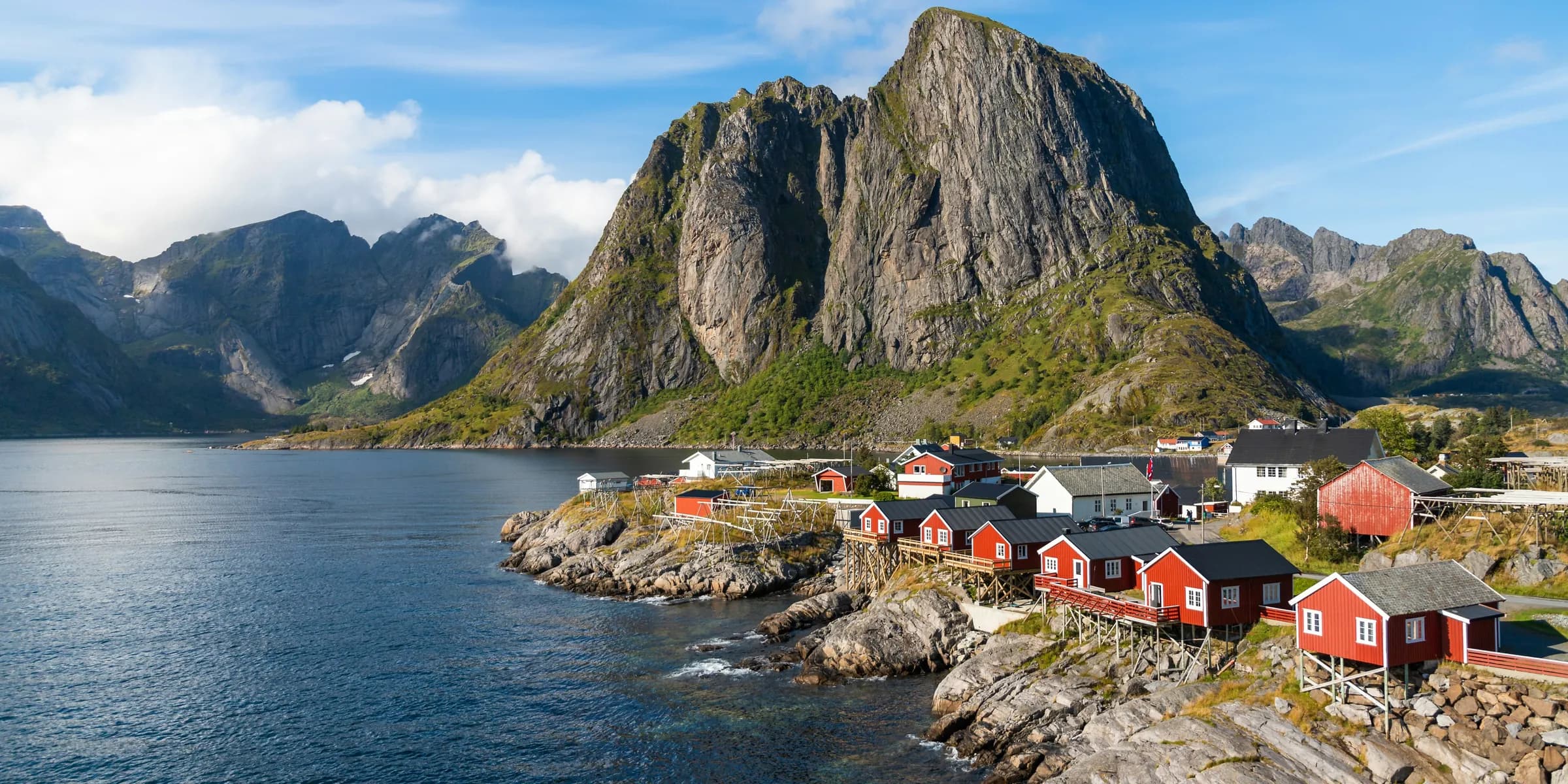
Days 7–9: Lofoten. Two nights east, then west — Svolvær to Reine is about two hours. Lofoten in winter is the better-looking half of this trip: peaks straight out of the sea, low pink light for the four or five hours a day it exists, and rorbu cabins on the water at Hamnøy and Nusfjord. Aurora nights four and five.
Day 10: Out. Leknes or Evenes, connecting through Oslo or Bodø.
How do the two routes compare, day by day?
| Day | Summer version | Winter version |
|---|---|---|
| 1 | Arrive Bergen | Arrive Oslo |
| 2 | Bergen — Bryggen, Fløyen | Fly to Tromsø (under 2h); aurora night 1 |
| 3 | Bergen Railway to Myrdal, Flåm Line down; night Aurland | Tromsø — dog sledding; aurora night 2 |
| 4 | Nærøyfjord boat (2h); Stegastein | Tromsø — Sami reindeer visit; aurora night 3 |
| 5 | Drive Aurland to Geiranger (~4h30) | Tromsø — whale boat toward Skjervøy (Nov–Jan) |
| 6 | Geiranger — Hellesylt ferry, Ørnevegen | Transit to Lofoten; night Svolvær |
| 7 | Geiranger to Ålesund or Hotel Union Øye | Eastern Lofoten — Henningsvær; aurora night 4 |
| 8 | Full transit day to Lofoten | Svolvær to Reine (~2h); western Lofoten |
| 9 | Eastern Lofoten — Henningsvær, Trollfjord | Reine and Hamnøy; aurora night 5 |
| 10 | Western Lofoten to Reine; depart Leknes | Depart Leknes or Evenes |
How long does each internal leg actually take?
These are the numbers that decide whether an itinerary works. Norwegian distances are deceptive on a map.
| Leg | Mode | Duration | Notes |
|---|---|---|---|
| Oslo–Bergen | Rail | 6.5–7h | 492 km, 4–5 direct services daily, NOK 299–999 |
| Bergen–Myrdal | Rail | ~2h | Connects to the Flåm Line |
| Myrdal–Flåm | Flåm Line | 45–60 min | 20 km, 866 m descent, 5.5% gradient, 20 tunnels |
| Flåm–Gudvangen | Electric boat | ~2h | Through Aurlandsfjord into the Nærøyfjord; year-round |
| Aurland–Geiranger | Road | ~4h30 | Includes ferry crossings; seasonal passes |
| Hellesylt–Geiranger | Ferry | ~1h | Past the Seven Sisters, with commentary |
| Geiranger–Ålesund | Road | ~2h15 | |
| Bergen–Ålesund | Air / road / boat | 45 min / ~8h / ~5h | Road is 367 km including a ferry; express boat is seasonal |
| Ålesund–Oslo | Air | 55 min | |
| Oslo–Tromsø | Air | Just under 2h | SAS and Norwegian |
| Bodø–Svolvær | Express boat | ~65 min | Only 1–3 weekday departures each way |
| Bodø–Moskenes | Car ferry | ~3h | 5–6 sailings daily in summer, about one in winter |
| Evenes–Svolvær | Road | ~2h | Evenes is 150 km from Lofoten |
| Svolvær–Reine | Road | ~2h | Through Henningsvær and Hamnøy |
What should you cut if you only have seven days?
Cut Lofoten from the summer version, or cut Tromsø from the winter one. Do not cut nights from bases — that's the mistake people make and it produces a trip that's mostly logistics.
A seven-day summer route is Bergen (2), Aurland (2), Geiranger (2), out from Ålesund. That's a genuinely excellent week and it needs no internal flight at all. A seven-day winter route is Tromsø (3) and Lofoten (3), with the transit day between them — you lose the Oslo night, which nobody misses.
What you should not attempt in seven days is Oslo, the fjords and the Arctic. We get asked for it regularly. It produces three internal flights, four one-night stops, and a photo album of airports.
What would we change about this itinerary?
Three things, honestly.
Add a day in Lofoten, not in the fjords. Almost everyone who does this route comes back saying Lofoten was the part they wanted more of. If you can stretch to twelve days, the two extra nights belong at Reine.
Consider dropping Geiranger in high summer. It's magnificent and it's the most cruise-affected place in Norway. If you're travelling in July, the Sunnmøre Alps and the Hjørundfjord give you the same landscape without the pier. We make the broader argument in the Norwegian fjords without a cruise ship.
Don't book the winter itinerary tightly. Five aurora nights should have five open evenings. Anyone selling you a fixed winter schedule with a booked activity every night is selling you a worse trip.
Who this suits — and who it doesn't
This itinerary is wrong for you if you want to unpack once. You'll change hotels four or five times in ten days and spend one full day in transit. It's wrong if you need every day accounted for in advance — the winter version deliberately isn't. And it's wrong if either of you is going to be cold or wet and quietly unhappy about it, which is the most common way a Norway trip fails.
It's also wrong for travelers who measure a trip by ground covered. Ten days here gets you two regions properly. Any itinerary promising you four is either lying about the distances or spending your holiday at gates.
It suits people who'll get up at six for good light, who are content with two or three fixed things a day, and who'd rather have one unrepeatable evening than ten predictable ones. It suits walkers and photographers overwhelmingly, and couples — which is why we build a lot of these as honeymoons.
How far ahead should you book?
Ten to twelve months for both versions. The binding constraint is never the trains or the flights; it's that Hotel Union Øye, Juvet Landscape Hotel, Lyngen Lodge and the good Lofoten rorbu lodges have between eight and forty rooms each, and the rooms worth having go first for exactly the weeks you want.
Private guides with their own vehicles book out earlier than hotels do, so if the winter version is yours, lock the aurora guide before you lock anything else. Six to nine months is workable for late May, September and November. Anything inside four months and you're building the route around what's left rather than around what's good.
Let our Norway specialist build your itinerary
The two routes above are the skeleton. What actually makes them work is the detail that isn't on any booking site — which of fifteen rooms has the view, which express boat sailing connects to the flight and which strands you, which aurora guide will drive to the Finnish border and which won't, and which day to leave completely blank. That's the part we handle. Every Juniper trip to Norway is fully private and built from scratch around your dates — no group coaches, no fixed departures. Katie Passamonte, our Managing Director and Norway specialist, will also tell you when ten days isn't enough for what you've asked for.
"This trip is fantastic! Excellent pace for the whole family and the sights are spectacular!" — Timothy H., verified Google review
Our Norway itineraries typically run 8–12 days and $5,000–$15,000+ per person. Start with our custom Norway trips, or Norway honeymoons if this is a trip for two — we build a lot of these versions for couples. For the season decision, read the best time to visit Norway; for what the ten days actually costs, how much a Norway trip costs. Then book a free consultation and we'll adapt this to your dates before quoting anything.