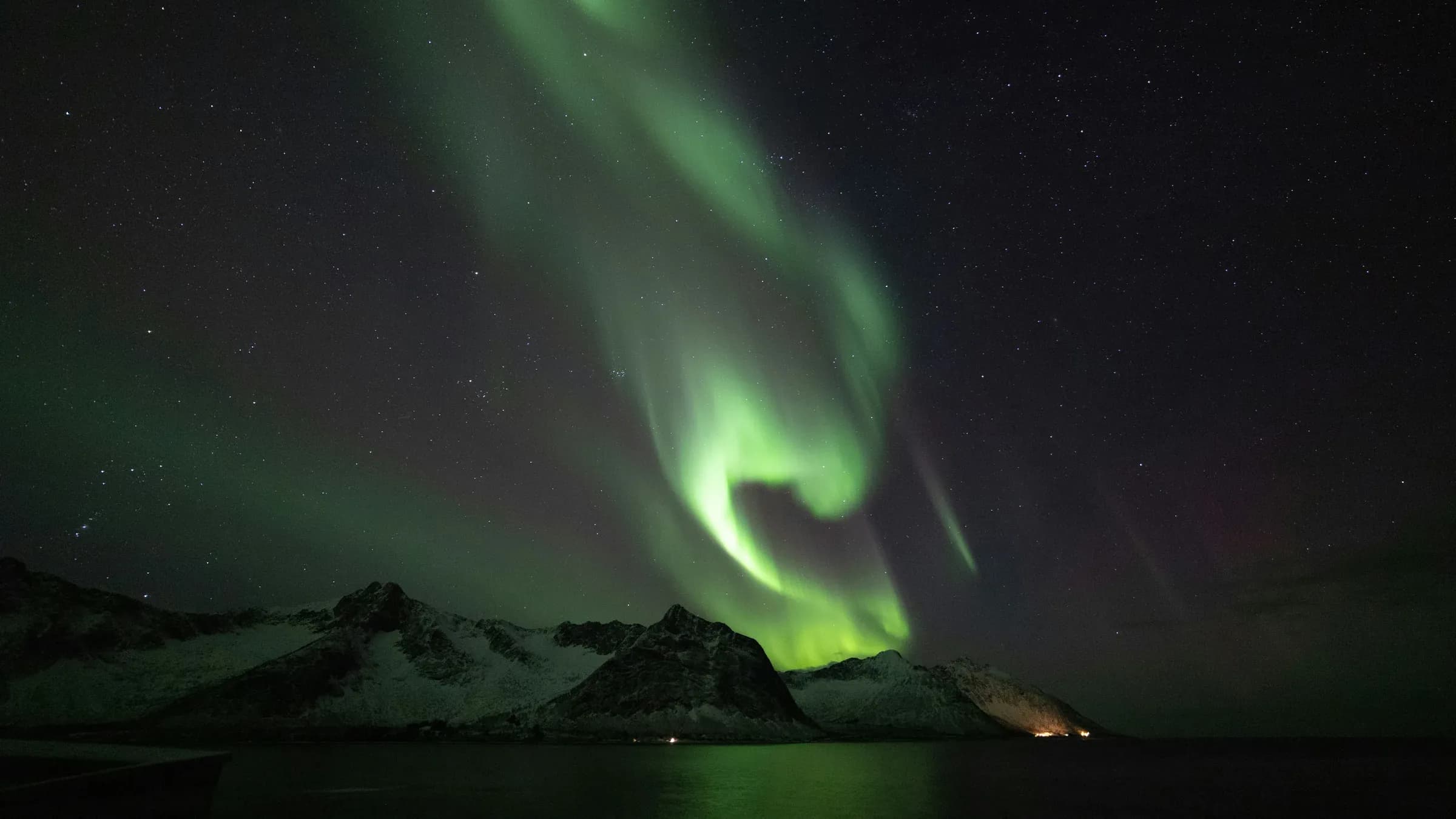
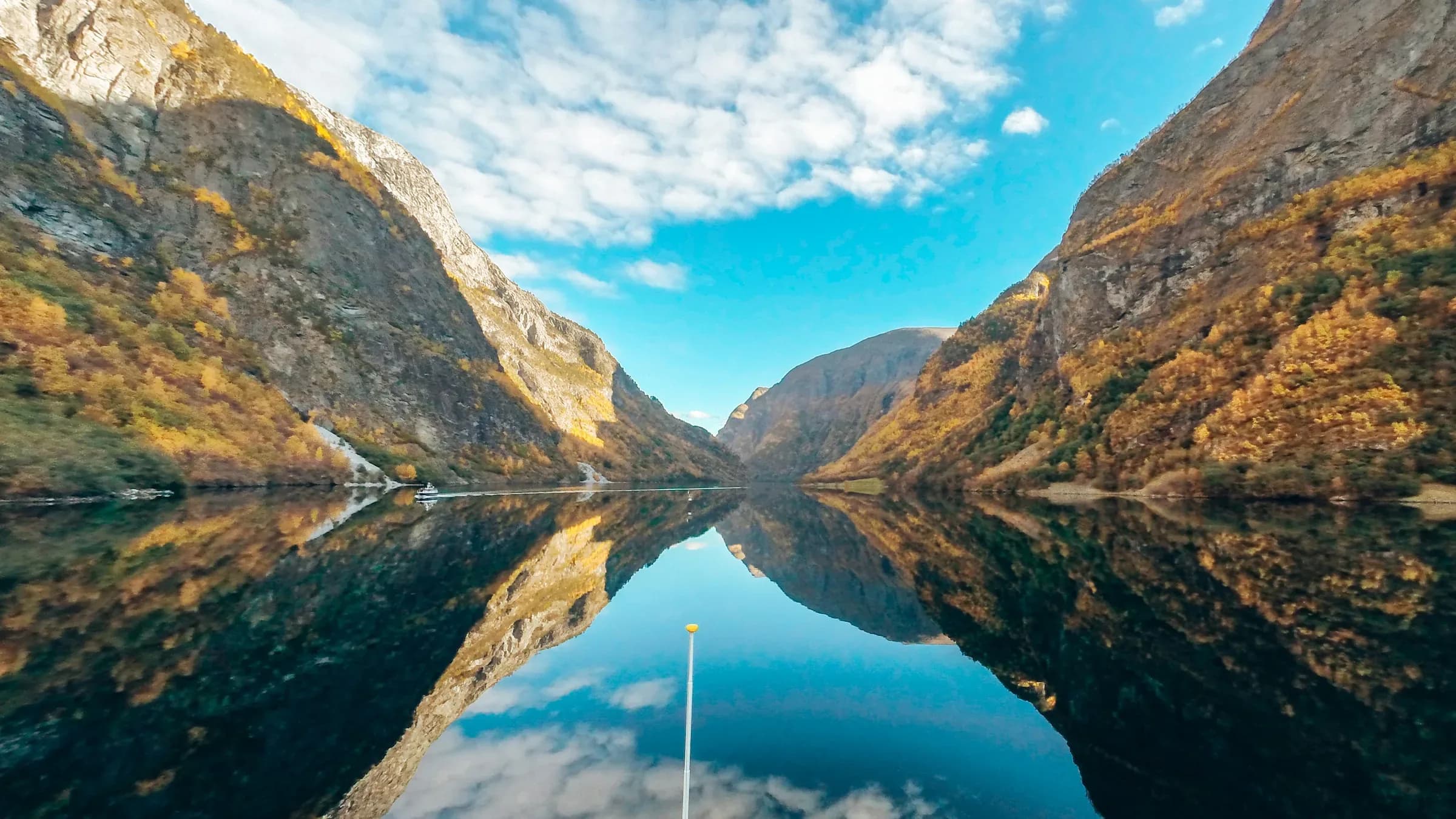
The best way to see the Norwegian fjords is from the water at eye level and from the land at night — which is exactly what a 3,000-passenger ship cannot give you. A land-based route pairs the 492 km Bergen Railway with the 20 km Flåm Line and small electric boats that carry under 400 people into the Nærøyfjord. Since January 1, 2026, vessels under 10,000 gross tons must run emission-free in the five World Heritage fjords. The small boats already do.
Key takeaways
- The World Heritage fjords are narrow, and narrow is the whole point. A large ship has to stand off in the wide water; a 400-passenger electric vessel goes where the walls close in.
- Norway's zero-emission rule took effect January 1, 2026 for tourist ships and ferries under 10,000 gross tons in Nærøyfjorden, Aurlandsfjorden, Geirangerfjorden, Sunnylvsfjorden and Tafjorden. Larger ships have until January 1, 2032.
- The Bergen Railway does the transfer for you. 492 km, 6.5–7 hours, 4–5 direct services daily, crossing the Hardangervidda plateau past Finse at 1,222 metres — the highest station on the line.
- The Flåm Line drops 866 metres in 20 km at an average 5.5% gradient through 20 hand-carved tunnels, in 45 to 60 minutes. It's a tourist attraction and it's also genuinely one of the great rail rides.
- A land-based fjord week costs about the same as a comparable cruise cabin and buys you evenings in the fjords instead of evenings on a ship.
- The Coastal Express is not a cruise, but it's not a fjord trip either. Its 12-day, 34-port, 2,500-nautical-mile route runs the outer coast, and it doesn't enter the Nærøyfjord at all.
- Staying two nights in one fjord village beats seeing four fjords in four days. The light changes; that's the experience.
Why do the big ships see the fjords worst?
Because a fjord is a narrow thing and a large ship is not. The Nærøyfjord — the UNESCO-listed one, inscribed with the West Norwegian Fjords in 2005 — is at points a few hundred metres across with walls rising more than a thousand metres either side. That geometry is the entire reason people come. A vessel that needs deep water and a wide turning circle cannot get into the part that makes it extraordinary. It can look at the entrance.
There's a second problem, which is scheduling. A cruise call in Geiranger or Flåm is typically six to nine hours: you arrive after breakfast, you're tendered ashore with everyone else, you have lunch and a queue, and you're back aboard before the light gets good. The fjords at 6 a.m. and 10 p.m. — the flat water, the low sun on the far wall, the village with nobody in it — are the two hours a day worth having, and a ship's schedule reliably excludes both.
And there's the crowding math. Flåm is a village. When two ships call on the same morning, the population of the pier exceeds the population of the town, and everything you came to see is happening behind a lot of other people's shoulders.
What does a land-based fjord trip actually look like?
The spine is simple and it has been the same for a century, because it works. You fly into Bergen or take the Bergen Railway across from Oslo. You base yourself in the fjord villages rather than passing through them. You move between them on scheduled rail, small boats and the car ferries that stitch the west coast road network together. You add a hire car or a private driver for two or three days to reach the roads and trailheads that no timetable serves.
A clean seven-day version: two nights Bergen, three nights on the Sognefjord arm around Flåm and Aurland, two nights in the Geiranger and Sunnmøre area, out from Ålesund. That gives you two full days in each fjord system rather than six hours, and it puts you on the water at the times of day the ships are not there.
The thing that surprises people is how little of it is difficult. Norway's public transport is excellent, punctual and cheap relative to everything else in the country. What it isn't is intuitive, because the connections are seasonal and the good ones sell out — which is where the planning goes.
Cruise versus land-based: how do they compare?
Per person, based on a seven-day fjord segment, two people sharing.
| Large cruise ship | Coastal Express | Land-based | |
|---|---|---|---|
| Time in the actual World Heritage fjords | 6–9 hours per call, 2–3 calls | Seasonal Geiranger detour only; no Nærøyfjord | Unlimited — you sleep there |
| Vessel size in the narrow water | Too large; stands off | Mid-size; port-focused | Under 400 passengers, all-electric |
| Morning and evening light | Almost never — you're aboard | Sometimes, from the deck | Every day, from the shore |
| Cost, 7 days, per person | $2,500–$6,000 | $2,800–$6,500 | $3,500–$8,000 |
| What's included | Cabin, meals, ship; shore excursions extra | Cabin and meals; excursions extra | Nothing bundled — you pay for what you use |
| Flexibility if weather turns | None | None | Total — change the day |
| Crowds you share it with | Everyone on your ship, plus any other ship in port | 500–650 fellow passengers | Whoever else is on the 8 a.m. boat |
| Physical effort | Minimal | Minimal | Moderate — trains, boats, some walking with bags |
Is the Bergen Railway worth building a trip around?
Yes, and it's the easiest good decision in Norwegian travel. The line runs 492 km between Oslo and Bergen in 6.5 to 7 hours, with 4 to 5 direct services a day, and it climbs onto the Hardangervidda — Europe's largest high mountain plateau — where there are no roads, no trees and, for long stretches, no evidence of anyone. Finse station sits at 1,222 metres beside the Hardangerjøkulen glacier, and in winter it is genuinely arctic.
It is also absurdly cheap by Norwegian standards: NOK 299 to 999, roughly $32 to $107, for what would be a headline luxury rail product anywhere else. Book early for the low end. Sit on the left travelling west for the better half of the views . We put it alongside the continent's best in luxury train journeys through Europe.
What is the Flåm Line, and is it a tourist trap?
It's both a tourist attraction and one of the steepest adhesion railways in the world, and the second fact survives the first. The Flåmsbana runs 20 km from Myrdal at 866 metres down to Flåm at sea level in 45 to 60 minutes, on an average gradient of 5.5%, through 20 hand-carved tunnels. In high season there are up to ten departures a day each way; in winter, four.
Yes, it is busy. High-season adult fares are NOK 510 one way and NOK 730 return (about $55 and $78), dropping to NOK 370 and 530 from November through March. The trap isn't the train — it's doing the train as a day trip from a ship, standing at the Kjosfossen waterfall stop with four hundred people, and leaving. Ride it in the first departure of the day, or the last, and stay the night in Flåm or Aurland. It becomes a different experience.
How do you get properly into the Nærøyfjord and Geirangerfjord?
Small boats. The Flåm to Gudvangen crossing takes about two hours through the Aurlandsfjord and into the Nærøyfjord on fully electric vessels, year-round, with several departures daily. There is no road along the Nærøyfjord — boat is the only way to see it, which is unusual and part of why it feels untouched.
For Geiranger, the Hellesylt–Geiranger ferry takes about an hour and passes the Seven Sisters and the Suitor waterfalls with a commentary. Approaching Geiranger by water from Hellesylt, then staying the night, then driving out over the Ørnevegen the next morning is the version of Geiranger that people remember. Arriving on a ship at 9 a.m. is not.
The mountain roads are the seasonal variable. Trollstigen opened on April 27 in 2026, unusually early against a normal mid-May opening, and the high passes close again in October or November depending on snow .
Is the Coastal Express a cruise?
Not really, and this is the most common confusion in Norwegian travel. The Bergen–Kirkenes coastal route is a working transport service that also carries tourists: 12 days round trip, 34 ports of call, 2,500 nautical miles, seven days northbound and six to seven back. Hurtigruten runs it daily; Havila Voyages runs four ships — Capella, Castor, Polaris and Pollux — sailing the route two days a week, with battery-assisted propulsion that lets them run silently for stretches.
It's a wonderful thing and we book it often. But understand what it is. It's a coastal voyage, not a fjord voyage. The route runs the outer coast and calls at working towns; several calls are 15 minutes in the middle of the night. It does not enter the Nærøyfjord, and Geiranger appears only on seasonal summer detours . If the fjords are what you came for, do the fjords by land and add the coastal voyage as a separate northbound leg toward Tromsø and Lofoten — which is how we usually build it.
Where should you actually sleep in the fjords?
On the water, in a village small enough to walk out of. The properties worth planning around are few and they're small:
- Hotel Union Øye, on the Hjørundfjord — historic, remote, and the reason some people come to Norway at all.
- Juvet Landscape Hotel, Valldal — glass cabins set into the landscape, minimalist to the point of severity, with a river spa.
- Storfjord Hotel, near Ålesund — a timber lodge above the fjord, the easiest to love of the three.
- Solstrand Hotel & Bad, at Os south of Bergen — a proper fjord spa hotel, and the right first or last night of a trip.
- Walaker Hotell, Solvorn — often called Norway's oldest family-run hotel, facing the Sognefjord.
Bergen itself is worth two nights, not one, and it is worth accepting that it will rain: the city averages 2,490 mm of precipitation across 198 wet days a year. May is the driest month at 110 mm. Opus XVI, in a converted bank building, is the pick for a small refined base.
Who this suits — and who it doesn't
A land-based fjord trip is wrong for you if unpacking once is the priority. You will change hotels three or four times in a week, and you will handle your own bags on and off trains and boats unless you're paying for private transfers throughout. A ship solves that problem genuinely well, and if mobility is a real constraint, a ship is the honest answer rather than the lazy one.
It's also wrong if you want a fixed, comprehensive, decided itinerary. Half the value of the land-based version is being able to change the day when the forecast changes, and that only pays off if you're willing to use it.
It suits travelers who care more about being somewhere than covering ground, who will get up at six for good light, and who would rather have two fjords properly than five from a rail. It suits photographers and walkers overwhelmingly. And it suits anyone who has already done a cruise here and came away feeling they'd been shown the fjords through a window.
How far ahead should you book?
Nine to twelve months for June through August. The constraint isn't the trains or the boats — those run frequently — it's that the fjordside properties above have between eight and forty rooms each, and the ones with the view go first. Hotel Union Øye and Juvet in particular sell out for peak summer roughly a year ahead.
Six months is enough for late May and September, which are better months anyway: fewer ships in port, better light, and Bergen at its driest in May. If you want a specific room at a specific property, treat that as the fixed point and build the rest of the route around its availability. That's how we sequence these.
Let our Norway specialist build your fjord route
The land-based version of the fjords is better and it is also harder to assemble — seasonal boat timetables, mountain roads that open on the weather's schedule, five or six properties that don't appear on the big booking sites, and connections that only work in one direction. That's the part we handle. Every Juniper trip to Norway is fully private and built from scratch around your dates — no group coaches, no fixed departures. Your Norway specialist sequences the route so you're on the water when the ships aren't.
"Best tours I have been on include this team and the care that they take of every detail and customer!" — Tyler K., verified Google review
Our Norway itineraries typically run 8–12 days and $5,000–$15,000+ per person. Start with our custom Norway trips, or Norway honeymoons if you're planning this for two. For the seasonal picture, read the best time to visit Norway; for what a week of this actually costs, how much a Norway trip costs. When you're ready, book a free consultation — and tell us if you're weighing a cruise, because we'll give you the honest comparison rather than the one that suits us.