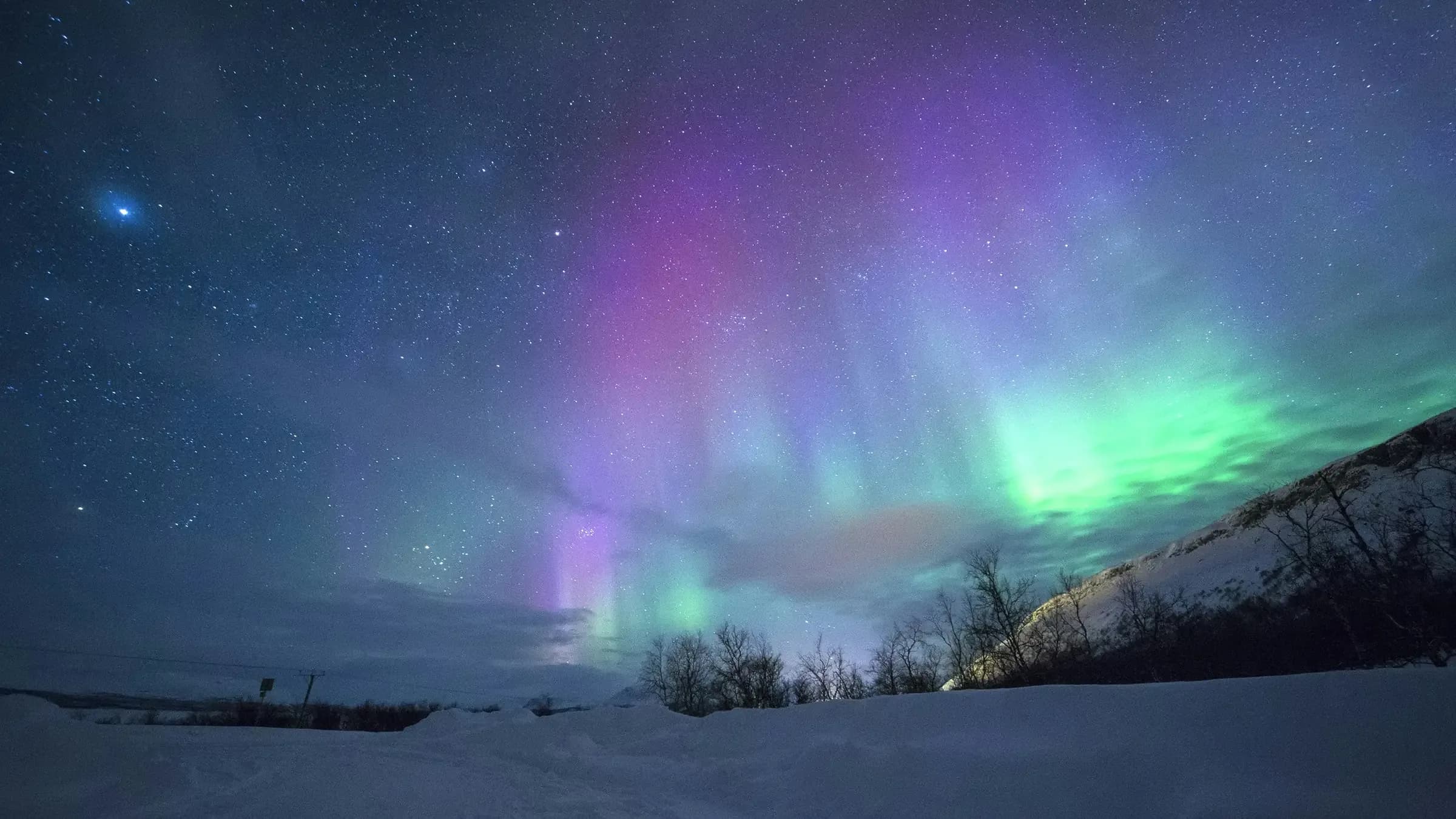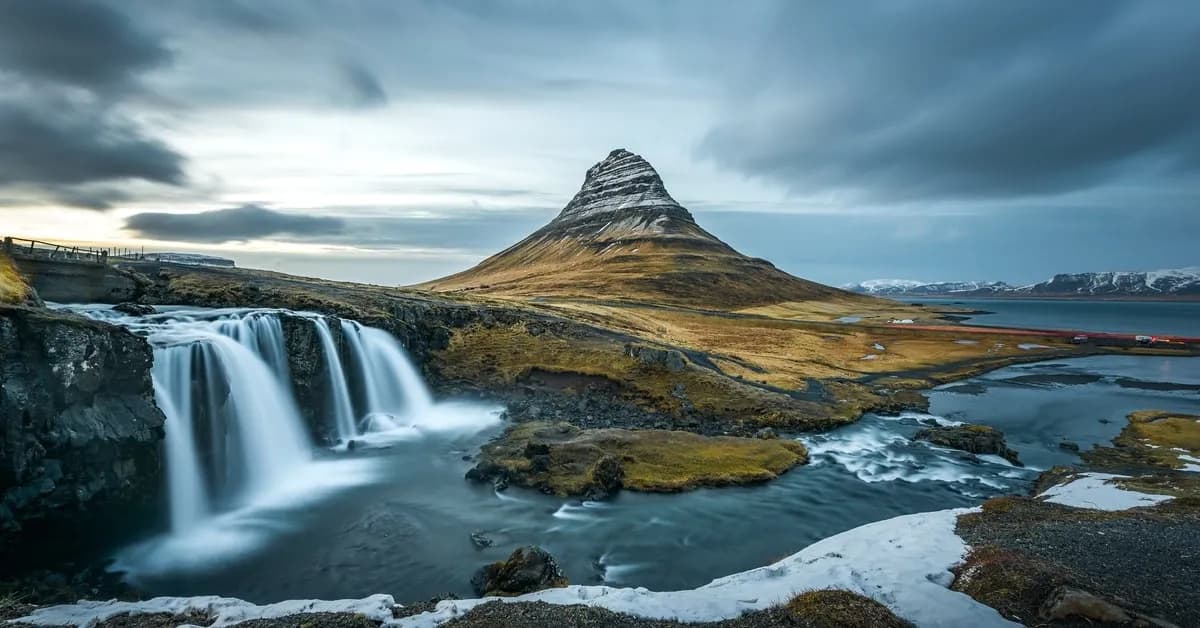
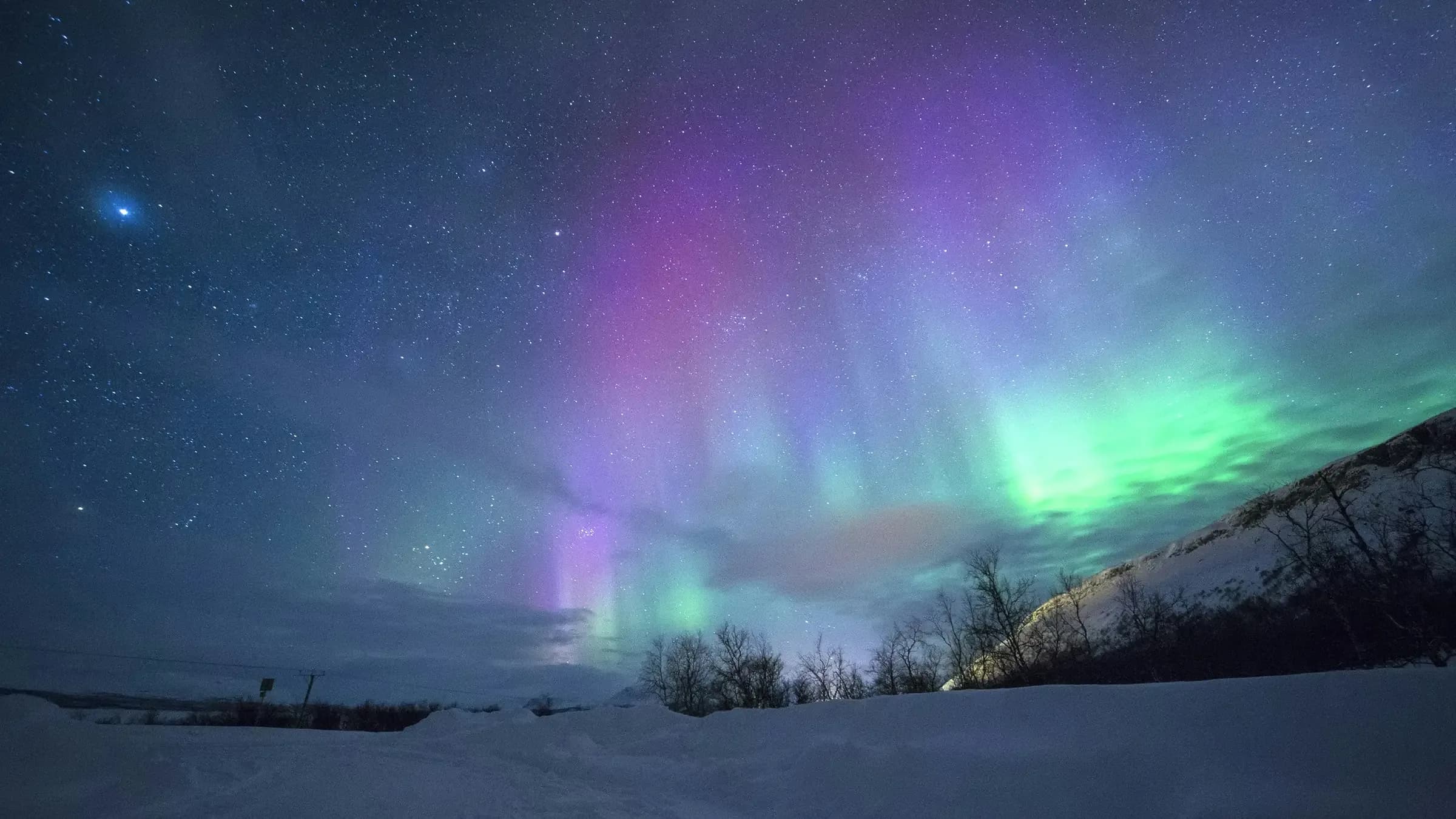
Solar Cycle 25 peaked in October 2024, and the declining phase it's in now is historically one of the better stretches for aurora — fewer flares, but bigger coronal holes throwing recurring high-speed solar wind at Earth on a 27-day rhythm. For 2026/27 the forecast favors latitude and dry air over raw activity: Tromsø at 69.65°N, Abisko at 68.3°N in a mountain rain shadow, then Iceland at 64.13°N. Budget six nights minimum.
Key takeaways
- The declining phase is not a bad season. Solar maximum passed in October 2024, but Cycle 23's biggest storms came in 2003, two years after its peak, and Cycle 24's largest flares came in 2017, three years after its peak.
- Coronal holes are the 2026/27 story. NOAA notes coronal holes are most common and persistent in the years around solar minimum, can last several 27-day solar rotations, and typically drive G1–G2 storms — modest but repeatable.
- Kp is a 0–9 scale where 5 and above is a geomagnetic storm; NOAA's G1 storm level starts at Kp 5 and G5 at Kp 9. Under the auroral oval you do not need a storm at all.
- Latitude beats activity. Tromsø can produce an overhead display at Kp 1. Reykjavík generally wants Kp 2–3 for something reliable.
- Cloud decides your trip. On any given night, sky cover is the binding constraint — which is why Abisko's rain shadow, one of the driest spots in Sweden, matters more than its extra degree of latitude.
- The equinox months are statistically the best. Geomagnetic activity peaks around March–April and September–October, an effect named for Russell and McPherron.
- Juniper's published ranges: about $5,000–$15,000 per person for a complete custom Iceland itinerary, and $5,000–$15,000+ for Norway.
Where does the 2026/27 forecast actually favor?
Nowhere, in the sense people mean. There is no seasonal aurora forecast that says "go to Tromsø in February." What there is: a solar cycle in a phase that produces frequent moderate activity rather than rare huge activity, and three destinations that convert that activity into sightings at different rates.
Given a declining-phase winter, the ranking on odds alone is Tromsø, then Swedish Lapland, then Iceland — that's just latitude. Given a declining-phase winter and the fact that most nights fail on cloud rather than on physics, the ranking shifts: Abisko and inland Swedish Lapland move up, because dry continental air produces more usable nights than a maritime coastline does.
And given that you also have to spend six days there, Iceland comes back into play, for the reasons we set out in Iceland or Norway for the northern lights. Which of those three framings is right depends entirely on whether the aurora is the trip or the reason for the trip.
What does Solar Cycle 25's declining phase mean for aurora?
Solar activity runs on an approximately 11-year cycle. Cycle 25 reached maximum in October 2024; NOAA's forecast panel had originally predicted a July 2025 peak with a smoothed sunspot number of 115, and the real cycle overshot and arrived early. Since then the numbers have come down. In 2024 the sun produced more than 50 X-class flares, twenty of them at X2.0 or above, and two G4 storms including one G5. In 2025 it produced 19 X-class flares, only four above X2.0, and one G4.
That looks like bad news and mostly isn't, for two reasons. The first is that the biggest storms in living memory did not happen at solar maximum. Cycle 23 peaked in 2001 and delivered its X10-plus events — including the estimated X40 flare that drove back-to-back G5 storms — in October 2003. Cycle 24 peaked in 2014 and delivered its largest flares in 2017. Declining phases produce fewer events and disproportionately large ones.
The second reason is coronal holes. These are open-field regions on the sun where solar wind escapes freely, and NOAA describes them as most common and persistent in the years around solar minimum. A large one produces a high-speed stream that can drive G1–G2 geomagnetic storming, and because it rotates with the sun it can come back around every 27 days for several rotations. For a traveler that's a better statistical shape than a cycle of rare spikes: modest activity, but often, and semi-predictably.
What is the Kp index, and what number do you actually need?
Kp is a planetary index of geomagnetic disturbance, averaged from magnetometer readings at 13 mid-latitude observatories, running 0 to 9. Zero is dead calm. Five and above is formally a geomagnetic storm, and NOAA's G-scale maps onto it directly: Kp 5 = G1 (minor) through Kp 9 = G5 (extreme).
Here is the part the apps don't tell you. Kp is a measure of how far the aurora has been pushed toward the equator, not of how bright it is. If you are standing under the auroral oval, a low Kp is fine — the lights are already above you. Kp only becomes the number that matters when you're south of the oval and waiting for it to expand down to you.
Which is why the same night can be a triumph in Tromsø and a bust in Reykjavík. Kp 1 at 69.65°N puts a band overhead. Kp 1 at 64.13°N puts a faint arc low on the northern horizon, where a hill, a cloud bank or a streetlight will erase it. Reykjavík generally wants Kp 2–3 before it's worth setting an alarm.
Chasing high Kp numbers is a trap. Book latitude instead. Then any night the sky is clear is a night you have a real chance, regardless of what the app says.
What is the auroral oval and why does it matter more than the forecast?
The aurora isn't a curtain that sweeps in from somewhere. It's a permanent ring of glowing atmosphere centered roughly on the geomagnetic pole, sitting over about 65–72°N during typical activity, and it is there essentially all the time. What changes is its diameter — activity pushes the ring outward and thickens it — and whether it's dark enough where you are to see it.
Tromsø, Abisko and Kiruna sit inside that ring on an ordinary night. Reykjavík sits under its southern edge. Everything downstream follows from that single geometric fact: the number of nights per season that produce something, the amount of activity needed, and how forgiving a low-latitude position is when conditions are only average.
It also explains a counterintuitive point. During a very strong storm the oval expands and moves south, which can push the brightest part of the display past the zenith at Tromsø and out over the horizon. On a G4 or G5 night, Iceland or even Scotland can briefly have the better view. Those nights are rare and you cannot plan around them.
Why does cloud cover matter more than solar activity?
Because it's binary and it's frequent. Solar activity varies between "a faint arc" and "the whole sky moving" — a bad activity night still gives you something. Cloud gives you nothing at all, and in the Arctic in winter it wins most nights.
On a seven-night trip you might get three or four usable nights. That number, not the Kp forecast, is what determines whether you see the aurora. Everything worth doing in planning is aimed at raising it:
- Choose dry geography. Abisko sits in the rain shadow of the Scandinavian Mountains and is one of the driest places in Sweden — the local nickname is the "blue hole." Inland Finnish and Swedish Lapland behave the same way. Coastal Tromsø and coastal Iceland do not.
- Be mobile. Tromsø's chase operators routinely drive two or three hours inland toward the Finnish or Swedish border to get under clear sky. That is not an upsell; it's the whole method.
- Be in more than one place. In Iceland especially, splitting nights between the south coast and the north near Akureyri means a single front can't cost you the trip. Juniper's Iceland approach is built on exactly this — multiple nights away from light pollution with flexibility built in.
- Buy more nights. Six is the floor. Three nights in aurora country is a coin flip dressed up as a holiday.
How do Tromsø, Iceland and Swedish Lapland compare?
| Criterion | Tromsø, Norway | Iceland (Reykjavík / Ring Road) | Swedish Lapland (Abisko / Kiruna) |
|---|---|---|---|
| Latitude | 69.65°N — inside the oval | 64.13°N — under its southern edge | 68.3°N (Abisko), 67.9°N (Kiruna) — inside the oval |
| Activity needed | Kp 1 for overhead | Kp 2–3 for something reliable | Kp 1–2 for overhead |
| Climate for clear skies | Maritime, high cloud; chase inland | Maritime, moderate and variable; outdrive it | Continental rain shadow; the driest of the three |
| Season | Late August to mid-April | September to mid-April | Early September to late March |
| Getting there from the US East Coast | No nonstop; Newark–Oslo ~7h 50m plus ~2h 8m | Nonstop New York–Keflavík ~5h 35m | No nonstop; via Stockholm to Kiruna, then ~1h 20m by road or rail to Abisko |
| What else there is to do | Whale watching, dog sledding, Sámi hosts, Lofoten and Senja nearby | Ice caves, glacier lagoons, geothermal baths, waterfalls, full daytime program | Dog sledding, Icehotel at Jukkasjärvi, snowshoeing, Sámi culture; thinner daytime program |
| Self-drive | Possible, but most use a driver | Yes — the Ring Road is 821 miles and plowed daily | Not advisable in deep winter |
| Best for | Maximum raw odds with a real Arctic town attached | A complete trip with the aurora as upside | The highest share of clear nights per week |
When in the season should you go?
Two forces pull in opposite directions. Darkness increases toward midwinter — Tromsø gets about 18 hours of usable dark in January against Reykjavík's 14. Geomagnetic activity, though, peaks near the equinoxes: the Russell-McPherron effect means the orientation of the interplanetary magnetic field couples more efficiently with Earth's around March–April and September–October, and the observed pattern is a clear twice-yearly bump.
The practical compromise most people should make: late September to late October, or late February to late March. You get the equinox activity bonus, enough darkness, and — importantly for Iceland — roads and daytime activities that still function properly. Deep midwinter gives you the most dark hours and the worst weather, the shortest daylight for everything else, and in Tromsø a polar night running roughly late November to mid-January.
For 2026/27 specifically, that argues for the March 2027 window if you're flexible, with the September–October 2026 shoulder as the near-term option.
Who this suits — and who it doesn't
Tromsø and Abisko are wrong for you if you need a full daytime program, hate connections, or only have five days. Both are a full travel day each way from the US, and both are small places you can exhaust in under a week if the weather sits on you.
Iceland is wrong for you if the aurora is genuinely the only reason you're going and you'd write off the trip without it. At 64°N on a short stay, that's a coin flip, and the honest advice is to go north instead.
None of the three is right for anyone who wants a guarantee. There isn't one, anywhere, and any operator implying otherwise is selling you something. If a sighting has to happen, the closest thing to insurance is six or seven nights at high latitude in dry geography — and even that is a probability, not a promise.
How far ahead should you book?
For the 2026/27 season, you are already inside the window and should move now — the good properties in Tromsø, Abisko and Iceland's south coast for the equinox and midwinter weeks have been selling since spring.
For 2027/28, start 10 to 12 months out. Northern Norway is the constraint: Tromsø has limited hotel inventory, and the best chase operators and Lofoten properties sell their January and February dates by the previous spring without releasing more. Abisko's mountain-station and lodge inventory is even smaller. Iceland is more forgiving at eight to ten months, but ice-cave permits and the small south-coast hotels are not.
Anything spanning New Year in any of the three is a 12-month booking. Combining two countries is also 12 months — you're constrained by the tighter calendar, which is always Norway's.
Let our Iceland specialist plan your northern lights trip
Taryn Harrison is Juniper's Iceland and Ireland specialist — CMSC certified, 25 years designing European itineraries, 41 countries traveled. She plans aurora trips the way the physics demands: several nights, in more than one place, positioned so one weather front can't take the whole week. Norway and Swedish Lapland itineraries are built by the same Northern Europe team. Every Juniper trip is fully private and built from scratch — no group coaches, no fixed departures, no shared minibus of forty people at the same pull-off.
"The trip to Iceland for our family of 11 was incredible. Many Thanks to Taryn for her patience, kindness, and guidance..." — Debra W., verified Google review
Read the destination pages side by side to see how the two countries differ in practice: luxury Iceland tours and custom Norway trips. Couples should look at Iceland honeymoons and Norway honeymoons, both built around slower pacing and better-positioned lodges. For the head-to-head, read Iceland or Norway for the northern lights; for Iceland's timing specifically, the best time to see the northern lights in Iceland; and if you'd rather drive it yourself, our self-drive Iceland honeymoon guide. When you have dates, book a free consultation and we'll tell you honestly what your odds look like.