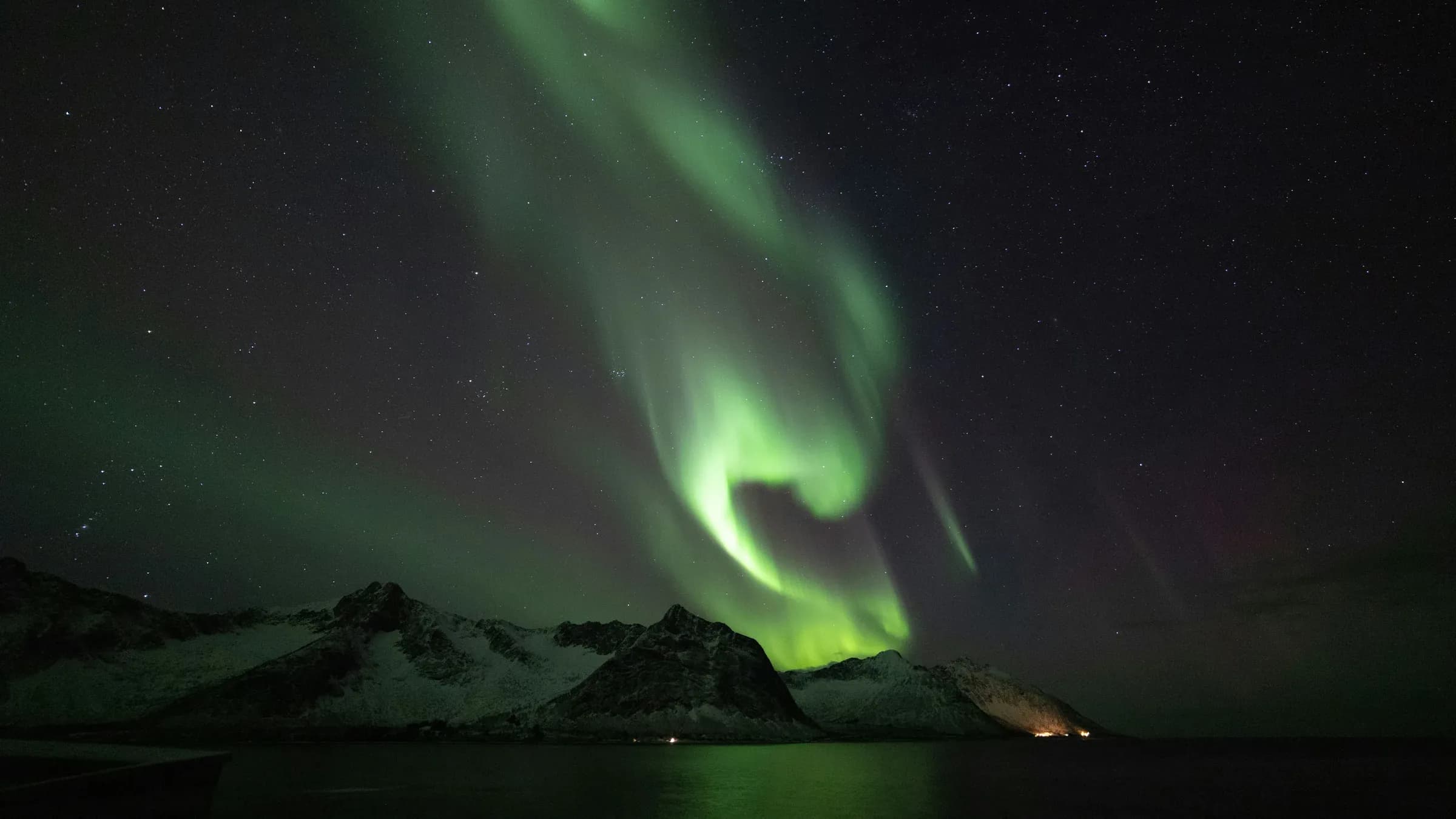
Norway runs on two clocks, and you have to pick one. Late September through March is aurora season: in Tromsø the sun does not rise at all between November 28 and January 14. May through July is midnight sun: in the same town the sun does not set between May 19 and July 26. The fjord hiking, the mountain passes and the small ferries belong to the second window. The northern lights belong only to the first. You cannot combine them.
Key takeaways
- Aurora season runs late September to late March. Above the Arctic Circle it needs genuine darkness, which Tromsø does not have between roughly April 10 and August 20.
- Midnight sun in Tromsø runs May 19 to July 26. In Lofoten it is a shorter window, roughly late May to mid-July, and in Bergen the sun still sets — you get 18 hours 55 minutes of daylight in June instead.
- June to early September is fjord season. Trollstigen and the high mountain roads open in late spring — the 2026 opening was April 27, unusually early — and the Nærøyfjord and Geiranger boats run at full frequency.
- February and March are the sweet spot for a winter trip. You get aurora-grade darkness plus 7 to 12 hours of usable daylight in Tromsø, which winter-solstice travelers do not.
- Bergen gets 2,490 mm of rain across 198 wet days a year. May is its driest month at 110 mm. Plan the fjords around that, not around July.
- Solar Cycle 25 peaked in 2024 and is now in its declining phase, which historically produces the long-lived coronal holes and recurring high-speed solar wind streams that drive strong aurora — so the 2026/27 season is a good one, not a fading one.
- Late April, early May, and late October are the two dead zones. Too light for aurora, too early or too late for the fjords, and half the seasonal infrastructure is shut.
When is the best time to visit Norway?
There isn’t one. There are two, and the honest version of this answer starts by asking what you came for.
If you want the northern lights, go between late September and late March, and preferably in February or March, when the darkness is still deep enough but the days have come back far enough to do something with. If you want the fjords — the water, the hiking, the small ferries, the mountain roads, the light that goes on until midnight — go between mid-June and early September, with late June through July as the peak.
The reason these do not overlap is geometric, not seasonal. The aurora is always there; you simply cannot see it against a lit sky. In Tromsø, at 69.6°N, mid-May gives you 22 hours 10 minutes of daylight and June gives you 24. There is no waiting until 2 a.m. for it to get dark. It does not get dark.
What does Norway look like month by month?
Daylight figures below are mid-month. Tromsø stands in for the Arctic north — Lofoten sits about a degree and a half south and runs a slightly milder version of the same pattern. Bergen stands in for the fjord west.
| Month | Daylight, Tromsø | Daylight, Bergen | Aurora | What this month is actually for |
|---|---|---|---|---|
| January | 1h 50m | 6h 50m | Peak | Deepest darkness. Dog sledding, Sami reindeer herding, orca and humpback boats out of Skjervøy. Very little daylight for scenery. |
| February | 7h 25m | 9h 10m | Peak | The best-balanced winter month. Aurora nights plus enough light to see Lofoten’s mountains and the Arctic coast. |
| March | 11h 50m | 11h 55m | Strong | Equinox aurora, snow still deep, near-equal day and night. Skiing and snowshoeing at their most reliable. |
| April | 16h 20m | 14h 40m | Fading, then gone | Aurora effectively finished by mid-month. Fjord roads only beginning to open. A month to avoid. |
| May | 22h 10m | 17h 25m | None | Bergen’s driest month at 110 mm. Waterfalls at full snowmelt. Midnight sun begins in Tromsø on the 19th. |
| June | 24h | 18h 55m | None | Midnight sun everywhere north of the Circle. Everything open, nothing dark, the fjords at their most alive. |
| July | 23h 35m | 18h 00m | None | Warmest month — Tromsø averages 15.6°C, Bergen 19.7°C. Also the busiest and the most expensive. |
| August | 18h 00m | 15h 30m | None until late | Berries, warmest sea, hiking trails clear to the summits. Crowds thin sharply after the 20th. |
| September | 13h 20m | 12h 50m | Returns | The overlap month, sort of: autumn color in the fjords and the first aurora nights up north from around the 10th. |
| October | 8h 55m | 10h 00m | Good | Aurora building, but Tromsø’s cloudiest stretch and the fjord season winding down. A gamble. |
| November | 3h 30m | 7h 25m | Peak | Whale season opens near Tromsø and Skjervøy. Polar night begins on the 28th. |
| December | 0h | 5h 55m | Peak | True polar night in Tromsø — blue twilight, no sunrise. Atmospheric, but you are traveling in the dark. |
When is northern lights season in Norway?
Late September to late March, with the strongest odds between November and February. What actually varies month to month is not the aurora itself but two things: how many dark hours you get, and how often the sky is clear.
Dark hours are fixed and predictable — the table above is the whole story. Cloud is neither, and on the Norwegian coast it is the real limiting factor. That is why a serious aurora trip is built around mobility — a guide who will drive two hours inland toward Finland to find a hole in the weather — rather than around a fixed lodge with a glass roof. It is also why three or four nights in one place beats a single night: each extra night is another independent roll against the weather, and the odds compound quickly.
On the solar side, the outlook for 2026/27 is genuinely good. Solar Cycle 25 reached maximum in 2024 and outperformed forecasts. The declining phase after a maximum is when long-lived coronal holes open up and send recurring high-speed solar wind streams at Earth, and those streams produce the steady, repeatable aurora that suits a planned trip better than a single dramatic flare does. Activity also lifts around the equinoxes, which is part of why late September and March punch above their weight. If you’ve read our guide to the best time to see the northern lights in Iceland, the physics is the same — Norway simply sits further north, and Tromsø is directly under the auroral oval rather than at its edge.
When is the midnight sun, and where can you see it?
You need to be north of the Arctic Circle at 66.5°N for the sun to literally never set. The further north you go, the longer the window:
- Tromsø (69.6°N): May 19 to July 26 — the longest easily reachable window, at roughly 68 days.
- Lofoten (around 68.2°N): roughly late May to mid-July.
- The North Cape (71.2°N): the longest window in mainland Europe, running roughly mid-May to late July.
- Bergen and the fjords (60.4°N): no true midnight sun. What you get instead is 18 hours 55 minutes of June daylight and a long blue dusk that never fully closes.
The practical effect is not that you stay up all night. It’s that the day loses its edges. You can climb Reinebringen at nine in the evening and eat dinner at midnight in full light. Bring a sleep mask — Nordic hotels are inconsistent about blackout curtains.
Can you see the northern lights and the midnight sun on the same trip?
No. Not in the same week, the same month, or even in adjacent months. The closest you can get is late August into the first ten days of September, when the north has real darkness returning at night and the summer infrastructure is still running — but that is a compromise that gives you a weak version of both rather than a strong version of either.
Anyone who tells you otherwise is selling you a September trip and hoping. If both are non-negotiable, the honest answer is two trips: a winter one built around Tromsø and Lofoten, and a summer one built around Bergen and the fjords. They are so different that they don’t feel like the same country anyway.
When are the fjords at their best?
Late May through mid-September, with two distinct characters inside that. Late May and June give you snowmelt — waterfalls at maximum volume, snow still on the tops, and Bergen at its statistically driest, with 110 mm of rain in May against 290 mm in December. Late August and early September give you warmer water, clear high trails, thinner crowds, and the first autumn color.
The mountain roads are the real seasonal constraint. Trollstigen and the other high passes are closed by snow for much of the year; Trollstigen opened on April 27 in 2026, unusually early, after normally opening in mid-May. For 2027, plan on mid-May at the earliest and check with the Norwegian Public Roads Administration before committing to a driving route.
Worth knowing if you are weighing a ship: since January 1, 2026, tourist vessels and ferries under 10,000 gross tons must operate emission-free in the five World Heritage fjords — Nærøyfjorden, Aurlandsfjorden, Geirangerfjorden, Sunnylvsfjorden and Tafjorden — with the same rule reaching larger ships on January 1, 2032. In practice the small electric boats are already the nicer way through.
What is the cheapest time to visit Norway?
Late October and the first three weeks of November, then again the second half of January into early February — excluding the holiday period, which is expensive everywhere. Rates in Bergen and the fjord towns drop sharply once the summer season closes, and Arctic hotel pricing softens in the weeks after New Year before the February half-term waves arrive.
The catch is that cheap months are cheap for a reason. Late October is the worst of both worlds in the fjords, and much of the seasonal boat and road network is shut. Norway also does not have a genuinely inexpensive season — a country where 1 USD buys about 9.3 NOK as of September 2026 is more affordable than it was five years ago, but the underlying cost of labor and food has not moved.
Who this suits — and who it doesn’t
Norway is wrong for you if you want reliable warmth, a beach, or a city that stays up late. Tromsø’s warmest month averages 15.6°C. Bergen is wet on 198 days a year. The food scene is excellent but small and closes early outside Oslo. If your ideal trip involves lying somewhere hot and being brought things, this is not it.
It is also wrong for travelers who want certainty. The aurora is a probability, not a booking. Weather closes mountain roads. Small ferries cancel. If a canceled crossing would ruin the trip rather than become the story, choose somewhere with more redundancy.
It suits people who are moved by scale, who don’t mind weather, and who would rather have three extraordinary days than ten pleasant ones. It suits photographers, walkers, and couples who want quiet. And it suits anyone who has done the obvious European destinations and wants something that still feels genuinely remote a two-hour flight from Oslo.
How far ahead should you book?
For a February or March aurora trip, start ten to twelve months out. The good Arctic properties are small — Lyngen Lodge and the Lofoten rorbu lodges have a handful of rooms — and they fill first for exactly the high-season weeks you want. Guides with their own vehicles book out even earlier.
For June through August in the fjords, work to nine to twelve months. The constraint there is not availability in general but availability of the specific fjordside rooms with the view, of which there are very few. Hotel Union Øye and Juvet Landscape Hotel are properties measured in single-digit or low-double-digit room counts.
For September and late April you can move at four to six months. But those are the months we most often talk clients out of.
Let our Norway specialist time your trip
The difference between a good Norway trip and a great one is almost entirely in the calendar — being in Tromsø in the right week of February rather than the wrong week of October, catching the fjord roads after they open rather than the week before, knowing which nights to keep loose so a guide can chase clear sky. That’s the part we handle. Every Juniper trip to Norway is fully private and built from scratch around your dates — no group coaches, no fixed departures. Your Norway specialist times the itinerary to what you actually came for, and tells you plainly when the month you’ve picked won’t deliver it.
“Great planning and experience- the trip provided everything we asked for and more” — Melanie D., verified Google review
Norway itineraries with us typically run 8–12 days and between $5,000 and $15,000+ per person, with hand-selected stays, private guides and transfers arranged end to end. Start with our custom Norway trips, or, if you’re planning the trip around two people, Norway honeymoons. When you’re ready, book a free consultation — we’ll tell you which window fits before we quote anything.