Ten days in Costa Rica is three bases, not five. The route below is San José, Arenal, Monteverde and a Pacific coast finish — nine nights, four moves, roughly 12 hours of total road time. The drives are what people underestimate: San José to La Fortuna is 3 hours, Arenal to Monteverde 3 to 3.5, Monteverde to Manuel Antonio 3.5. Budget $5,000–$15,000+ per person, and expect dry season to cost more than green.
Key takeaways
- Three bases plus an arrival night is the ceiling. San José (1), Arenal (3), Monteverde (2), Pacific coast (3). Four transfers in ten days, none longer than three and a half hours.
- Costa Rican drives are slow, not long. Two-lane mountain roads, fog above 1,200 m and trucks setting the pace. Assume every leg takes 30–50% longer than the distance suggests, and never drive Route 606 after dark.
- Route 606 to Monteverde is now paved throughout and a 4x4 is not required on the main approaches — a real change from a decade ago. The northern route from La Fortuna still has pressed-gravel sections.
- Manuel Antonio National Park is closed Tuesdays, opens 7am–4pm otherwise, caps entry at 1,200 visitors a day (down from 3,000) and charges $16 plus tax for adults. Buy tickets in advance, not from the men outside the gate.
- The Monteverde Cloud Forest Reserve limits entry to 450 people a day and 250 at a time, 7am to 4pm. The first entry of the day is the one worth having.
- Dry season runs roughly December to April, green season May to November, with September and October the wettest on the Pacific — wet enough that many Osa Peninsula lodges close. The Caribbean reverses this and is at its best in September and October.
- An internal flight is worth it for the Osa and rarely otherwise. San José to Drake Bay is about 50 minutes against five hours of driving plus a 90-minute boat. Sansa's regular-fare baggage allowance is 30 lb and they weigh you at check-in.
What does a 10-day Costa Rica itinerary actually cover?
One volcano region, one cloud forest, one coast. That is the classic ten days, and it's classic because it works: three genuinely different ecosystems within a day's drive of each other, and enough time in each to see wildlife rather than drive past it.
Costa Rica is about the size of West Virginia, which encourages people to plan five stops, and the country punishes that. Every night in a fourth or fifth base is a morning lost to packing and an afternoon lost to a van. The route below sits in Juniper's $5,000–$15,000+ per person band, with private ten days in 4- and 5-star lodges typically landing at $6,500–$11,000 per person; our Costa Rica cost guide breaks it down. Juniper's Best of Costa Rica runs this exact arc over ten days with private transfers, and the fifteen-day version adds Tortuguero and Guanacaste.
What is the 10-day route, day by day?
Day 1: Arrive San José. One night, near the airport in Alajuela rather than downtown. Most US flights land in the afternoon, and driving three hours to Arenal on arrival day is the most common mistake on a Costa Rica itinerary. The Central Valley coffee farms are twenty minutes away if you land early.
Day 2: San José to Arenal. About 3 hours north through Zarcero and San Ramón, or the slower prettier road round Lake Arenal. Arrive by lunch. Afternoon in the hot springs — Tabacón, Nayara, or the free river spot below the Tabacón bridge if you're that kind of traveler.
Day 3: Hanging bridges and the waterfall. The Mistico bridges with a naturalist guide first thing, when the birds are up: eyelash vipers, howler monkeys, toucans. Afternoon at the La Fortuna waterfall — about 500 steps down and the same back up.
Day 4: Arenal, your choice. Zipline, the Río Celeste day trip, the 1968 lava-flow trail, a safari float on the Peñas Blancas, or horseback. Arenal last erupted in 2010 and has been resting since, so what you're looking at is a perfect cone rather than lava — which is fine, because the cone only shows itself about half the time anyway.
Day 5: Arenal to Monteverde. The jeep–boat–jeep, about 3 hours and around $45 per person shared, departing typically at 8am and 2pm: a van to the lake, a crossing of Lake Arenal — the largest artificial lake in Central America — and a van up the far side. The road alternative is 3 to 3.5 hours and duller. Take the boat.
Day 6: The cloud forest. Monteverde Cloud Forest Reserve at 7am with a guide, before the day's 450 visitors arrive — the reserve holds only 250 at a time. Quetzals are a January-to-May proposition and never a guarantee. Afternoon on a canopy walkway or at the quieter Santa Elena reserve. A guided night walk is the best two hours in Monteverde.
Day 7: Monteverde to Manuel Antonio. About 3.5 hours down Route 606 and south along the coast highway. The descent is the section people remember: sharp curves and cliffside stretches between Guacimal and the valley, all paved, all slow. Arrive mid-afternoon.
Day 8: Manuel Antonio National Park. Go at opening, 7am, with a naturalist guide and their spotting scope — you'll see four times as much as you would alone. Closed Tuesdays, capped at 1,200 people a day, entry $16 plus tax for anyone six and over. Beach afternoon at Playa Espadilla Sur inside the park or Biesanz outside it.
Day 9: The coast, unstructured. Catamaran and snorkel, Nauyaca Falls, a mangrove kayak in Damas, or nothing. Leave this day empty on purpose.
Day 10: Out. About 3 hours back to San José, or a 20-minute flight from Quepos if your international departure is early. Build in the buffer either way; the coast highway floods in the green season.
What does the route look like in one table?
| Day | Base | Travel leg | Highlight |
|---|---|---|---|
| 1 | Alajuela / San José | Arrive SJO | Nothing scheduled; Central Valley coffee if you land early |
| 2 | Arenal | San José–La Fortuna, ~3h | Afternoon hot springs under the volcano |
| 3 | Arenal | Local only | Mistico hanging bridges at dawn; La Fortuna waterfall |
| 4 | Arenal | Río Celeste optional, ~2h each way | Zipline, safari float or the 1968 lava trail |
| 5 | Monteverde | Jeep–boat–jeep, ~3h, ~$45pp | Crossing Lake Arenal instead of driving round it |
| 6 | Monteverde | Local only | Cloud Forest Reserve at 7am; guided night walk |
| 7 | Manuel Antonio | Monteverde–Manuel Antonio, ~3h30 | Route 606 descent; sunset on the Pacific |
| 8 | Manuel Antonio | Local only | National park at opening with a naturalist guide |
| 9 | Manuel Antonio | Local only | Catamaran, Nauyaca Falls, or a deliberately empty day |
| 10 | Depart | Manuel Antonio–SJO ~3h, or Quepos–SJO ~20 min by air | Buffer for the coast highway |
How bad are the roads, really?
Better than their reputation and worse than a map suggests. Route 606, the main approach to Monteverde, is now paved throughout and does not require a 4x4, and the highways between San José, Arenal and the Pacific coast are fine. What's still true: they're mostly two-lane, they climb and descend constantly, fog sits on the Monteverde section from mid-afternoon, and the stretch between Guacimal and Monteverde has sharp curves and cliffside sections with no barrier. Nobody should drive it after dark.
| Leg | Time | Notes |
|---|---|---|
| San José–La Fortuna | ~3h | Via San Ramón or Zarcero |
| La Fortuna–Monteverde by road | 3–3.5h | Northern route has pressed-gravel sections |
| La Fortuna–Monteverde jeep–boat–jeep | ~3h | ~$45pp shared; 8am and 2pm departures |
| Monteverde–Manuel Antonio | ~3.5h | Route 606 descent then the coast highway |
| Liberia (LIR)–Monteverde | 2–2.5h | The shortest airport-to-cloud-forest leg in the country |
| Sierpe–Drake Bay by boat | ~1h30 | $20pp cash; departures 11.30am and 3.30pm |
| Sierpe–Drake Bay by road | ~3h | 4x4 essential; unreliable in the green season |
| San José–Drake Bay by air | ~50 min | ~$170pp each way; roughly 5 flights daily in high season |
When is an internal flight worth it?
Three cases, and only three. The Osa Peninsula: Drake Bay is 50 minutes from San José by air against five hours of driving to Sierpe plus a 90-minute boat at $20 per person, cash — or three hours on a 4x4-only road the green season regularly closes. Flying the Osa is the difference between three nights there and one. Guanacaste and Papagayo, if you're not flying into Liberia — though better still, fly into Liberia (LIR) directly and skip San José. And any leg over four and a half hours: Manuel Antonio to Papagayo by road is most of a day; Quepos to Liberia by air is under an hour.
Two caveats. Sansa's regular fare carries 30 lb of baggage and the full fare 40 lb, extra weight runs $1–$1.50 a pound, and every passenger is weighed with their carry-on at check-in. And book the early departures: 5–6am flights are noticeably more stable than afternoon ones, which in the wet season can be rough or cancelled.
Which coast should you finish on?
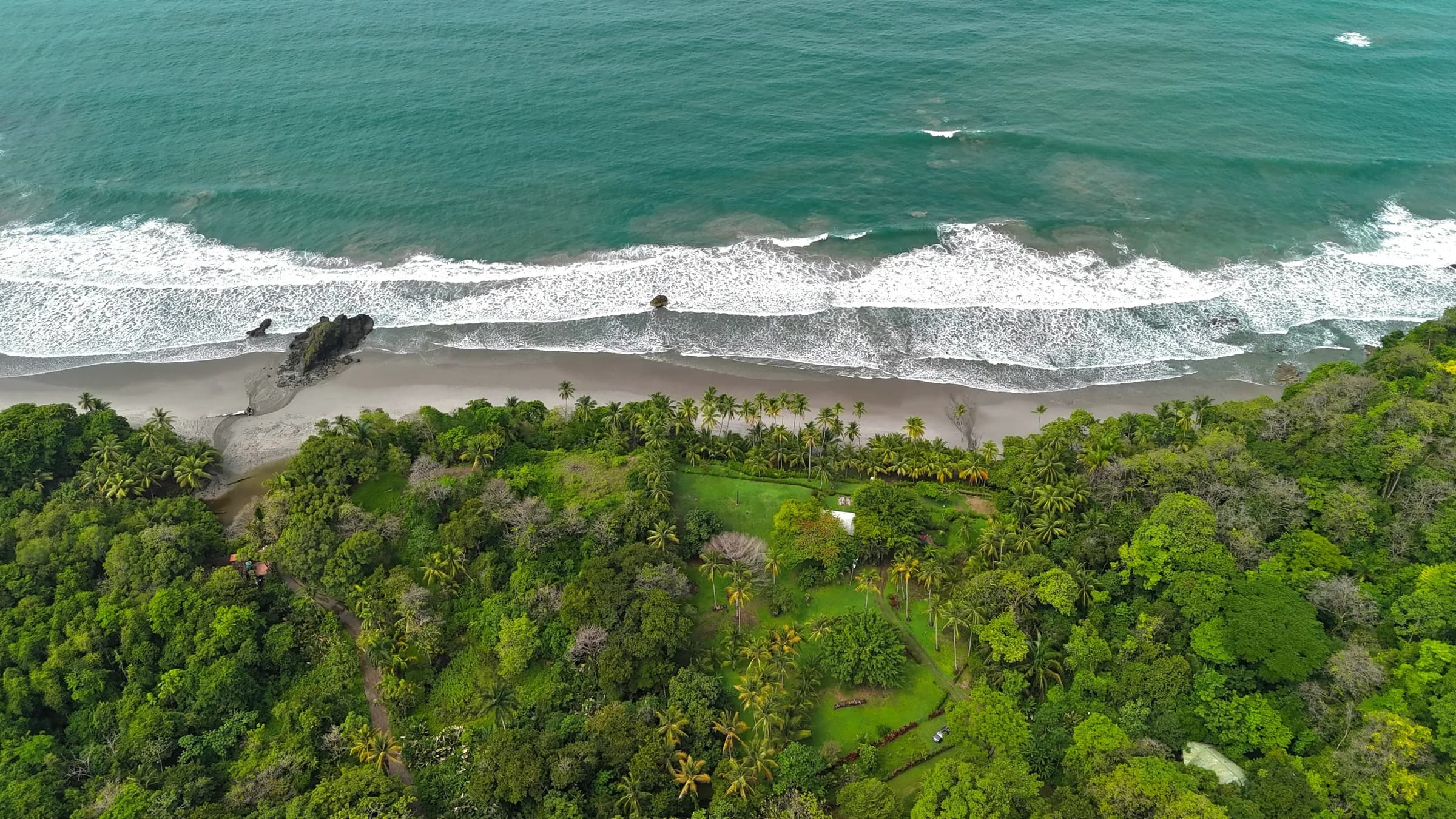
Manuel Antonio is the default and the right call for a first trip: 3.5 hours from Monteverde and 3 hours from San José, with the most wildlife-dense easy walk in the country and good hotel stock on the ridge. It's also the busiest — the 1,200 daily cap exists for a reason.
Papagayo and Guanacaste is the resort answer: dry, hot, reliable dry-season sun, the best big-hotel product in the country and the shortest airport transfer. Weakest for wildlife, strongest for families who want a pool for three days. Fly out of Liberia if this is your finish.
The Osa Peninsula is the serious one. Corcovado is the most biodiverse place in Costa Rica, and the Drake Bay lodges are small and remote. It needs the flight, three nights minimum, and many lodges close in September and October. Choose it if wildlife is the actual point — our Costa Rica adventure travel guide goes deeper on what the Osa involves.
Dry season or green season?
Dry season runs roughly December to April, green season May to November. The difference isn't sun versus rain — it's reliable mornings versus reliable mornings plus an afternoon downpour. In the green season it commonly doesn't rain at all on more than half the days. What actually changes:
- Prices and crowds. Late December through March is peak, with Christmas and Easter the spikes. May, June, September and October are materially cheaper.
- September and October are the wettest months on the Pacific — wet enough that many Osa lodges close. Don't build an Osa finish into those months.
- The Caribbean reverses the pattern. Puerto Viejo and Tortuguero are at their driest and sunniest in September and October, when the rest of the country is at its wettest — the single most useful piece of Costa Rican weather knowledge there is.
- Wildlife doesn't leave. Green-season Costa Rica has more frogs, fuller waterfalls and better light. Quetzal season in Monteverde is roughly January to May, which is a dry-season argument.
We work through the month-by-month case in the best time to visit Costa Rica. The short version: if you can choose, take late November to mid-December, or the second half of April.
Is the reverse routing better?
Frequently, and the deciding factor is your international airport. Run it in reverse — Liberia (LIR) in, coast first, then Monteverde, then Arenal, then San José out — and the drives get shorter at the start, when you're tired.
Reverse it if you can fly into Liberia. LIR to Papagayo is under an hour and LIR to Monteverde is 2 to 2.5 hours, both far gentler than San José to anywhere. You start on a beach on day one instead of losing a day to Alajuela, and your last drive is on the country's best road rather than its most winding.
Keep it as written if you're flying into San José, which most people are, and if you want the trip to build — volcano, cloud forest, ocean. Ending on the Pacific with three unstructured nights is the shape most couples ask for, which is why a lot of these become Costa Rica honeymoons; Juniper's eight-day honeymoon itinerary is the compressed version. One open-jaw option worth asking about: SJO in, LIR out, which removes a five-hour backtrack for very little more on most US carriers.
What do you cut for seven days, and add for fourteen?
For seven days, cut Monteverde. It's the region people are most attached to in advance and least sorry to lose. Arrival night, Arenal (3), Pacific coast (3) is an unhurried week with only two transfers, and you still get a volcano, a rainforest, hot springs and an ocean. For wildlife travelers, the alternative is to skip the coast: Arenal (3) plus Monteverde (3), the shortest drive time of any version. What does not work is San José, Arenal, Monteverde, Manuel Antonio and Guanacaste — five bases and four transfer days in a week.
For fourteen days, add one region, not three:
- The Osa Peninsula. Three or four nights at Drake Bay or Puerto Jiménez via the 50-minute flight. Corcovado with a guide is the best wildlife day in the country; avoid September and October.
- Tortuguero. The Caribbean canals, reached by boat and small plane, with green turtle nesting roughly July to October. Two or three nights — Juniper's fifteen-day Best of Costa Rica adds exactly this plus Guanacaste.
- Nosara or the Nicoya Blue Zone. Surf, yoga and a genuinely different pace, and the shape Juniper's wellness escape is built around.
Fourteen days also lets you slow the ten down: four nights in Arenal, three in Monteverde, four on the coast. With a multigenerational group that's usually a better use of the extra days than a fourth region — we make the case in our guide to multigenerational Costa Rica.
Who this suits — and who it doesn't
This itinerary is wrong for you if you want a beach holiday. There are three beach days in ten and seven days of early starts, humidity, guided walks and switchback roads. If what you actually want is a pool and an ocean view, book Papagayo for a week and skip the rest — it's a better trip than a bad version of this one.
It's wrong if anyone in the party gets carsick: four transfers, all winding. It's wrong if you need to see wildlife on demand — quetzals, sloths and the Arenal cone itself are weather-and-luck propositions, and a guide who promises them is overselling. And it's wrong if 6am starts are a dealbreaker, because every good wildlife hour in Costa Rica is before nine.
It suits people who want three genuinely different environments in one trip, who'll hire a naturalist guide rather than walk a trail alone, and who are content with one fixed thing a day. It suits families with children over about eight extremely well, and couples who want the trip to end on the ocean rather than start there.
How far ahead should you book?
Nine to twelve months for December through March, and further for Christmas and Easter — those two fortnights sell out first and price highest. The constraint is lodges, not flights: the properties worth staying at in Monteverde and on the Osa have eight to thirty rooms.
Four to six months is comfortable for May, June, September and October, the value months and, on the Caribbean side, the best ones. Naturalist guides book earlier than hotels — the good ones in Monteverde and Corcovado are spoken for well ahead. Book the Manuel Antonio park tickets and the Monteverde reserve entry as soon as your dates are fixed; both are capped daily and worth having in hand rather than negotiating at the gate.
Let our Costa Rica specialist build your itinerary
The route above is the skeleton. What makes it work is the detail that isn't on any booking site: which Arenal lodge actually has the volcano view rather than a view of the trees in front of it, which Monteverde guide finds the quetzal, and which three days to leave unplanned. That is what our Costa Rica specialists handle. Every Juniper trip is fully private and built from scratch around your dates — no group coaches, no fixed departures.
"This trip is fantastic! Excellent pace for the whole family and the sights are spectacular!" — Timothy H., verified Google review
Our Costa Rica itineraries typically run 7–12 days at $5,000–$15,000+ per person. Start with our custom Costa Rica trips, or Costa Rica honeymoons if this is a trip for two. For the season decision, read the best time to visit Costa Rica; for the budget, how much a Costa Rica trip costs; for the Osa and Corcovado version, Costa Rica adventure travel; and if you're bringing three generations, our multigenerational guide. Then book a free consultation and we'll adapt this to your dates before quoting anything.