Go in May or September. The reason is midges and daylight, not temperature — Scotland's warmest month, July, averages only 66°F in Edinburgh, so heat is never the variable. Midge season runs late April to the first frost and is worst in June, July and August on the west coast and in the Highlands. Edinburgh gets 17 hours 36 minutes of daylight at midsummer and 6 hours 57 minutes in late December. May and September sit either side of the bites.
Key takeaways
- Temperature is not the deciding factor. Edinburgh's warmest months average a high of 66°F and its coldest 44°F — a 22-degree spread, the smallest of any destination we plan.
- Midges are the deciding factor. The season starts in late April, peaks in July and August, and ends with the first hard frost, usually in October.
- Daylight is the other one. Edinburgh runs from 6 hours 57 minutes on December 21 to 17 hours 36 minutes on June 21, and the Highlands stretch both ends further.
- May is the sunniest month in the east. Edinburgh gets 50 mm of rain across ten days and 6.5 hours of sunshine a day — more than June, July or August.
- August in Edinburgh is a different city. The Fringe runs August 6–30 in 2027 and the Military Tattoo August 6–28. Rates double or worse and the Old Town is close to impassable.
- The heather peaks in mid-to-late August — the one strong argument for the worst midge month. Ling, the species that turns whole moors purple, runs from mid-August.
- West is far wetter than east. Edinburgh gets 730 mm of rain a year; Glasgow 1,360 mm and the west Highlands over 1,500 mm.
When is the best time to visit Scotland?
May, then September. Both give long days, workable weather and a country that isn't being bitten off you.
May is the stronger of the two if the trip is weighted toward the Highlands, Skye and the west. The midge season has technically started — late April is the usual emergence — but populations are small and the biting negligible until June. Edinburgh averages 6.5 hours of sunshine a day in May, more than any other month, and the days already run past sixteen hours.
September is the stronger choice for the Highland Games season, the heather still holding, and a warmer sea. The midges collapse through the month and the light turns. Edinburgh still averages 62°F, and September is drier than July or August at 55 mm.
What both avoid is the trap of assuming summer means good. June, July and August are Scotland's wettest, most crowded and most expensive summer months, and its worst for biting insects — for a temperature barely three degrees better than May.
What does Scotland look like month by month?
Temperatures and rainfall are Edinburgh averages; the west is wetter throughout.
| Month | High / rain | Daylight | Midges | What's on |
|---|---|---|---|---|
| January | 44°F / 65 mm | 7h 30m | None | Burns Night on the 25th. Two hours of sunshine a day. Castle-and-whisky weather. |
| February | 46°F / 55 mm | 9h 30m | None | Light returning fast. Snow on the Cairngorms; the quietest month for touring. |
| March | 49°F / 50 mm | 11h 45m | None | Clocks change and evenings open up. Lambing; ferries stepping up. |
| April | 53°F / 40 mm | 14h | First emergence, negligible | Driest month in Edinburgh. Excellent light, cold nights, properties reopening. |
| May | 58°F / 50 mm | 16h 15m | Present, not biting hard | The best month. Sunniest of the year at 6.5 hours a day. Empty single-track roads. |
| June | 63°F / 65 mm | 17h 30m | Bad on the west coast | Longest days of the year. Highland Games opening; midges arrive properly mid-month. |
| July | 66°F / 70 mm | 16h 45m | Peak | Warmest and wettest. Bell heather starting. Peak crowds on Skye. |
| August | 66°F / 70 mm | 15h | Peak | Fringe August 6–30 and the Tattoo August 6–28 in 2027. Heather at its best. |
| September | 62°F / 55 mm | 12h 45m | Falling fast | The other best month. Braemar Gathering, late heather, the rut beginning. |
| October | 56°F / 75 mm | 10h 30m | Over after first frost | Wettest month in Edinburgh. Autumn color in Perthshire; the rut in full swing. |
| November | 49°F / 65 mm | 8h 30m | None | Dark, wet, cheap. Two and a half hours of sunshine. Cities and distilleries. |
| December | 44°F / 65 mm | 7h | None | Shortest days — 6h 57m at the solstice, 1.5 hours of sunshine. Hogmanay on the 31st. |
How bad are the midges, really, and when?
Bad enough to end an evening, not bad enough to end a trip — provided you're in the right month and the right place. The Highland midge emerges in late April, becomes a genuine nuisance from mid-June, peaks in July and August, and dies back with the first hard frost, typically in October. Estimates put the peak-season population at around 180 trillion, and Scottish tourism is reckoned to lose about £268 million a year to travelers avoiding them.
Three things suppress them, and all three are plannable:
- Wind. Anything above about 5 mph grounds them. Exposed coast and ridges are fine when a sheltered glen is unbearable.
- Time of day. They feed at dawn, roughly 5 to 9 a.m., and dusk, 6 to 9 p.m. Midday is largely clear.
- Geography. Glen Coe, Fort William, Torridon, Skye and Argyll are worst; Edinburgh, the Borders, Fife and the east coast are drier and windier and have far fewer.
An August trip that stays east and coastal is barely affected; an August trip camping in Glen Coe is a different experience entirely. If you want the west Highlands and Skye at their best, that is the argument for May and September — see our guide to Skye's Trotternish Loop.
How much daylight do you actually get?
The range is extreme, and it changes what a day can hold. Edinburgh runs from 6 hours 57 minutes on December 21 to 17 hours 36 minutes on June 21. Move north and both ends stretch: Inverness gains roughly half an hour at midsummer, and Lewis and Shetland go past eighteen hours in June.
In June and July the sky never fully darkens in the north — the Scots call it the simmer dim — and you can walk a ridge at nine in the evening. In December a Highland day starts at half past eight and is finished by half past three, which is why a December trip has to be built around cities, castles and distilleries rather than touring.
Should you avoid Edinburgh in August?
Yes, unless the festivals are the reason you're going — in which case go, and plan a year ahead. In 2027 the Edinburgh Festival Fringe runs August 6 to 30 and the Royal Edinburgh Military Tattoo August 6 to 28, on the theme "The Same Heart Beat", with the International and Book Festivals overlapping. The city's population effectively doubles, the Royal Mile becomes a slow-moving crush, and hotel rates go to two or three times their May level.
That isn't a criticism of the festivals, which are worth building a trip around. It's a warning against arriving in August for unrelated reasons and finding the castle a two-hour queue. If your trip is about the Highlands, put Edinburgh in May or September. If the Tattoo is the point, read our guide to the Military Tattoo and book the moment tickets release — 2027 seats went on sale in August 2026.
When does the heather bloom?
Bell heather colors the hills from July; ling — the one that turns whole moors purple — runs from mid-August into early September, peaking in the second half of August.
This is the one genuine tension in our recommendation: the best heather and the worst midges are the same fortnight. If the purple hills are what you came for, take the second half of August, stay east or on exposed coast, and accept the trade. Otherwise the first two weeks of September usually still have color on the high ground with a fraction of the biting.
Does the best time depend on the region?
Yes, and along the east–west axis rather than north–south.
- The east — Edinburgh, Fife, Aberdeenshire, the Borders. Driest and least midge-affected, workable April to October. Edinburgh's 730 mm a year is less than Rome's.
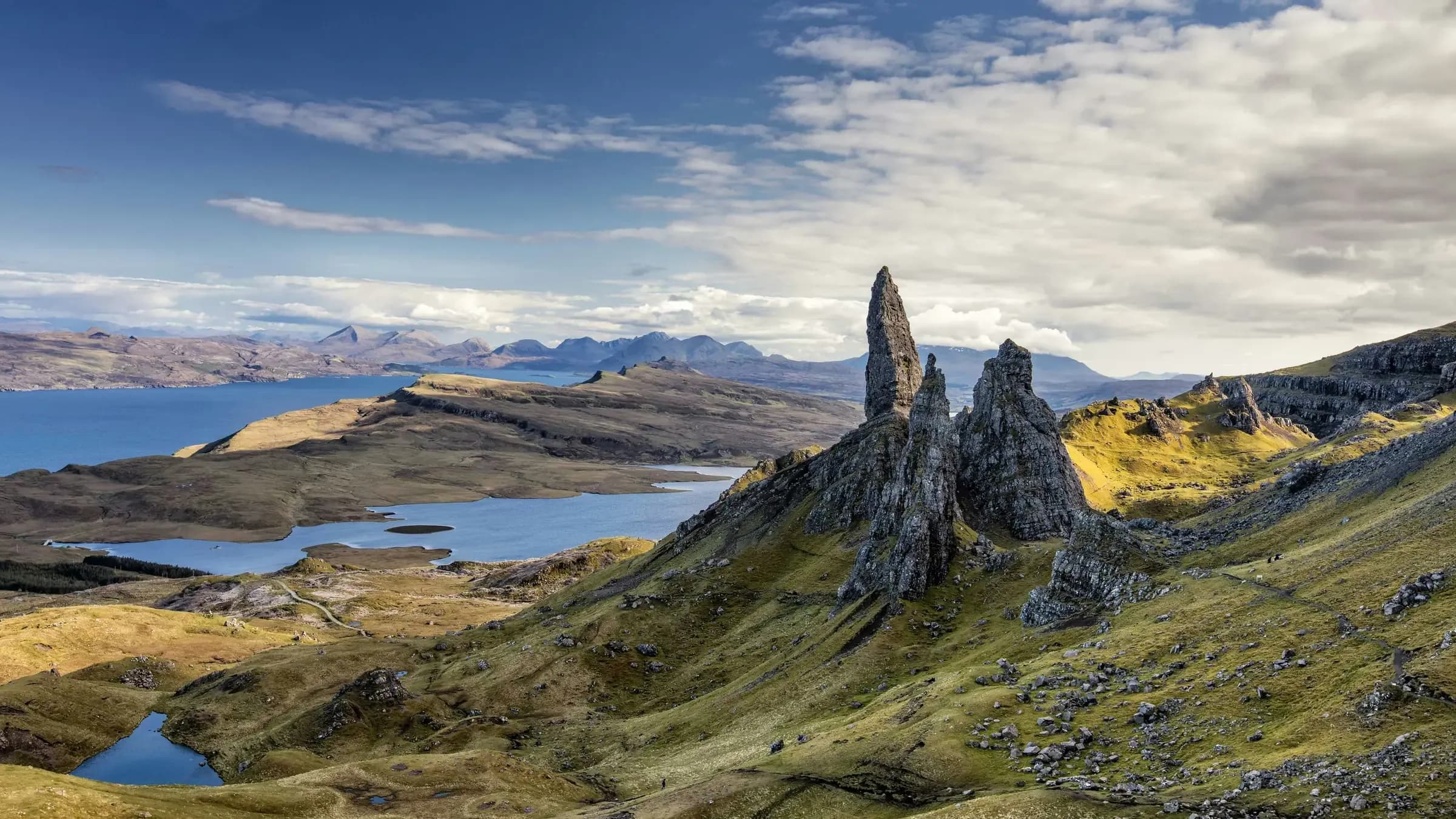
- The west Highlands and Skye. The most beautiful and the most constrained: over 1,500 mm of rain a year and the worst midges in Britain. May and September are not a preference here, they're the answer. The same goes for the North Coast 500, at its most crowded in July and August.
- The islands — the Hebrides, Orkney, Shetland. Windy enough that midges are less of a problem than the mainland west, but ferry-dependent. May to September; May and June for the machair in flower.
- The Cairngorms and Speyside. Colder and drier than the west, excellent in September and October, and the only part of Scotland with a real winter season.
What is the cheapest time to visit Scotland?
November through February, excluding Hogmanay. Airfare from the US bottoms out and Highland hotels that stay open discount heavily. Rates can run 50–60% below August.
The cost is daylight: seven hours of it in December, and 1.5 hours of actual sunshine a day. That's a fair trade for a city-and-distillery trip and a poor one for touring. The best-value month that is still a proper Scotland month is late April into early May — shoulder pricing, the driest weather of the year, sixteen hours of light and no midges to speak of.
What is the best time to avoid crowds?
Late April to mid-May, and the second half of September into October. Both sit outside the international peak and the UK school holidays, with ferries running and enough daylight to drive on. Peak crowding is narrower than people expect: July and August, concentrated on Skye, the NC500, Loch Ness and Edinburgh. If someone tells you Scotland is overrun, they mean five places are.
So when should you go, for what you want?
| What you want | Go | Why |
|---|---|---|
| The best all-round trip | May, or September | Long days, driest weather, either side of peak midge season |
| The Highlands and Skye without midges | Late April to end of May | Populations still small; 16 hours of daylight, empty roads |
| Heather in bloom | Mid-August to early September | Ling turns the moors purple; peak in the second half of August |
| Edinburgh's festivals | August 6–30, 2027 | Fringe and Tattoo overlap; book a year ahead, expect peak rates |
| Highland Games | June to early September | The Braemar Gathering is the first Saturday in September |
| Red deer rut and autumn color | Late September to October | The glens at their most dramatic; midges finished |
| Lowest prices | November to February, excluding Hogmanay | Rates well below summer, but seven hours of daylight |
Who this suits — and who it doesn't
Scotland is wrong for you if you need warmth. The warmest month averages 66°F, and it rains on 128 days a year in the drier east and more in the west. There is no season you can plan around sunshine. If a wet day would ruin the trip rather than change it, this is the wrong country.
It's also wrong for travelers who won't tolerate inconvenience. Island ferries cancel in weather, single-track roads are slow, and midges will find you between June and September however carefully you plan.
It suits walkers, drivers, whisky people and anyone who responds to weather rather than being defeated by it — travelers who like short distances and constant change, a city in the morning and an empty sea loch by lunch. And it suits couples, because May and September are when the small castle hotels and Highland lodges are actually available.
How far ahead should you book?
For May and September, nine to twelve months. The constraint is the small properties — the eight-room Highland lodges, the castle hotels, the good rooms on Skye, which has very limited quality inventory and sells out earliest.
For August, twelve months if Edinburgh is on the itinerary at all: festival accommodation is booked a year out. For June and July, eight to ten months, with the NC500 and Skye the pinch points.
For October through March, three to five months is comfortable. A February week in Edinburgh and Speyside can be put together in six.
Let our Scotland specialist time your trip
The difference between a good Scotland trip and a frustrating one is rarely the itinerary — it's the week. Being on Skye in May rather than July, keeping Edinburgh out of the Fringe fortnight, putting the exposed coast on the evenings the glens would be unbearable. Taryn Harrison, our Scotland specialist, CMSC certified with 25 years of European itinerary design, plans around those constraints. Every Juniper trip to Scotland is fully private and built from scratch around your dates — no group coaches, no fixed departures.
"Taryn did an amazing job planning our trip to Scotland. I had never been out of the country and was totally overwhelmed thinking about it. I told her that I was interested in castles and my granddaughter was interested in Harry Potter and she took that information and ran with it. We had an excellent trip and a wonderful time." — Becky Hale, verified Google review
Scotland itineraries with us typically run 7–12 days and between $5,000 and $15,000 per person, with castle stays and boutique hotels, private guides and transfers arranged end to end. Start with our custom Scotland trips, or, for two people, Scotland honeymoons. If the Games are what you're timing around, read why you should go for the Highland Games; if you're weighing Scotland against its neighbor, see our Scotland and Ireland tours. When you're ready, book a free consultation — we'll tell you plainly whether the week you've picked will give you the Highlands you're imagining.