Switzerland has two seasons worth the money and two that aren't. Go mid-December to early April for snow, or late June to late September for the mountains. Avoid late April into May and November: that's when cable cars shut for maintenance — Grindelwald First closed October 26 to November 27 in 2026 — the high passes are still under snow, and the Glacier Express stops running entirely, as it did from October 11 to December 4, 2026.
Key takeaways
- The high passes open late and close early. In 2026 the Gotthard opened May 8, the Furka and Grimsel May 29, the Susten June 12. A May driving itinerary over the Alps is a gamble.
- The Glacier Express does not run year-round. Its 2026 summer timetable ran May 2 to October 10, then nothing until winter service began December 5, running to May 7, 2027.
- November is the emptiest month in the Alps, and not in a good way. Most cable cars are shut for maintenance, the passes are closed, and Zurich gets 60 hours of sunshine all month against 225 in July.
- Late April to mid-May is the other dead zone. Lower resorts have closed, higher lifts are in maintenance, and trails above about 6,000 feet are still under snow.
- Some mountains never close. Jungfraujoch, the Schilthorn cableways, Matterhorn Glacier Paradise and Titlis run 365 days a year. Build a shoulder-month trip around those.
- Alpine wildflowers peak at altitude in June, after the valley meadows in May. The hiking season runs mid-June to mid-October, with snow lingering high into early July.
- The same resort is two different products. Zermatt averages 33°F in January and 68°F in July. Wengen, Grindelwald and Mürren sell skiing in one half of the year and hiking in the other.
When is the best time to visit Switzerland?
Two right answers, and you have to pick one. Late June through late September is the mountain-summer answer: passes open, trails clear, every lift running, lake swimming, long days. Mid-December through early April is the snow answer.
Between those, September is the best single month. Zurich still runs 66°F highs and Zermatt 60°F, the crowds have gone, the trails are at their most reliable of the year, and everything is still operating. July and August are warmer — Zurich 76°F, Zermatt 68°F — but also Switzerland's wettest, at 130 mm in Zurich, most of it afternoon thunderstorms.
What makes Switzerland unusual is that the shoulder season isn't a compromise, it's an absence. In Italy or Greece the off-months are quieter versions of the same country. Here the infrastructure that makes the country worth visiting is physically switched off for weeks at a time.
What does Switzerland look like month by month?
Zurich stands in for the lowland plateau, Zermatt for the high Alps at 5,300 feet. Both are average daily highs.
| Month | Zurich / Zermatt high | What's running | Crowds |
|---|---|---|---|
| January | 38°F / 33°F | Full ski season. The plateau sits under fog, the mountains above it in sun. | High in resorts, low in cities |
| February | 41°F / 35°F | Best-balanced ski month: deep snow plus returning daylight. Half-terms push rates up. | Peak in resorts |
| March | 50°F / 42°F | Spring skiing at altitude, long days, softer snow low down. Lower resorts start closing. | Moderate |
| April | 58°F / 50°F | Ski season ends at most resorts, lift maintenance begins, passes firmly shut. | Low |
| May | 66°F / 57°F | Valley wildflowers, but high trails snowbound and many lifts closed. Furka opened May 29 in 2026. | Low |
| June | 72°F / 64°F | Alpine wildflowers at their peak. Susten opened June 12 in 2026; hiking begins mid-month. | Building |
| July | 76°F / 68°F | Everything open. Warmest and joint-wettest at 130 mm in Zurich, mostly afternoon storms. | Peak |
| August | 75°F / 67°F | Swiss National Day on the 1st. Lake swimming, passes reliable, huts fully staffed. | Peak |
| September | 66°F / 60°F | Best month for hiking: reliable trails, thinning crowds, everything still running. | High, easing fast |
| October | 57°F / 52°F | Larch color in the Engadine. Passes close late; the Glacier Express stopped October 10 in 2026. | Low |
| November | 46°F / 41°F | The dead month. Most lifts in maintenance, passes closed, 60 hours of sun. Cities only. | Lowest |
| December | 39°F / 35°F | Higher resorts open from mid-month; Christmas markets. Glacier Express winter service from December 5. | Rising sharply from the 20th |
When do the high passes actually open?
Later than most itineraries assume, and there is no national opening date. Each canton clears its own passes and reopens them when snow clearance and avalanche assessment are done, so the date moves two or three weeks year to year. The 2026 benchmark:
- Gotthard Pass: opened May 8
- Furka Pass: opened May 29
- Grimsel Pass: opened May 29
- Susten Pass: opened June 12
Closing comes in late October or early November — Uri closed both the Furka and the Susten on October 27, 2025. Switzerland Tourism describes the Furka's driving season as June to October, which is the honest version.
The planning consequence is specific: any self-drive route crossing the central Alps — the Lucerne–Andermatt–Valais loop, most of the Grand Tour's mountain sections — doesn't work before June and needs a plan B after mid-October. Nufenen, Klausen, Umbrail and the Great St Bernard follow the same pattern. Confirm status with the cantonal road authorities or TCS before committing to a driving day.
When does the Glacier Express run, and when does it stop?
It has two timetables and a gap. In 2026 summer service ran May 2 to October 10, up to four departures a day each way. Then nothing from October 11 to December 4. Winter service began December 5, 2026 and runs to May 7, 2027, at one or two trains a day.
People miss this constantly. The Glacier Express is why a lot of Switzerland itineraries exist, and the eight weeks it isn't running fall exactly in the autumn window Americans like to travel. If late October is your only option, the route is still coverable on regular Matterhorn Gotthard Bahn and Rhaetian Railway services — same scenery, no panoramic glass.
Fares: CHF 159 second class or CHF 272 first class one-way, plus a compulsory CHF 54 seat reservation. Excellence Class carries a CHF 540 supplement and runs only on trains 902 and 903. Full detail in our guide to the Glacier Express.
What actually closes in the between-seasons months?
Swiss mountain transport shuts for maintenance twice a year, roughly mid-April to mid-May and late October through late November. Some 2026 examples:
- Grindelwald First cableway: closed October 26 to November 27
- Grindelwald–Männlichen and Wengen–Männlichen: closed October 26 to December 11
- Mürren–Allmendhubel funicular: closed October 19 to December 11
- Pilatus and the Gornergrat railway: closed October 19 to November 27, and November 2 to 14, respectively
What doesn't close is the escape hatch. Jungfraujoch runs 365 days a year, as do the Schilthorn cableways from Mürren, Matterhorn Glacier Paradise, Titlis and Säntis. A November trip built around those, plus cities and lakes, is a real trip. One built around a generic "we'll take the cable cars" plan is not.
When is alpine wildflower season?
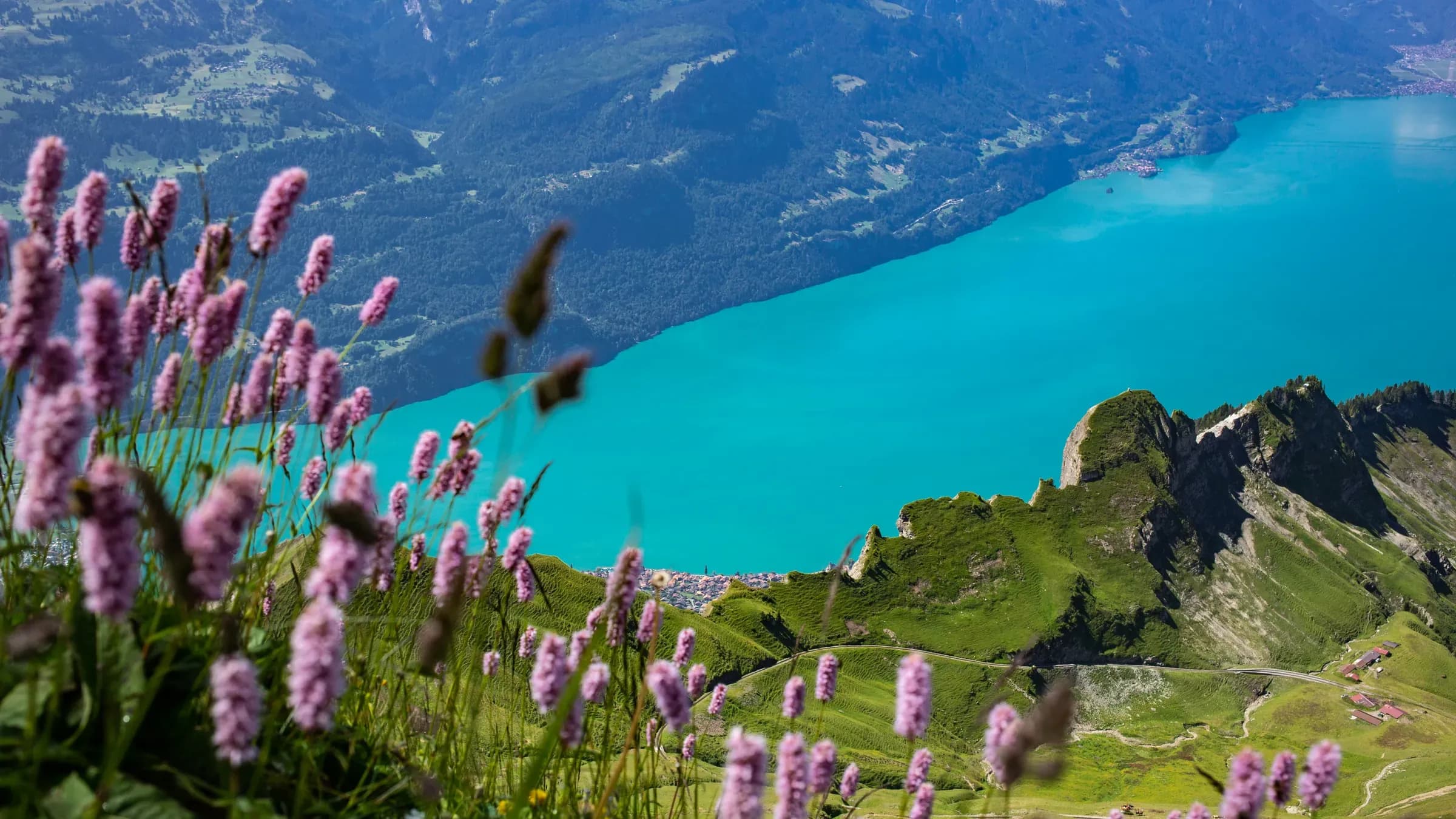
Late May in the valleys, June at altitude. Meadows below about 4,000 feet flower from May; the high alpine meadows — gentian, alpenrose, orchids — come three to four weeks later, peaking through June and into early July above 6,000 feet.
This is the one genuinely good argument for June, which otherwise sits awkwardly between seasons: flowers at their best, most lifts open and prices below July. What it doesn't reliably give you is the high passes — the Susten didn't open until June 12 in 2026 — or clear trails above the tree line. September is the mirror image: no flowers, but the most stable trail conditions of the year. If the trip is about walking, take September; if it's about the meadows, take late June.
Is a Swiss resort better in winter or summer?
Neither, and that's the useful part: Zermatt, Grindelwald, Wengen, Mürren and St Moritz sell two different products at similar prices, and the choice is about you.
Winter gives you skiing, short days and higher rates around Christmas, New Year and February half-term. It also gives you the plateau inversion: Zurich under fog for days while Wengen sits above it in sun — a real reason to be in the mountains in January rather than the cities.
Summer gives you the hiking network, which is the best in the world and the actual reason to come, plus long daylight, lake swimming and mountain huts. Zermatt in July averages 68°F, and the lift that carries skiers in February carries walkers to a trailhead in August.
If you've never been and you're not a skier, come in summer. Switzerland's winter is excellent, expensive and does one thing; its summer does five. The longer case is in reasons to visit Switzerland in the summer; the winter version is Best of Switzerland Winter.
What is the cheapest time to visit Switzerland?
November, and the first three weeks of December. Then late April into early May. Those are the months when resort hotels either close or discount hard and the cities, which stay fully functional, sit at their lowest rates of the year.
Switzerland has no cheap season in absolute terms, only a less expensive one. Labor, food and rail costs don't move with the calendar, and a mountain hotel discounting 30% in November is still a Swiss mountain hotel. What varies is the resort peak: Christmas, New Year and mid-February carry the highest rates of the year, often double the same room in June. We go through where the money actually goes in how much a luxury Switzerland trip costs.
What is the best time to avoid crowds?
Late September and early October if you want quiet plus a functioning country. Walking crowds thin dramatically after the first week of September, trails are at their best, and everything runs until the October closures begin. The other quiet window inside a working season is the second half of January, after the New Year wave and before the February half-terms: reliable snow, softer rates, noticeably calmer resorts. November is quieter than either, but that's because there's less to do, not because you've found an edge.
So when should you go, for what you want?
| What you want | Go | Why |
|---|---|---|
| Hiking | Mid-June to mid-October, ideally September | Trails clear, huts staffed, most reliable conditions of the year |
| Alpine wildflowers | Late June to early July | High meadows peak three to four weeks after the valleys |
| Skiing | Mid-December to early April, best in February | Deep snow plus returning daylight; higher resorts open first |
| Driving the high passes | Mid-June to mid-October | Furka and Grimsel opened May 29 in 2026, Susten June 12 |
| The Glacier Express in summer form | Early May to mid-October | Four daily departures; no service mid-October to early December |
| Lakes and lake swimming | July to mid-September | Warmest air and water; Zurich averages 76°F in July |
| Lowest prices | November, or late April to early May | Resorts discount or close; cities at their annual low |
| Fewest people in a working season | Late September, or late January | Everything running, crowds gone, rates off peak |
| Christmas markets | Late November to December 23 | Basel, Zurich and Montreux; the mountains are still shut |
Who this suits — and who it doesn't
Switzerland is wrong for you if you want a country you can improvise in. The whole thing runs on a timetable, and the timetable has holes: passes that open on a date the canton decides in May, cable cars shut for five weeks in autumn, a flagship train with an eight-week gap. If you like to arrive and see what happens, you'll spend this trip finding out what isn't running.
It's also wrong for anyone whose budget assumes a shoulder-season discount. There isn't one worth having: the cheapest months are cheap because the mountains are closed, and a Switzerland trip without the mountains is some very pleasant lakeside cities at Swiss prices.
It suits people who like being outside and don't mind planning — walkers, skiers, train people, photographers — and travelers who value things working. It suits couples who want two or three properties and a slow pace, because Switzerland rewards staying put in one valley far more than moving.
How far ahead should you book?
For July through September, nine to twelve months. The constraint is the mountain-village properties: the good hotels in Wengen, Mürren, Zermatt and the Engadine have small room counts and no ability to expand, and they sell their summer first. Glacier Express Excellence Class seats also go early.
For Christmas, New Year and February half-term, twelve months — the highest-demand weeks in the Alps, booked a year out by returning guests. For mid-January and March, four to six months is workable and you'll pay less. For June, five to eight months, built so a late pass opening doesn't break the itinerary.
Let our Switzerland specialist time your trip
Switzerland is the destination where timing is least forgiving and most checkable. Whether the Furka is open, whether the Grindelwald lifts are in maintenance your week, whether the Glacier Express is running at all — these aren't judgment calls, they're facts someone has to look up before the itinerary is committed. Lexi Blade, who leads our Switzerland trips from Florence, watches exactly that calendar. Every Juniper trip to Switzerland is fully private and built from scratch around your dates — no group coaches, no fixed departures.
"Everything planned by Juniper Tours went incredibly smoothly. Every driver and guide was wonderful." — Hailey M., verified Google review
Switzerland itineraries with us typically run 8–12 days and between $5,000 and $15,000+ per person, with hand-selected mountain and city stays, private guides and every rail segment arranged end to end. Start with our custom Switzerland trips, or, for two people, Switzerland honeymoons. If you're costing the trip out, read how much a luxury Switzerland trip costs. When you're ready, book a free consultation — we'll check what's actually open in your window before we quote anything.
Planning a trip to Switzerland
Juniper Tours designs private, custom Switzerland itineraries — never group tours, never fixed departures. Most run 8–12 days and fall between about $5,000 and $15,000+ per person, with hand-selected 4- and 5-star stays, private guides and transfers arranged end to end. Planned by Lexi Blade. The 30-minute consultation is free; a $100 planning deposit begins your itinerary. See our private Switzerland tours →