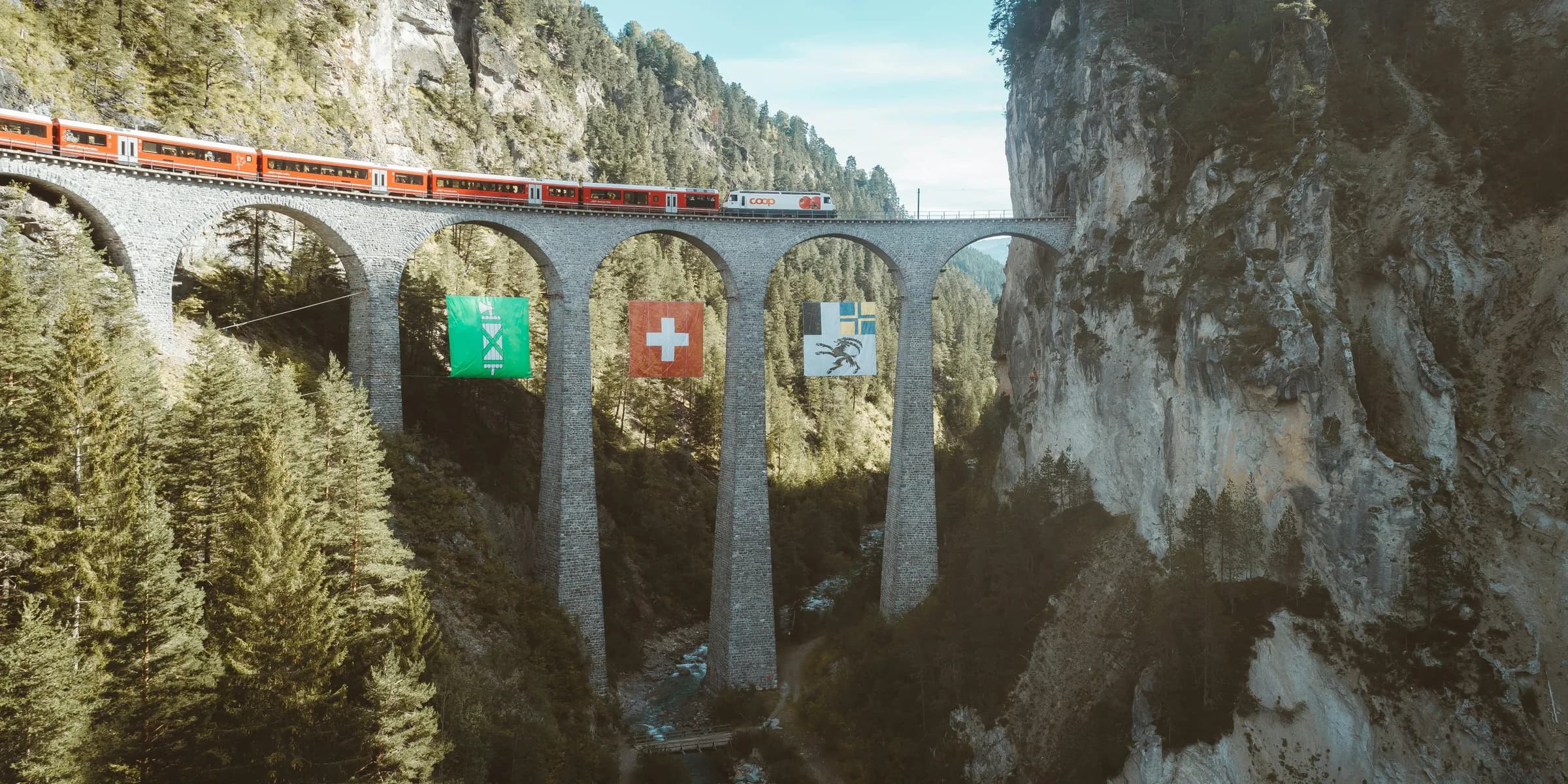
Ten days by rail covers Zurich, Lucerne, the Bernese Oberland, Zermatt and one full scenic-train day. The route below is nine nights, five bases and six named trains, finishing with the Glacier Express — 290 km in about 7 hours 30 minutes. Reservations on it are compulsory at CHF 54, an 8-day Swiss Travel Pass is CHF 439 second class, and a rental car is a liability on at least four of these ten days.
Key takeaways
- Five bases, nine nights, one single-night stop. Zurich (1), Lucerne (2), Bernese Oberland (3), Zermatt (2), St Moritz (1). The Oberland gets three because two only buys you one mountain day.
- The Glacier Express requires a compulsory seat reservation — CHF 54 in first or second class, on top of a fare of CHF 159 second / CHF 272 first Zermatt to St Moritz. Excellence Class reservation is CHF 540 and includes a five-course lunch.
- The Glacier Express did not run 11 October to 4 December 2026. Summer service ran 2 May–10 October 2026; winter runs 5 December 2026–7 May 2027. The same autumn gap recurs each year.
- The Bernina Express also requires reservations — CHF 36 high season, CHF 32 low — and is a different trip: 144 km, 4 hours, 55 tunnels, 196 bridges, topping out at Ospizio Bernina at 2,253 m. It's a 14-day addition, not a 10-day one.
- Pilatus is seasonal. The cogwheel railway from Alpnachstad ran 11 May to 29 November 2026. Outside those dates you go up by cable car from Kriens, or swap to Rigi or Titlis.
- An 8-day Swiss Travel Pass is CHF 439 second class, CHF 697 first (2026 prices, the first rise since 2024). It covers the Glacier Express fare but not the reservation, and gives 25% off Jungfraujoch and 50% off Pilatus.
- Zermatt, Wengen and Mürren are car-free. Cars stop at Täsch, 12 minutes short of Zermatt. Book 9–12 months ahead for July, August and the Christmas–New Year fortnight.
What does a 10-day Switzerland rail itinerary cover?
Switzerland is small and its trains are extraordinary, which fools people into over-scheduling. Everything is technically reachable — and then you spend your holiday changing at Spiez. Ten days done well is four regions and one big rail day, not eight regions and six.
The route runs Zurich in, west and south through Lucerne and the Bernese Oberland to Zermatt, then east across the Alps on the Glacier Express to St Moritz and back north to fly: one long traverse instead of three out-and-backs. Expect $5,000–$15,000 per person, with a well-built ten days in good hotels typically landing at $9,000–$14,000 per person; we break the numbers down in how much a luxury Switzerland trip costs. Juniper's Switzerland Grand Rail Tour is the twelve-day version with six legendary trains; Best of Switzerland — Summer is the eight-day compression.
What is the 10-day rail route, day by day?
Day 1: Arrive Zurich. One night. The airport train reaches Zurich HB in about 10 minutes. Do nothing ambitious — the Old Town, the lake, an early dinner. Our 24 hours in Zurich guide is built for this night.
Day 2: Zurich to Lucerne. Morning in Zurich, then the train to Lucerne, about 45–50 minutes, two or three times an hour. Afternoon on the Chapel Bridge and along the Reuss, and an evening lake steamer if the weather is with you.
Day 3: Pilatus. The Golden Round Trip: boat across Lake Lucerne to Alpnachstad, the cogwheel railway to the summit at 2,119 m, cable cars down to Kriens. CHF 119.80 second class, CHF 42 with a Swiss Travel Pass; three to four hours. Between 30 November and 10 May the cogwheel is closed — go up by cable car both ways, or swap to Rigi or Titlis.
Day 4: Lucerne to the Bernese Oberland. The Luzern–Interlaken Express over the Brünig line, about 1 hour 45 minutes past Sarnen, Lungern and Brienz — one of the loveliest ordinary trains in Europe, no reservation needed. Then up into the Lauterbrunnen valley to Wengen or Mürren; both are car-free and both beat staying in Interlaken itself.
Day 5: Jungfraujoch. Go early; the first connections are quiet and the cloud usually builds by midday. From Interlaken the fastest routing via the Eiger Express gondola is 1 hour 37 minutes, the classic cogwheel route via Kleine Scheidegg 2 hours 7 minutes. The gondola itself is about 15 minutes from Grindelwald Terminal to Eigergletscher. The station at 3,454 m is the highest in Europe: around CHF 227 return in high season, roughly 10% less outside it, 25% off with a Swiss Travel Pass. Seat reservations are mandatory May to August.
Day 6: The valley on foot. The day people remember. Schilthorn and Piz Gloria from Mürren, the Männlichen–Kleine Scheidegg path, or the walk down from Wengen past the Staubbach Falls. Leave it unbooked and decide over breakfast, based on the cloud base.
Day 7: Bernese Oberland to Zermatt. About 2 hours 15 minutes with two changes: Interlaken Ost–Spiez 22 minutes, Spiez–Visp 26, Visp–Zermatt 1 hour 6. Hourly, roughly 6am to 8pm, no reservation. Arrive by early afternoon and go straight up the Gornergrat Bahn — the Matterhorn is usually clearest first and last thing.
Day 8: Zermatt. A full day: Matterhorn Glacier Paradise by cable car, the Five Lakes Walk from Blauherd, or the Gornergrat again if yesterday clouded out. Zermatt is car-free and walkable, and the one place here where an unstructured day beats a booked one.
Day 9: The Glacier Express. Zermatt to St Moritz, just over 290 km in about 7 hours 30 minutes, over the Oberalp Pass at 2,033 m, through the Rhine Gorge and across the Landwasser Viaduct. Morning departure, late-afternoon arrival. Bring a book anyway — the middle two hours are the weakest.
Day 10: St Moritz to Zurich, and out. About 3 hours 20 minutes via Chur, with a walk around the Engadine lakes first if your flight allows.
What does the route look like in one table?
| Day | Base | Rail leg | Highlight |
|---|---|---|---|
| 1 | Zurich | Airport–Zurich HB, ~10 min | Old Town and the lake; nothing scheduled |
| 2 | Lucerne | Zurich–Lucerne, 45–50 min | Chapel Bridge; evening lake steamer |
| 3 | Lucerne | Golden Round Trip, boat and cogwheel | Pilatus summit, 2,119 m |
| 4 | Wengen or Mürren | Luzern–Interlaken Express, ~1h45 | The Brünig line; into the Lauterbrunnen valley |
| 5 | Wengen or Mürren | Eiger Express, 1h37 from Interlaken | Jungfraujoch, 3,454 m — Europe's highest station |
| 6 | Wengen or Mürren | Local cable cars only | Schilthorn or the Männlichen ridge walk |
| 7 | Zermatt | Interlaken–Spiez–Visp–Zermatt, 2h15 | Gornergrat Bahn for the Matterhorn at dusk |
| 8 | Zermatt | — | Matterhorn Glacier Paradise or the Five Lakes Walk |
| 9 | St Moritz | Glacier Express, ~7h30 | Oberalp Pass, Rhine Gorge, Landwasser Viaduct |
| 10 | Depart | St Moritz–Zurich via Chur, ~3h20 | Engadine lakes before the train |
Which scenic trains need seat reservations?
This is the question that costs people their itinerary. Panoramic trains and ordinary trains follow different rules, and a Swiss Travel Pass covers the fare on both but the reservation on neither.
| Train | Route | Duration | Reservation |
|---|---|---|---|
| Glacier Express | Zermatt–St Moritz | ~7h30 | Compulsory. CHF 54 (1st or 2nd); CHF 540 Excellence |
| Bernina Express | Chur–Tirano | ~4h | Compulsory in panoramic cars. CHF 36 high / CHF 32 low |
| GoldenPass Express | Montreux–Interlaken | 3h15 | Optional in 1st and 2nd; compulsory in Prestige (CHF 49) |
| Luzern–Interlaken Express | Lucerne–Interlaken | ~1h45 | Not required |
| Gornergrat Bahn | Zermatt–Gornergrat | ~33 min | Not required |
| Jungfrau Railway | Interlaken–Jungfraujoch | 1h37–2h07 | Mandatory May–August; optional September–April |
The practical rule: reserve the Glacier Express and the Bernina Express the day your dates are fixed, reserve Jungfraujoch if you're travelling May to August, and don't bother with anything else. Ordinary Swiss intercity trains have no reservations at all — you turn up, you get on, it leaves within a minute of the timetable.
The seasonal traps matter as much. The Glacier Express takes its maintenance gap each autumn, Pilatus's cogwheel is a summer-and-shoulder proposition, and the Grindelwald–Kleine Scheidegg and Wengen–Kleine Scheidegg sections take breaks in May and November respectively. None of these stop the trip; they change which day does what.
Is the Swiss Travel Pass worth it on this route?
Generally yes. 2026 adult prices are CHF 254 for 3 days, 309 for 4, 399 for 6, 439 for 8 and 499 for 15 second class; first class is 405 / 492 / 634 / 697 / 787. The Flex version costs about 15% more and is only worth it if you'll skip public transport on several days — on this itinerary you won't.
An 8-day consecutive pass at CHF 439 covers every rail leg on this route outright, plus boats, buses and museum entry, then gives 25% off the Jungfraujoch section and 50% off Pilatus. Where it stops paying is if you plan to sit still: three Oberland nights with a pass you're not using is money left on the table, and a Half Fare Card plus point-to-point tickets can beat it on a slower trip.
Where is a rental car actually a liability?
On most of this itinerary, for four concrete reasons. Zermatt is car-free — you stop at Täsch, park in the Matterhorn Terminal's 2,100 covered spaces and take the shuttle train, 12 minutes over about 5 km, every 20 minutes — so you pay for a car that sits in a garage for two days. Wengen and Mürren are car-free too, same problem in Lauterbrunnen. The Glacier Express is a one-way traverse, and a car left in Zermatt is 300 km from you in St Moritz, with punitive one-way drop fees. And city parking in Zurich and Lucerne is the worst-value thing in the country, in two entirely walkable cities.
Where a car earns its place: Appenzell, the Emmental, Gruyères and the smaller Valais side valleys, which the trains reach slowly or not at all. That's a good trip — it just isn't this one.
Is the reverse routing better?
Often, and the deciding factor is your flights. Run it Geneva in, Zurich out and it looks like this: Geneva, a night in Montreux on Lake Geneva with the Château de Chillon, the GoldenPass Express to Interlaken in 3 hours 15 minutes — one train now, thanks to gauge-changing bogies, so no change at Zweisimmen — three nights in the Bernese Oberland, Zermatt, the Glacier Express east, home from Zurich.
Reverse it if your transatlantic routing favours Geneva, which for a lot of US departures it does, and if you'd rather start on a lake than in a city.
Reverse it in winter. The Montreux–Lavaux end works year-round and looks good in low light, whereas Pilatus's cogwheel is shut from 30 November to 10 May and the Lucerne lake steamers thin out. Juniper's Best of Switzerland — Winter uses exactly this shape.
Keep it as written if you want the Glacier Express as the climax rather than a mid-trip leg, and if you're travelling June to September when Pilatus and the high paths are all open. Ending in the Engadine also puts the Bernina Express within reach if you can add a day.
What do you cut for seven days, and add for fourteen?
For seven days, cut the eastern traverse. Zurich (1), Lucerne (2), Bernese Oberland (3), out from Zurich, with a Golden Round Trip and a Jungfraujoch day. You lose the Matterhorn and the Glacier Express and keep a trip that breathes. The alternative, if the Matterhorn is non-negotiable: Zurich (1), Bernese Oberland (3), Zermatt (3), out via Geneva — fewer trains, two mountains, no Lucerne.
What does not work in seven days is Zurich, Lucerne, Interlaken, Zermatt, St Moritz and Geneva. We're asked for it regularly. It is six bases in six nights and a week spent on platforms.
For fourteen days, add the southeast:
- The Bernina Express and Ticino. St Moritz or Chur to Tirano — 144 km, 4 hours, 55 tunnels, 196 bridges, over Ospizio Bernina at 2,253 m, on a UNESCO-listed line built 1896–1904. Continue by bus to Lugano for two or three nights. Two daily trains in summer, one in winter.
- Lake Geneva and the Lavaux. Montreux, Chillon, the terraced vineyards and the GoldenPass Belle Époque up to Zweisimmen. Two or three nights, and the food improves noticeably.
- Northern Italy. Juniper's Switzerland & Italian Alps runs twelve days through Zurich, Lucerne, Interlaken, Zermatt, Milan, Lake Como and Cortina. Tirano sits on the border precisely so you can do this.
Who this suits — and who it doesn't
This itinerary is wrong for you if you want to unpack once — five bases in ten days, and Swiss hotels do not have porters waiting at every mountain station. It's wrong if you can't manage luggage on and off trains: the changes at Spiez and Visp are four minutes each, level but brisk. Book SBB's station-to-station luggage forwarding, or bring less.
It's wrong if seven and a half hours on the Glacier Express sounds like a chore, which for some people it honestly is. And it's wrong if you're going to ski: this is a summer and shoulder-season route, and winter Switzerland is a different itinerary with fewer bases.
It suits people who like trains as an experience rather than a means, who are content with one big thing a day, and who'd rather do the Lauterbrunnen valley for three days than tick four cantons. It suits walkers strongly, and couples — Wengen, Mürren and Zermatt are three of the best two-person bases in Europe, which is why a lot of these become Switzerland honeymoons.
How far ahead should you book?
Nine to twelve months for July, August and the Christmas–New Year fortnight. The binding constraint is hotels, not trains: the good properties in Wengen, Mürren and Zermatt are small, family-run and booked by returning guests before they're advertised.
Six months is comfortable for June, September and early October — and September is arguably the best month here, with the paths open, the crowds thinned and the Glacier Express running until 10 October. Scenic-train reservations open on a different clock, roughly 90 days ahead, so lock the hotels first and diarise the reservation date.
Let our Switzerland specialist build your rail itinerary
The route above is the skeleton. What makes it work is the detail no booking site shows you: which side of the Glacier Express carriage faces the Rhine Gorge, whether Wengen or Mürren suits how you actually walk, and which Zermatt hotel is five minutes from the Gornergrat station rather than twenty uphill. Lexi Blade, our Switzerland lead specialist, has run this country more than ten times and designs the Alpine itineraries, including the versions that connect Switzerland to Italy. Every Juniper trip is fully private and built from scratch around your dates — no group coaches, no fixed departures.
"Everything planned by Juniper Tours went incredibly smoothly. Every driver and guide was wonderful." — Hailey M., verified Google review
Our Switzerland itineraries typically run 8–12 days at $5,000–$15,000 per person, with June to September the core season and December to February the winter one. Start with our custom Switzerland trips, or Switzerland honeymoons if this is a trip for two. For the budget, read how much a luxury Switzerland trip costs; for the arrival night, things to do in Zurich in 24 hours; and for the big train itself, our Glacier Express guide. Then book a free consultation and we'll adapt this to your dates before quoting anything.
Planning a trip to Switzerland
Juniper Tours designs private, custom Switzerland itineraries — never group tours, never fixed departures. Most run 8–12 days and fall between about $5,000 and $15,000+ per person, with hand-selected 4- and 5-star stays, private guides and transfers arranged end to end. Planned by Lexi Blade. The 30-minute consultation is free; a $100 planning deposit begins your itinerary. See our private Switzerland tours →