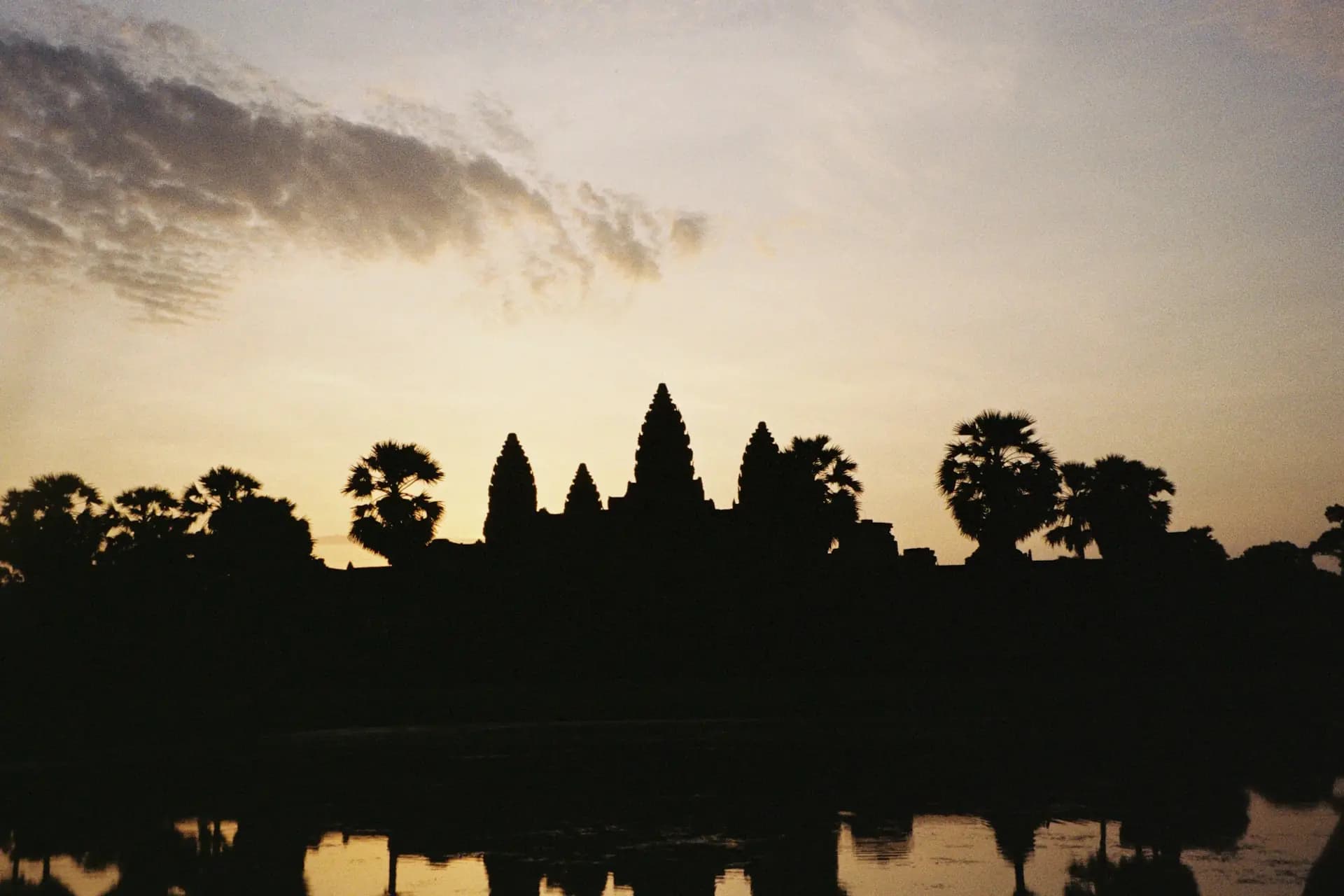
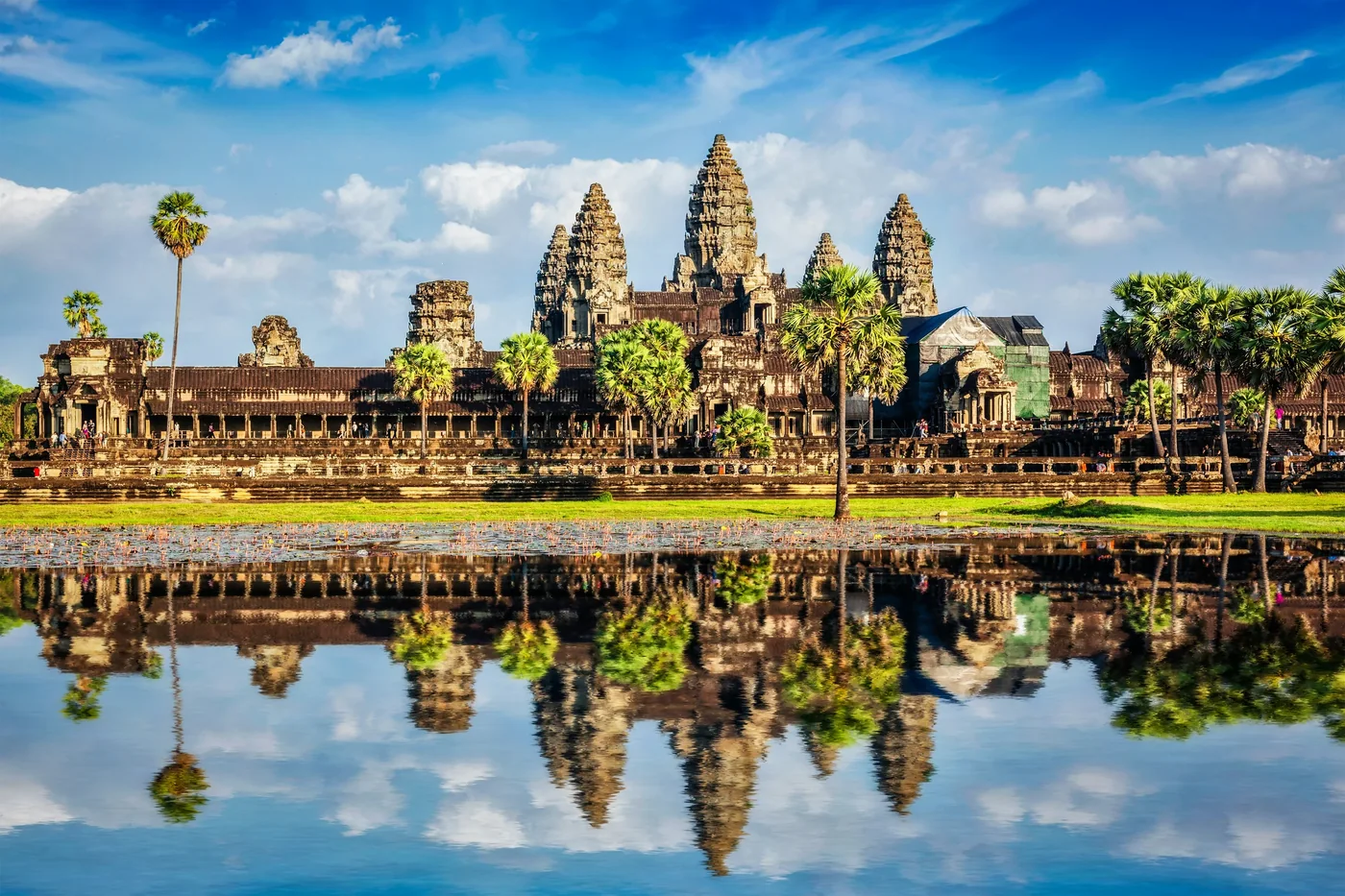
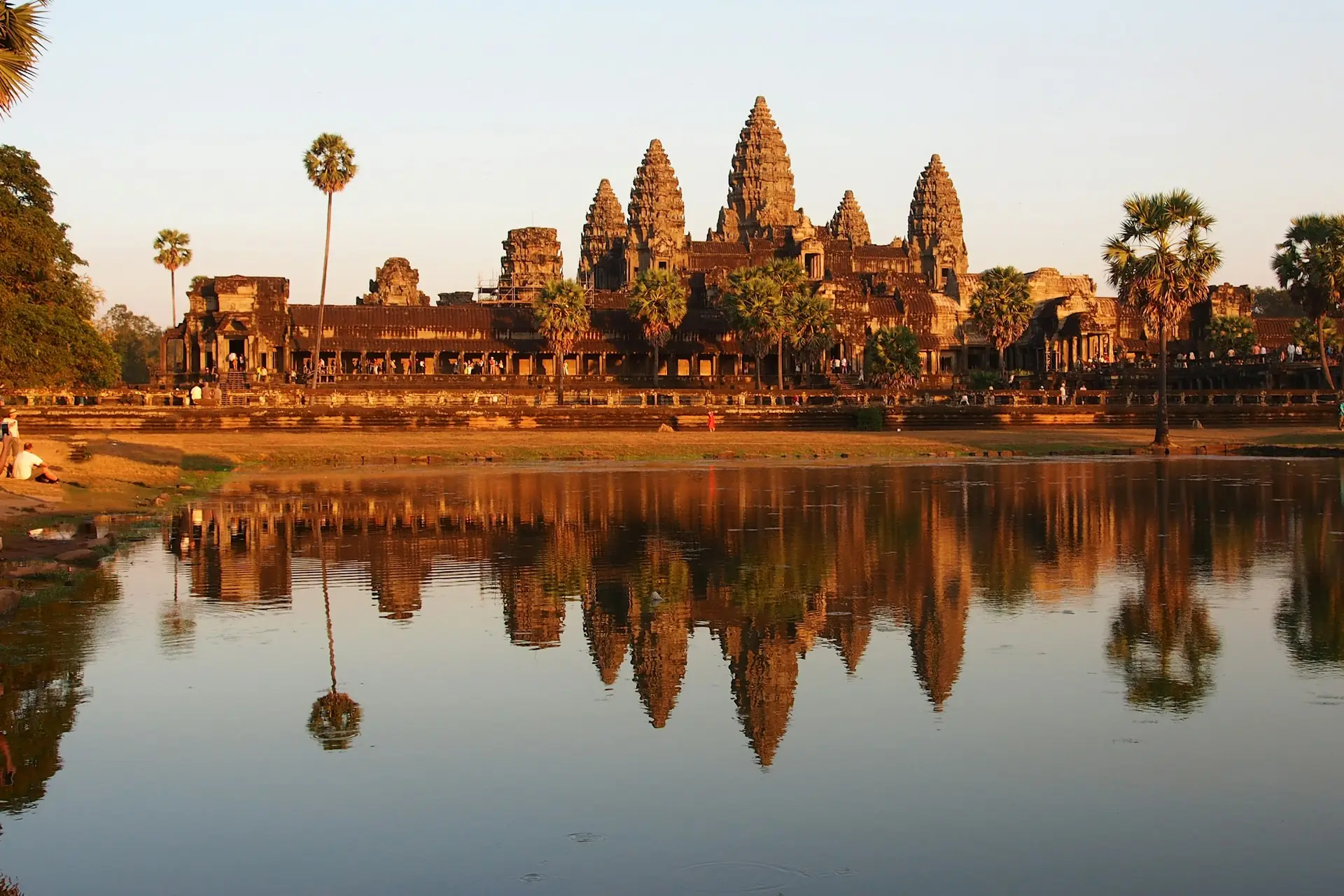
Angkor Wat faces west. That single architectural decision, made in the twelfth century, is why several hundred people are standing behind two reflection pools in the dark every single morning: it is one of the only great monuments on earth that the sun rises directly behind. When the sky goes from black to indigo to burnt orange and the five towers resolve out of the darkness — doubled in the pool in front of you — you understand why nobody hits snooze in Siem Reap.
Here is the honest version of how that morning works, what it costs, and the trick that makes the whole experience dramatically better.
How the sunrise morning actually works
The Angkor Archaeological Park opens its gates at 5:00 AM. You leave your hotel in Siem Reap around 4:30, cross the moat causeway by flashlight, and claim a spot behind the northern reflection pool — the classic mirror-image view. Depending on the season, the sun clears the towers anywhere from about 5:35 to 6:30 — the month-by-month table below has the exact windows. Then, and this is the part most people miss: the temple itself is open, and the crowd that watched sunrise mostly leaves for breakfast. The hour right after dawn — galleries of bas-reliefs to yourself, light still soft — is quietly better than the sunrise.
Angkor sunrise times by month
Siem Reap sits close to the equator, so the numbers barely move year to year — mid-month figures, local time:
| Month | First light | Sunrise |
|---|---|---|
| January | 6:08 | 6:31 |
| February | 6:05 | 6:27 |
| March | 5:51 | 6:12 |
| April | 5:30 | 5:52 |
| May | 5:16 | 5:38 |
| June | 5:14 | 5:37 |
| July | 5:22 | 5:45 |
| August | 5:29 | 5:51 |
| September | 5:32 | 5:53 |
| October | 5:33 | 5:55 |
| November | 5:41 | 6:03 |
| December | 5:56 | 6:19 |
Read it against the 5:00 AM gate: from November through February, sunrise is 6:00–6:30, so entering at 5:15–5:30 still gets you a front-row pool spot with time to spare. From April through October, first light arrives within half an hour of the gates opening — be at the entrance at 5:00 sharp, because the sky is already turning by the time you reach the pools. Times shift a few minutes across each month; they are astronomical, not seasonal guesses, so you can plan a proposal around them.
Is Angkor Wat at sunrise worth it?
Once — absolutely, crowds and all. It is the largest religious monument in the world and a UNESCO World Heritage Site, and the reflection-pool dawn is one of travel’s genuinely earned cliches. What we tell Juniper travelers is to treat it as a two-morning strategy: sunrise at Angkor Wat on day one, then on day two use the same early start against the crowd — be at Ta Prohm when it opens, while everyone else is back at the reflection pools. Ta Prohm — the temple the jungle is slowly reclaiming, strangler-fig roots pouring over the doorways — in near-silence at 6 AM is, for many of our travelers, the moment that beats the famous one. The vast stone faces of the Bayon in Angkor Thom work the same way.
What to know before the 4:30 AM start
Dress for the temple, not the hour: shoulders and knees covered is the rule for sacred areas, and it is enforced at the Bakan — Angkor Wat’s steep upper tier — which opens later in the morning and is worth the climb once the crowd thins. Bring a small flashlight for the causeway, insect repellent for the pool-side wait, and skip the drone: flying over Angkor requires permits that casual visitors will not get. Coffee carts and noodle stalls appear near the entrance by first light; breakfast after the empty-galleries hour, not before it.
North pool or south pool?
Both reflection pools face the towers; the northern pool draws the bigger crowd because the classic postcard angle lives there. The southern pool is usually thinner and the composition is nearly identical — and from either, the show improves if you turn around occasionally: the light moving up the causeway behind you is half the spectacle. If the sky is flat gray, do not write the morning off; some of the best photographs at Angkor happen in the moody ten minutes after a failed sunrise, when almost everyone has left.
What does an Angkor pass cost?
Tickets are sold by Angkor Enterprise, the official operator: $37 for one day, $62 for three days, and $72 for seven days. The three-day pass does not need to be used on consecutive days — it is valid across a ten-day window (the seven-day pass across thirty), which suits the two-morning strategy perfectly. Buy online in advance from Angkor Enterprise — the official and only legitimate seller — or at the official ticket center; you will want the pass in hand the night before a sunrise start, not in a queue at 4:50 AM.
When is the best time to visit Angkor?
November through February is the classic window — dry, relatively cooler, and the reflection pools are full. March and April turn seriously hot; sunrise starts stop being optional and become survival strategy. The green season, roughly May through October, is underrated: the moats and pools brim, the stone glows against storm skies, and afternoon rain conveniently arrives after the morning temple hours are done. Whatever the month, the rhythm in Siem Reap is the same — temples early, pool and spa in the afternoon heat.
How we build Cambodia into a trip
Most of our travelers pair Angkor with Thailand or Vietnam rather than flying across the world for Cambodia alone. Our Thailand & Cambodia Highlights itinerary is the template: Bangkok’s temples and river life, then two to three nights in Siem Reap with a private guide who knows which gate, which pool, and which hour — and our Grand Tour of Southeast Asia goes bigger for couples with more time. Everything is private and custom, built with the on-the-ground team we work with across Southeast Asia, so the 4:30 AM logistics — driver, guide, tickets, cold towels afterward — are simply handled.
If Angkor is on your list, start with our Thailand & Southeast Asia pages or book a free consultation — we will tell you honestly how many days it deserves in your trip, and make sure you are standing in the right spot when the sky starts to turn.