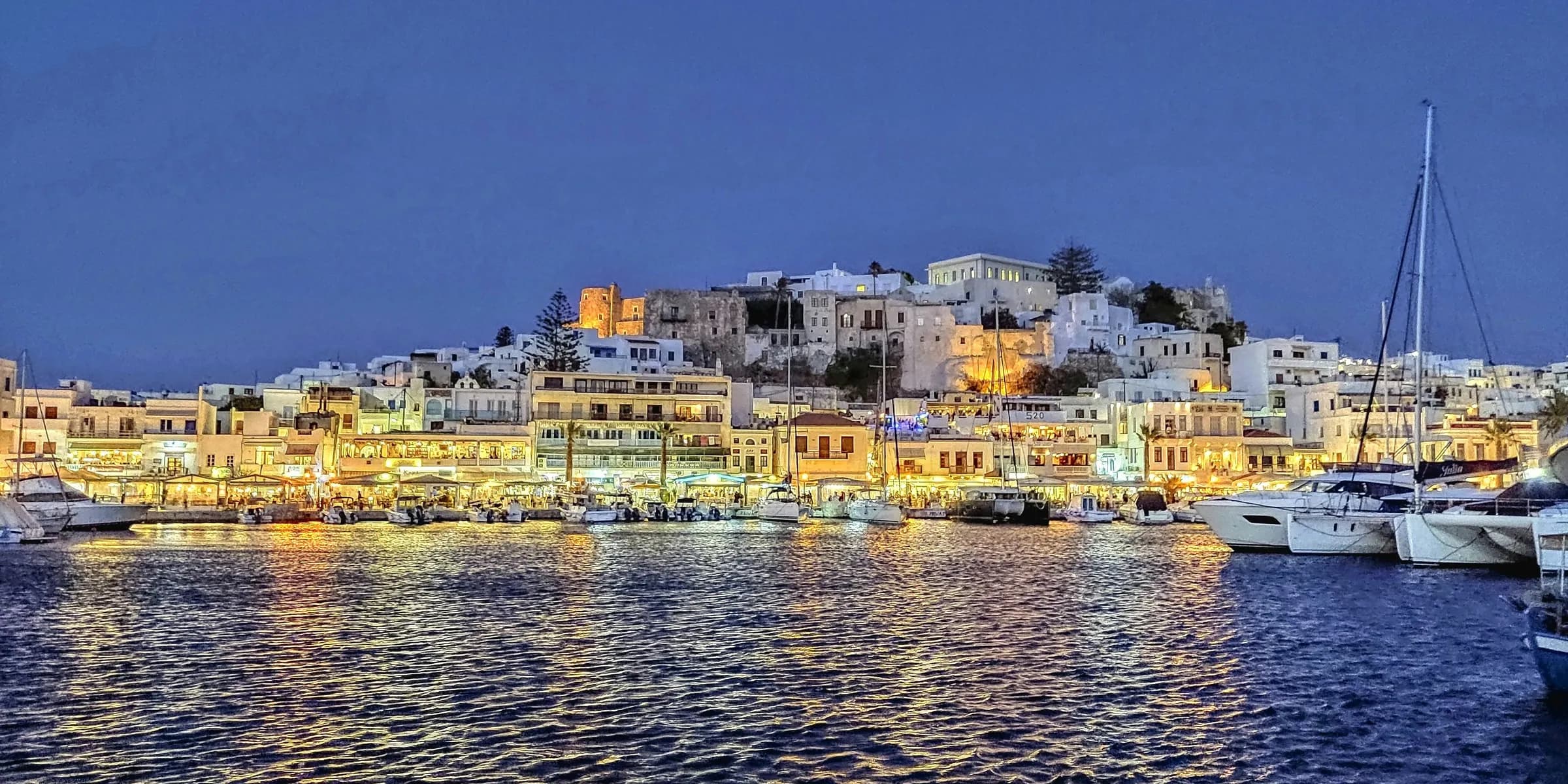
Santorini is the wrong Greek island for a multigenerational group. Its caldera villages are built on steps — the old stair from Fira to the port is 588 steps — and hotel rooms sit down flights no porter can shortcut. Choose Crete, Naxos, Paros or Rhodes instead: flat towns, real roads, villa inventory and, on Naxos and beyond, sea-access ramps installed on over 250 Greek beaches. Budget $5,000 to $15,000+ per person.
Key takeaways
- Santorini's geography is the problem, not its crowds. The Karavolades stairs from Fira down to the old port are 588 steps, steep and slippery with marble-edged rims. Caldera hotels are stacked down a cliff face, and the rooms with the view are the ones furthest down.
- Crete is the best all-round island for three generations. It is large enough to have real roads, hospitals, supermarkets and villa inventory, with flat old towns in Chania and Rethymno and beaches on both coasts.
- Naxos has a sea-access ramp at Agia Anna. Greece's Seatrac system — solar-powered, remote-operated and usable without an assistant — is installed on over 250 beaches nationally, including Agia Anna on Naxos and Perissa on Santorini.
- Fly to the big islands; ferry only between neighbors. Piraeus to Naxos is about 5 hours on a conventional ferry (€42–€72.50) or 3 hours 30 on a high-speed (€69.70–€72.30), with at least three sailings a day in summer.
- A villa beats a hotel above six people, and decisively in Greece, where dinner rarely starts before 8:30 and a kitchen is the only way the youngest and oldest eat on their own clock.
- Rhodes is the accessibility outlier and Paros the compromise. Rhodes has resort infrastructure, flat beach fronts and level promenades; Paros gives the Cycladic look without the Cycladic terrain.
Which Greek islands actually work for a group with grandparents?
Island suitability for a mixed-age group comes down to three things almost nobody checks: whether the town you walk in every evening is flat, whether a vehicle can reach the door of where you sleep, and whether getting there is one journey or three. Santorini and Mykonos fail all three. Crete, Naxos, Paros and Rhodes pass.
| Island | Why it works for three generations | Watch for |
|---|---|---|
| Crete | The best all-round choice. Real infrastructure — hospitals, supermarkets, a fast north coast road. Flat Venetian old towns in Chania and Rethymno. Deep villa inventory. Two airports with direct flights from Athens | Large enough that base choice matters; the south coast is a long drive from the north; the Samaria Gorge is a serious hike, not a family walk |
| Naxos | The most self-sufficient Cyclades island. A long flat sandy west coast, a real agricultural economy, good food, and a Seatrac ramp at Agia Anna. Chora is walkable at ground level | The Kastro quarter above Chora is stepped; the mountain villages are a switchback drive |
| Paros | The Cycladic look without the Cycladic terrain. Naoussa and Parikia are flat at the waterfront; excellent ferry connections; broad hotel and villa supply | Busy in August; the interior villages such as Lefkes are stepped |
| Rhodes | The most accessible island in Greece. Large international-standard resorts, flat beach fronts and level promenades, built for a market that includes older travelers | The medieval Old Town is cobbled and uneven; Lindos village is steep and its acropolis is a climb |
| Santorini | Almost nothing, for this group | Caldera villages are stair systems; see below |
Why is Santorini the wrong island for this trip?
Because the thing that makes Santorini beautiful is a cliff, and everything worth seeing is arranged vertically on it. Start with the number everyone quotes and few think through: the Karavolades stairs from Fira to the old port at Gialos are 588 steps, steep, with marble-edged rims that get slippery, and shared with donkeys. The cable car is the sensible alternative and is one bottleneck for the whole cruise-ship population of the town. But the stairs are only the famous instance of the problem: the caldera villages — Fira, Firostefani, Imerovigli, Oia — are terraced settlements on a near-vertical face.
- Hotel rooms are down flights of steps from the road, not up an elevator from a lobby. A caldera-view room routinely means dozens of steps down from where the taxi stops, carrying your own bags, with every trip out that climb in reverse.
- There is no flat evening walk. The pleasure of Oia at sunset is a stepped, crowded path with drop-offs and no railing in places.
Two honest qualifications. Santorini has a Seatrac sea-access ramp at Perissa on the flat black-sand side, so the island is not accessibility-free. And a determined group can do it properly: base on the flat southeast around Perissa or Kamari and visit Oia once, by vehicle, in the late afternoon, without staying there. What does not work is booking a caldera cave hotel for a family of nine and hoping. Our guide to the best Greek islands to visit covers the comparison for couples, where Santorini's case is much stronger.
Ferry or flight for a group of eight?
Fly to the big islands; ferry only between neighbors. Ferries are romantic in the abstract and demanding with eight or ten people — luggage across an open vehicle deck, boarding on a ramp with a crowd behind you, and a schedule subject to wind cancellations that can strand a group for a day. In July and August meltemi winds cancel high-speed sailings regularly; large conventional ferries sail in conditions the fast catamarans will not.
| Route | Mode | Duration | Notes |
|---|---|---|---|
| Athens (Piraeus) to Naxos | Conventional ferry | Around 5 hours | €42–€72.50; at least three sailings a day in summer; more stable in wind |
| Athens (Piraeus) to Naxos | High-speed ferry | 3 hours 30 | €69.70–€72.30; more prone to cancellation in meltemi conditions |
| Athens to Crete or Rhodes | Flight | About 1 hour | The clear choice for a group; multiple daily services |
| Naxos to Paros | Ferry | A short hop | The one ferry leg genuinely worth doing with a group |
The rule that follows: one island, or two neighbors. Each change is a ferry or flight plus two transfers plus a check-in, which is most of a day. Two practical notes: book numbered seats in an upper lounge, not deck class, because a five-hour crossing on a bench with a four-year-old is a different experience; and pre-book private transfers at both ends, since the taxi rank at a Cycladic port when a large ferry unloads is not a plan.
Villa or hotel for a Greek island group?
Villa, above six people, and the case is stronger in Greece than almost anywhere. The decisive factor is dinner: Greek kitchens frequently do not serve before 8:30 or 9 p.m. and island tavernas fill later still — a delightful rhythm for adults and an impossible one for a five-year-old and a grandparent who eats at six. A villa kitchen resolves it: children and grandparents eat simply at 6:30 on the terrace, and the adults walk into town at 9.
- Pools. A private pool matters more in Greece than most destinations, because midday July and August heat is genuinely unsuitable for young children and elderly travelers. The pool is where 11 a.m. to 5 p.m. happens.
- Shade and air conditioning. Verify both in writing. Older villas frequently have air conditioning in the bedrooms only — fine for sleeping, irrelevant at 3 p.m.
- Access. Ask three questions: is the final approach paved, how many steps from parking to the front door, and is there a bedroom and bathroom on the entrance level. Greek villas are commonly built across levels on a slope, and listings show the view rather than the stairs.
- Distance to a town. A villa 25 minutes from the nearest taverna means a designated driver on unlit island roads every evening. Ten minutes beats a better view.
Where a hotel wins: on Rhodes and Crete, the large resorts are genuinely good for three generations — kids' clubs, several restaurants with different service times, level access throughout, lifeguarded pools and a doctor on call. If nobody wants to cook or drive, this is the format, and it is better executed in Greece than the word "resort" suggests to an American ear.
How accessible are Greek beaches?
Better than they were. Greece has installed the Seatrac sea-access system on over 250 beaches: a solar-powered track that carries a user from the beach into the sea. You transfer from your wheelchair onto the seat, take the remote and operate it yourself — no attendant needed — and it is typically installed for summer only. Documented locations include Agia Anna on Naxos, Perissa on Santorini, Paleokastritsa on Corfu and Koukounaries on Skiathos. Crete has provision at Elafonisi through a different system. Installations move year to year, so confirm the beach for your dates.
Beyond the ramps, the rule for a group with a walker or wheelchair: organized beaches beat wild ones. A beach with a taverna, sunbed rows and a boardwalk has by definition a hard surface from the car park to the water, shade, a toilet and somewhere to sit. A beautiful empty cove down a goat path has none of those. Naxos's west coast — Agia Anna, Plaka, Agios Prokopios — is a long run of organized sandy beach with shallow entry, close to ideal for a group spanning a three-year-old and a seventy-eight-year-old. Our guide to the best beaches in Greece covers the wider list.
How do you build a split day on a Greek island?
The Greek split day is easier than most, because the beach is a natural reconvening point.
- Beach morning, split afternoon. Everyone at the beach from 9 to noon. Then the teenagers stay for windsurfing lessons, the young children and grandparents go back for the pool and a nap, and the adults take a boat or a village.
- Mountain village day. Parents and teenagers drive up to Halki or Apiranthos; grandparents and small children stay at sea level in Chora for the flat waterfront and the Portara at sunset, one of the few Cycladic landmarks reachable on level ground.
- Boat day as the whole-group activity. A private day boat is the single best three-generation activity in the Greek islands: everyone is on the same vessel, the swimmers swim, the non-swimmers sit in the shade, and it removes walking entirely. Specify a swim platform and a ladder with handrails, and shade over half the deck.
On vehicles: two mid-size cars, not a van. Island roads are narrow, village parking is scarce, and a nine-seater cannot get through Chora. Book automatics far ahead — island fleets are overwhelmingly manual and automatics sell out for July and August months in advance. On Crete, where distances are real, add a private driver for the long transfers.
Which Greek island activities suit which ages?
| Activity | Young kids (3–8) | Teens | Adults | Grandparents with limited mobility |
|---|---|---|---|---|
| Organized sandy beach (Agia Anna, Plaka) | Excellent | Excellent | Excellent | Excellent — boardwalks, shade, shallow entry, Seatrac at Agia Anna |
| Private day boat with swim stops | Excellent | Excellent | Excellent | Excellent with a ladder and handrails; confirm boarding |
| Naxos Chora waterfront and the Portara | Good | Good | Excellent | Good — the causeway is level |
| Oia at sunset | Difficult — crowds and drop-offs | Excellent | Excellent | Not advisable |
| Fira to old port stairs (588 steps) | Not advisable | Doable and unpleasant | Doable | Not possible; use the cable car |
| Lindos acropolis, Rhodes | Hard — steep and hot | Excellent | Excellent | Not possible; the beach below is excellent |
| Knossos, Crete | Fine — short and open | Good | Excellent | Mixed — uneven ground and raised walkways |
How do meals work across three generations in Greece?
Greek food is the easiest part; Greek timing is the hardest. The cuisine is built on shared plates, so everyone eats what they want from the same table without anyone ordering a separate children's meal. Grilled meat, chips, bread, tomato, feta, yoghurt, plain rice — a fussy six-year-old eats well without negotiation. Vegetarians do genuinely well; strict vegans should note that yoghurt, feta and honey are everywhere.
The timing problem is structural: island tavernas often do not begin dinner until 8:30, and locals eat at 10. Three responses. Make lunch the group meal — a long taverna lunch at 2 p.m. by the water is the best hour of a Greek family day and takes the pressure off the evening. Split the evening: villa dinner at 6:30 for the youngest and oldest, taverna at 9 for the adults and teenagers. And find the one taverna that opens early, which in most island towns is a beachfront place serving continuously from lunch. Ask the villa manager on day one, not day five. One thing is genuinely easy: Greek restaurants are unreservedly welcoming to children and large tables.
Who this suits — and who it doesn't
A Greek island trip with three generations is wrong for you if the images that sold the trip are Santorini's. That conflict is worth surfacing in the family group chat before anyone books, because the caldera villages are the most photographed places in Greece and the least suited to this group. If Santorini is non-negotiable, base on the flat southeast and accept that the cave hotel with the plunge pool is not happening this trip.
It is wrong in August if you have any flexibility: peak heat, peak European holidays, peak prices, and meltemi winds that cancel high-speed ferries. June and late September are materially better — warm sea, thinned crowds, everything still open.
It is wrong if the plan is island-hopping. Three islands in ten nights is a good trip for two people in their thirties; for nine across three generations, each hop costs a day.
It is also wrong if anyone needs guaranteed medical proximity and the base is a small island. For a group with a genuine medical consideration, Crete or Rhodes are the responsible choices — both have full hospitals and direct flights out.
Who it does suit: a group that wants a villa, a pool, a beach with a taverna on it, and one long lunch a day.
How far ahead should you book?
For 2027, ten to twelve months for a July or August villa and eight to ten for June or September. Villas are the constraint: a property sleeping ten with a pool, air conditioning throughout, a paved approach and a bedroom on the entrance level is a small subset of the island market, and the best rebook with returning families before they list. Flights matter more in Greece than most destinations because the domestic legs are the bottleneck — Athens to the islands in July and August has finite capacity, and nine seats on one morning aircraft is not always available late. Book in this order: villa, international flights, domestic flights, transfers, then boats and experiences.
Let our Greece specialists plan your family's trip
Kaycee Shields, our Italy, France and Greece specialist, paces Greek itineraries — which, for a group of nine, is the entire game — and builds them with logistics and dietary requirements arranged in advance rather than improvised at the table. She will tell you which island your group should be on, and it may not be the one on the mood board. Every Juniper trip is fully private and built from scratch — no group coaches, no fixed departures.
"I took the most amazing girls trip to Greece, and everything was handled for us from start to finish." — Shawneen T.
Start with custom Greece tours. Our Athens and the Cyclades itinerary shows how the mainland-and-island split gets built, and our Greece itinerary guide covers the routing. For choosing between islands, read the best Greek islands to visit and the best beaches in Greece; for the mainland bookend, top things to do in Athens. Couples should see Greece honeymoons, which is where Santorini genuinely belongs. For the same problem in other terrain, read Ireland with kids and grandparents, Italy with three generations, and Costa Rica for multigenerational families. When you want a real answer, book a free consultation.
Planning a trip to Greece
Juniper Tours designs private, custom Greece itineraries — never group tours, never fixed departures. Most run 10–14 days and fall between about $5,000 and $15,000+ per person, with hand-selected stays, private transfers and island connections arranged end to end. Planned by Kaycee Shields. The 30-minute consultation is free; a $100 planning deposit begins your itinerary. See our private Greece tours →