
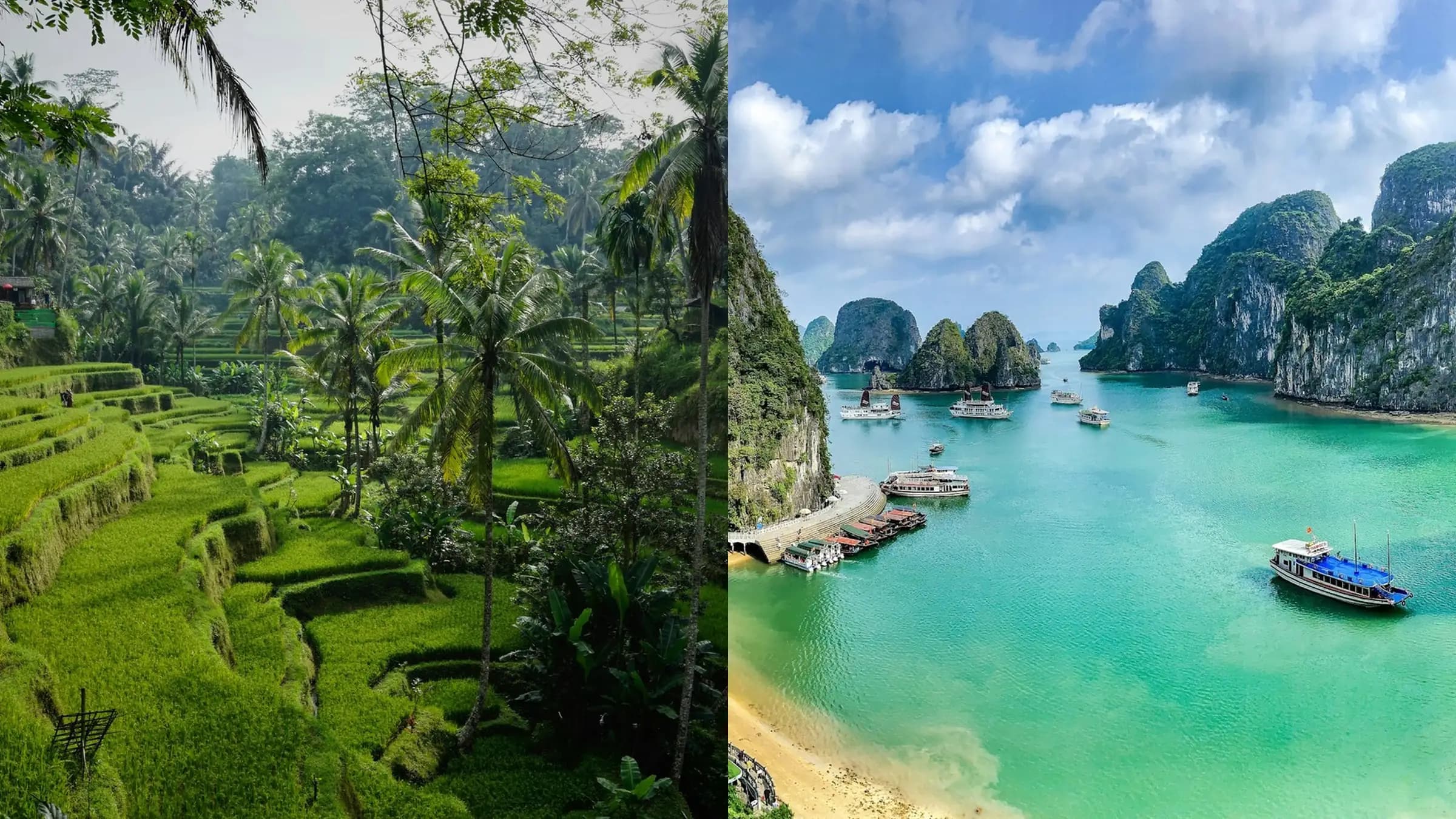
Bali is a place you stay. Vietnam is a country you move through. That single distinction decides most of this question. Bali is roughly 90 miles across and you can settle into two or three villas for a fortnight; Vietnam runs 1,030 miles north to south and a real trip means three or four internal flights. Vietnam is cheaper on the ground and has the region's only nonstop from the US — 16 hours 20 minutes, San Francisco to Ho Chi Minh City.
Key takeaways
- Vietnam is 1,650 km (1,030 miles) long and only 50 km wide at its narrowest. That shape is why a Vietnam trip is a sequence of flights, and why the weather is different in each region on the same day.
- Bali is small enough to base yourself. The whole island is about 90 miles across, so a two-week trip can run on two or three properties and a driver.
- Vietnam has a nonstop from the US; Bali has none. Vietnam Airlines flies San Francisco to Ho Chi Minh City in about 16 hours 20 minutes. The fastest one-stop to Bali is around 20h 30m from Los Angeles.
- Vietnam runs cheaper on the ground. A three-star room is roughly $25–60 in Vietnam against $48–72 in Bali, and Bali stacks 11% VAT plus 10% service on restaurant bills.
- Entry costs differ. Vietnam's e-visa is $25 single-entry for up to 90 days. Indonesia's visa on arrival is 500,000 IDR (about $30) for 30 days, extendable once, plus a 150,000 IDR (about $10) Bali tourism levy.
- Vietnam is the busier country; Bali is the busier place. Vietnam drew a record 21.2 million international arrivals in 2025; Bali drew 6.95 million onto one small island, up 9.72%.
- Both sit in the same Juniper band — about $5,000–$15,000+ per person for a fully private custom trip with four- and five-star stays, private guides and transfers arranged end to end.
Bali or Vietnam — which is better?
Neither, and the useful question is what kind of holiday you actually want at the end of a very long flight.
Choose Bali if the answer is rest. Bali's real product is the private-pool villa — the deepest inventory of them anywhere in Asia — plus a spa culture, a temple-and-rice-terrace landscape you can see in half-days, and enough good restaurants to eat well for two weeks without moving. You will not see much of Indonesia. You will be extremely well rested.
Choose Vietnam if the answer is to have seen something: Hanoi's old quarter, Lan Ha Bay, the imperial and lantern-lit middle around Hue and Hoi An, the Mekong Delta, Ho Chi Minh City — genuinely different places with different food, architecture and history. The cost is motion: internal flights, hotel changes, early mornings.
People who pick wrong usually do so in one direction: they book Vietnam wanting a honeymoon, discover it's a two-week travel schedule, and finish tired. That's fixable with a five-night beach stay at the end — but it needs to be a decision, not an accident.
How do Bali and Vietnam compare head to head?
| Criterion | Bali | Vietnam |
|---|---|---|
| Scale | One island, roughly 90 miles across | 1,030 miles north to south; 331,210 km² |
| Trip shape | Two or three bases, a driver, no internal flights | Three to five stops, two to four internal flights |
| Getting there from the US | No nonstop; about 20h 30m minimum from LA via Manila | Nonstop SFO–Ho Chi Minh City, about 16h 20m |
| Cost on the ground | 3-star $48–72; add 11% VAT and 10% service | 3-star $25–60; street meals $1.50–3 |
| Entry | 500,000 IDR (~$30) visa on arrival, 30 days, plus 150,000 IDR (~$10) tourism levy | $25 e-visa, up to 90 days, 4–6 working days to process |
| Travel fatigue | Low — the main strain is Bali's traffic | Moderate to high — flights, transfers and early starts |
| Food | Strong international scene; Balinese food is a smaller part of it | One of the world's great national cuisines, regional and everywhere |
| Beaches | Famous ones are surf beaches; swimming is on the Nusa islands, Sanur and Nusa Dua | Long swimmable coast — Hoi An, Da Nang, Phu Quoc, Con Dao, Ninh Van Bay |
| Crowds | 6.95 million foreign arrivals in 2025 onto one small island | 21.2 million across an entire country |
| Juniper's published range | About $5,000–$15,000+ per person | About $5,000–$15,000+ per person |
What does "a place you stay" versus "a country you move through" actually mean?
It means the two trips have different failure modes.
In Bali, everything is close on the map and slow in practice. The island is about 90 miles across , but the southern road network is congested enough that a 25-mile transfer from Canggu to Ubud can take an hour and a half at the wrong time of day . The response is not to fight it but to move rarely: two or three properties across two weeks, each somewhere you'd happily not leave.
In Vietnam, the map is the problem. The country is 1,650 km long and only 50 km wide at its narrowest. You cannot drive it in the time you have. A standard itinerary flies Hanoi to Da Nang, then Da Nang to Ho Chi Minh City — each about 90 minutes and $40–80 — plus road transfers at either end. It works, but it means three hotel check-ins minimum and a couple of 6am starts.
That shape is also why Vietnam has no single season: north, center and south run on different weather calendars, so the best time to go depends on which third you're weighting — a point we cover in our guide to the rice terrace seasons.
Which one costs less?
Vietnam, on almost every line except the flight.
A three-star room is roughly $25–60 in Vietnam against $48–72 in Bali. Food is dramatically cheaper — a street meal is $1.50–3 in Vietnam, a local beer under a dollar. Bali also adds 11% VAT plus 10% service on restaurant and hotel bills, turning a listed price into something meaningfully larger .
Entry costs run the same direction. Vietnam's e-visa is $25 single-entry for stays up to 90 days, with 4–6 working days of processing. Indonesia charges 500,000 IDR — about $30 — for a 30-day visa on arrival, extendable once to 60 days, plus the 150,000 IDR Bali tourism levy, around $10, best paid online before you land.
At Juniper's level both sit in the same band, about $5,000–$15,000+ per person. What differs is what the money does: in Bali it buys a better villa; in Vietnam it buys smoother logistics — private transfers, good internal routing, guides who make Hue and the Mekong land properly rather than pass by.
Which one will wear you out?
Vietnam, and it's worth being honest about how much.
A twelve-night Vietnam itinerary typically means two or three internal flights, four or five hotels, and at least two mornings starting before seven — on top of a 16-hour flight and jet lag 11 to 12 hours out of phase. Vietnam is not a hard country to travel in; it is a country where you're constantly in motion, and that is a different kind of tiring.
Bali's fatigue is front-loaded and then gone. Getting there is worse — no nonstop from anywhere in the US, and the quickest routing from Los Angeles is around 20 hours 30 minutes via Manila, with most itineraries landing between 21 and 24 hours. But once you arrive, you can do nothing for eleven days. For travelers with limited vacation time who need to return functional, that asymmetry matters.
The fix for Vietnam is structural: put the beach at the end. Five nights in Phu Quoc, Con Dao or Ninh Van Bay converts a demanding trip into a well-paced one.
Which has better food?
Vietnam, decisively, and this is the least controversial claim in this post.
Vietnamese food is one of the world's great national cuisines, and it is regional in a way that rewards moving through the country: pho and bun cha in Hanoi, the small-plate culture of Hue's imperial kitchen, cao lau and banh mi in Hoi An, the herb-heavy southern cooking and the Mekong's river fish. It is cheap enough that eating exceptionally well costs almost nothing.
Bali's scene is strong but differently shaped — largely international, with Australian-influenced cafés in Canggu and Seminyak, excellent Japanese and serious cocktail bars. Balinese food itself is more limited in day-to-day restaurant form than visitors expect, and the standout traditional experiences need seeking out. If food is a primary reason for the trip, Vietnam wins.
Which has better beaches?
Vietnam has more swimmable coast; Bali has better beach infrastructure.
Bali's famous beaches are mostly surf beaches. Uluwatu, Canggu and Bingin are spectacular and are not places you swim casually — the breaks are serious and several involve a scramble down a cliff. Southern Bali's swimming beaches are Sanur, Nusa Dua and Jimbaran, which are calm, family-friendly, and not what anyone means when they picture Bali. The genuinely great water is off-island, around Nusa Penida and Lembongan or the Gilis.
Vietnam has 3,260 km of coastline and much of it is straightforwardly good: An Bang near Hoi An, Da Nang's city beach, Phu Quoc's west coast, Con Dao for near-empty sand, Ninh Van Bay for resorts you reach only by boat. The catch is seasonal — the central coast has a typhoon and rain window roughly September through November, so beach timing and touring timing don't always align.
Which is the better honeymoon?
Bali, for most couples, and Vietnam for a specific kind of couple.
Bali is built for it. The private-pool villa is the island's signature product, the spa culture is genuine rather than decorative, and the logistics are simple enough that a honeymoon can be actually restful. We make the case in our honest answer on Bali honeymoons and compare it to its nearest rival in Bali or Thailand for a honeymoon.
Vietnam works when both of you want to travel together rather than rest together — when the memory you want is Hoi An at night and a boat through Lan Ha Bay rather than eleven mornings in the same pool. With a five-night beach finish it's a superb honeymoon. As a straight touring itinerary, it's a great trip that happens to follow a wedding.
Could you do both in one trip?
Yes, and it's more sensible than most Southeast Asia pairings, because the two halves do different jobs.
Fly into Hanoi, work south over nine or ten nights, then Ho Chi Minh City to Denpasar — roughly five hours, usually with one connection — and finish with five to seven nights in Bali. Home from Denpasar. Call it 16 to 18 nights door to door.
Do it in that order for recovery: Vietnam is the demanding half, Bali the restful one, and reversing it means finishing a holiday exhausted. The reason not to do it at all is time — under fourteen nights the combination gives you a rushed Vietnam and a token Bali. Under fourteen nights, pick one.
Who this suits — and who it doesn't
Bali is wrong for you if you want to feel like you've seen a country. You will see one island, and a heavily developed part of it. It's also wrong if traffic and development spoil places for you — southern Bali is busy, built up and getting busier, with 6.95 million foreign arrivals in 2025 landing on an island of modest size.
Vietnam is wrong for you if you have ten days or fewer, if anyone in your party struggles with early starts or repeated packing, or if the primary goal is rest. It's also wrong if you need reliable beach weather on fixed dates — some part of Vietnam is always in its wet window.
Neither suits a traveler who wants a short, low-effort tropical trip. Both are long-haul — 16 hours nonstop at best, 24 with connections at worst — and neither is worth doing in under nine nights. If you have a week, Hawaii or the Caribbean is the better answer, and we'd tell you so.
How far ahead should you book?
For 2027 travel, eight to twelve months in both.
Bali's constraint is villa inventory in the dry season, roughly April through October, with July, August and Christmas–New Year tightest. The best private-pool villas are single properties, not room blocks — when one is taken, it's taken. If your dates fall in peak, book at twelve months.
Vietnam's constraint is flights, not hotels. The SFO nonstop has limited capacity and prices climb steeply as it fills, and internal Hanoi–Da Nang and Da Nang–HCMC legs sell their cheap fare buckets early. Tet, the Vietnamese Lunar New Year, closes businesses and fills domestic transport for about a week — plan around it rather than through it.
Doing both? Twelve months, and let the Vietnam leg set the calendar.
Let our Bali and Vietnam specialists build your trip
Allison Tucker plans both. A dual US–UK citizen raised between California and Europe, she spent years traveling Southeast Asia, with Bali among her favorites, and she designs private itineraries from scratch around how you actually like to travel — which, on this particular question, is the whole decision. Cherisse Liptzin also covers Vietnam and Southeast Asia and has explored 21 countries and counting. Every Juniper trip is fully private and built from scratch: no group coaches, no fixed departures, no set itinerary you're joining.
"I cannot recommend this company enough!!!!! I used Juniper Tours for my honeymoon trip, and it was absolutely perfection!" — Caylie N., verified Google review
Read the two destination pages side by side: custom Bali tours and private Vietnam trips. Couples should compare Bali honeymoons against Vietnam honeymoons — the pacing is the real difference between them, and it's worth seeing that written out. For the honeymoon question specifically, start with our honest answer on Bali and Bali or Thailand for a honeymoon. When you have dates and a rough budget, book a free consultation and we'll tell you which of these two matches the trip you're describing — including if the answer is both.