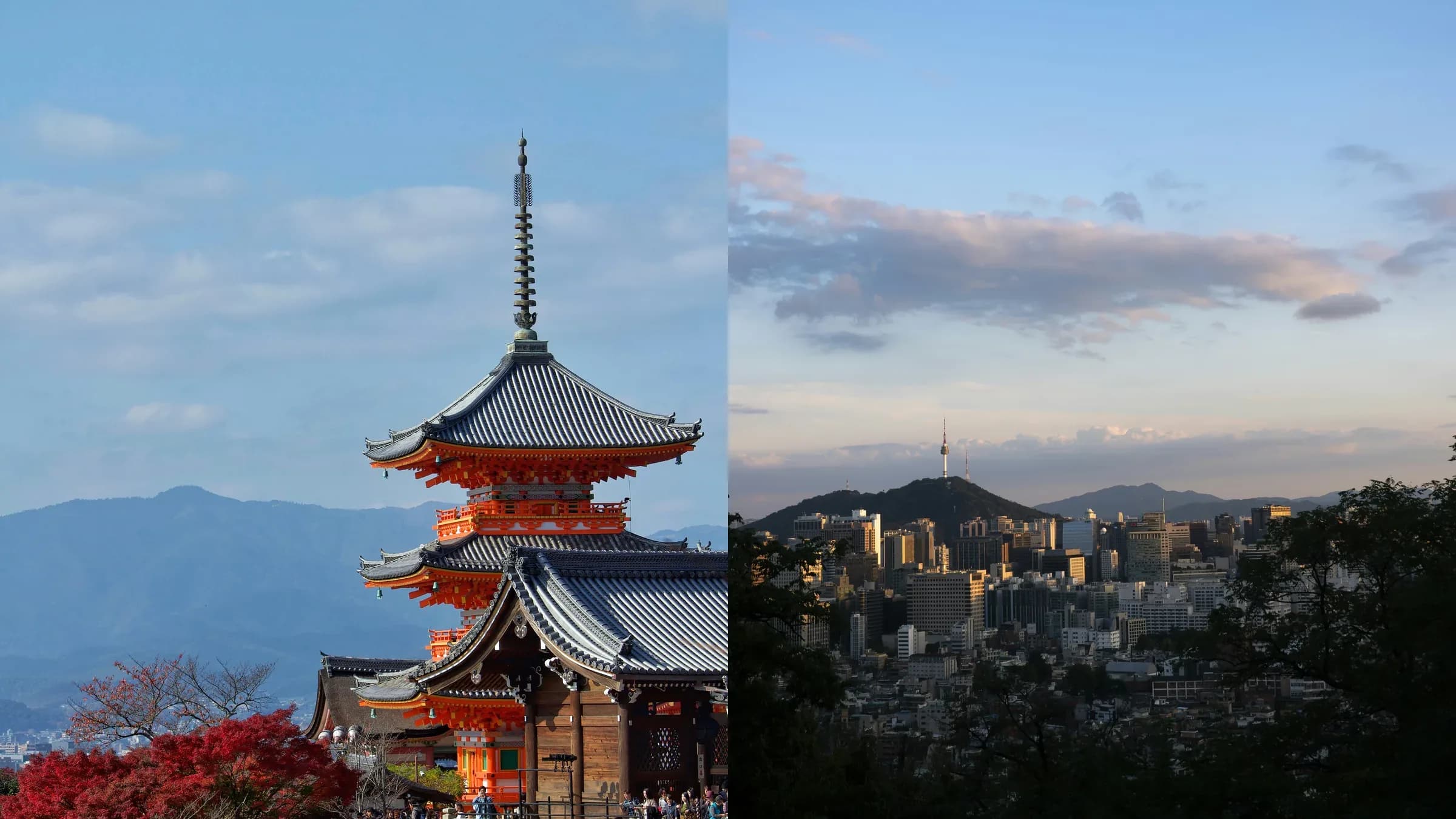
Japan is the deeper trip and the more expensive one. South Korea is faster to move around, cheaper, and more contemporary. Budget roughly $215 a day mid-range in Tokyo against $163 in Seoul, a 7-day JR Pass at ¥53,000 from October 2026 against a $45 Seoul–Busan KTX fare, and 42.7 million visitors a year competing with you in Japan. For temples, craft and depth, go to Japan. For cities, ease and value, go to Korea.
Key takeaways
- Korea runs roughly 20–25% cheaper day to day. Mid-range daily budgets land near $163 in Seoul against $215 in Tokyo, with the gap widest on hotels and restaurant meals.
- Japan's rail network is the better one; Korea's is the easier one. The JR Pass costs ¥53,000 for 7 days from October 1, 2026 (up from ¥50,000). Korea needs no pass — Seoul to Busan on the KTX is about $45 one way.
- English is genuinely easier in Korea. Korea ranked 48th of 123 countries in the 2025 EF English Proficiency Index; Japan ranked 96th, its lowest ever, with a score of 446 against a global average of 488.
- Japan is much more crowded. International arrivals hit 36.9 million in 2024 and 42.7 million in 2025. Kyoto in cherry-blossom season is the sharp end of that.
- Japan is adding traveler taxes. The departure tax tripled from ¥1,000 to ¥3,000 on July 1, 2026, and Kyoto's accommodation tax now peaks at ¥10,000 per person per night for luxury stays.
- Tokyo remains the world's most decorated food city — 160 starred restaurants in the 2026 Michelin Guide, including 12 at three stars.
- Korea's entry rules need watching. The K-ETA exemption for US citizens is confirmed only through December 31, 2026; 2027 travelers should check status before booking flights.
Japan or South Korea for a first trip to Asia?
If this is your first trip to Asia and you only take one, take Japan. Not because Korea is lesser, but because Japan is the more complete introduction: it has the mountains, the coast, the megacity, the wooden temple towns, the rail network that makes all of it accessible, and a hospitality culture that absorbs a nervous first-timer better than almost anywhere on earth. It is also the trip most people are actually picturing when they say "a first trip to Asia."
Korea is the better choice in three cases. If your budget is fixed, Korea gives you a materially better trip for the same money. If you want a contemporary city rather than a historical one, Seoul is the stronger destination and it isn't close. And if you have eight days rather than fourteen, Korea's smaller footprint means you spend them in places rather than in transit.
The mistake is treating this as a ranking. A traveler who loves the quiet, mannered, craft-focused version of East Asia will prefer Japan. A traveler who wants energy, informality and food at 2am will prefer Korea.
How do Japan and South Korea compare head to head?
| Criterion | Japan | South Korea |
|---|---|---|
| Mid-range daily budget | About $215 per person in Tokyo | About $163 per person in Seoul |
| Rail | Shinkansen plus dense JR network; 7-day JR Pass ¥53,000 from Oct 2026 | KTX plus excellent metros; no pass needed, Seoul–Busan about $45 |
| Flight time from the US | Roughly 11–12 hours from the West Coast, 13–14 from the East | Roughly 12–13 hours from the West Coast, 14–15 from the East |
| English accessibility | 96th of 123 in the 2025 EF index; signage good, conversation limited | 48th of 123; signage and app coverage noticeably better |
| Crowds | 42.7 million international arrivals in 2025; Kyoto is the pressure point | Far lower foreign volume; domestic crowds concentrate on weekends |
| Food | 160 Michelin-starred restaurants in Tokyo alone, 12 at three stars | Deeper street and market food; strong but smaller fine-dining scene |
| Traveler taxes | ¥3,000 departure tax; Kyoto lodging tax up to ¥10,000 per person per night | No comparable tourist taxes |
| Entry for US citizens | Visa-free for 90 days | K-ETA exemption confirmed through Dec 31, 2026; check 2027 status |
| Trip length that works | 12–16 nights to do it properly; 10 is tight | 8–11 nights covers the country comfortably |
| Juniper's published range | About $5,000–$15,000+ per person | About $5,000–$15,000+ per person |
How much cheaper is South Korea, really?
About 20–25% on day-to-day spending, and less than that on a fully private custom trip.
The daily-budget comparison puts a mid-range traveler at roughly $215 in Tokyo and $163 in Seoul — a 24% gap . The gap shows up in three places. Mid-range hotels run near $120 a night in Japan against $90 in Korea. A local meal is $5–8 in Korea against $8–12 for a bowl of ramen in Japan. And Korea has no equivalent of Japan's new traveler taxes.
At Juniper's level the gap narrows sharply, because the ranges converge: both countries sit at roughly $5,000–$15,000+ per person for a fully private itinerary with four- and five-star stays, private guides and end-to-end transfers. What changes is what you get for the same number. In Korea, $9,000 per person buys a longer trip, better rooms, or both. In Japan, it buys access — a ryokan with a private onsen, a kaiseki counter that seats eight, a temple opened before public hours.
The honest framing: Korea is cheaper. Japan is where the money has more to buy.
Which is easier to get around?
Korea, by a clear margin — and Japan has the better network. Both things are true.
Japan's rail system is the best in the world and the most complicated to use. The Shinkansen reaches essentially everywhere a visitor wants to go, but you're navigating multiple JR regions, reserved and non-reserved cars, private lines that the JR Pass doesn't cover, and a pass whose value math changed when prices rose. The 7-day ordinary JR Pass costs ¥53,000 from October 1, 2026, up from ¥50,000, with 14-day at ¥84,000 and 21-day at ¥105,000. At those prices the pass stopped being an automatic yes; for many two-city itineraries, buying individual tickets is now cheaper.
Korea's system is smaller and simpler. The KTX links Seoul to Busan for around $45, Seoul's metro is one of the best-signed in the world, and there's no pass decision because point-to-point fares are already low. Korea is also compact enough that Seoul works as a base for much of a trip, whereas Japan requires genuine multi-city logistics.
Which is easier if you don't speak the language?
Korea, and the gap is measurable. In the 2025 EF English Proficiency Index, South Korea ranked 48th of 123 countries while Japan ranked 96th — tied with Afghanistan, its lowest placement ever, with a score of 446 against a global average of 488.
It plays out unevenly. Japan's infrastructure is superb — bilingual station signage, English ticket machines, well-captioned museums. What's harder is unscripted conversation: an allergy, a changed booking, a problem. Korea's signage is comparably good and the conversational floor is higher, particularly in Seoul. Neither is a reason to avoid a first trip. It is a reason to have a private guide on the days that matter.
Which has the better food scene?
Japan at the top, Korea in the middle, and it depends entirely on how you eat.
Tokyo is the most decorated food city on earth: the 2026 Michelin Guide awards 160 starred restaurants out of 526 selected — 12 at three stars, 26 at two, 122 at one. Add Kyoto's kaiseki tradition, Osaka's street food and the fact that a ¥1,200 lunch at an unmarked soba counter can be extraordinary, and Japan's ceiling and floor are both higher.
Korea's strength is different and, for many travelers, more fun: a market-and-street culture — Gwangjang in Seoul, Jagalchi in Busan — with a late-night rhythm Japan doesn't have and less reservation anxiety. If your trip is organized around booked meals, Japan. If it's organized around wandering into things, Korea.
How bad are the crowds in each?
Japan's crowding is real and getting worse. International arrivals ran 36.9 million in 2024 and 42.7 million in 2025, with 2026 tracking higher again. That volume concentrates: Kyoto in cherry-blossom season and autumn foliage season, Fushimi Inari at midday, the Nara deer park, the Kamakura coast on a summer weekend. Japan has begun responding with policy — Kyoto's accommodation tax, restricted access at some sites, and the tripled departure tax that took effect on July 1, 2026.
Korea's foreign visitor volume is a fraction of Japan's, and crowding follows a different pattern: it's domestic and weekend-driven. Gyeongbokgung on a Saturday and Jeju in summer are genuinely busy. Tuesday almost anywhere is not.
Neither country is unmanageable if you plan around it — our guide to the best time to visit Japan covers the specific windows that work. But if crowd avoidance is high on your list, Korea gives it to you without effort.
What about entry requirements and taxes for 2027?
Japan is straightforward for US citizens: visa-free for 90 days. Japan raised visa fees roughly fivefold from July 2026, but that does not apply to Americans, who don't need one. What does apply is the ¥3,000 international departure tax, collected in your airfare since July 1, 2026, and city-level lodging taxes — Kyoto's has run on a five-tier scale since March 1, 2026, peaking at ¥10,000 per person per night on luxury stays.
Korea is where you need to pay attention. Korea has temporarily waived the K-ETA electronic travel authorization for US citizens and dozens of other nationalities, but that exemption is confirmed only through December 31, 2026. Whether it extends into 2027 has not been settled as of this writing. If you're planning 2027 travel to Korea, check the status before you're at the airport — and if the exemption lapses, K-ETA is a straightforward online application, not a visa.
Could you do both in one trip?
Yes, and this is one of the easiest pairings in Asia. Tokyo or Osaka to Seoul is a 2- to 2.5-hour flight with dozens of daily departures, and the two countries' arrival airports both connect cleanly back to the US. Juniper runs a combined itinerary — Best of Japan & South Korea — for exactly this reason.
The version that works is 16 to 18 nights: ten to twelve in Japan covering Tokyo, Kyoto or Kanazawa, and one rural region, then four to six in Korea built around Seoul with a KTX run to Gyeongju or Busan. Fly into Tokyo, out of Seoul, and you'll never backtrack.
What doesn't work is twelve nights split evenly. Japan alone needs twelve to be unhurried; halving it produces a highlights lap. If you have under fourteen nights, pick one country and go deeper. You'll come back for the other.
Who this suits — and who it doesn't
Japan is wrong for you if your budget is fixed and tight, if you have fewer than ten nights, or if the idea of crowds at the famous sites would genuinely spoil the trip. It is also wrong if you dislike formality — Japan's hospitality is exceptional, but it is structured, and some travelers find it keeps them at arm's length.
Korea is wrong for you if you're going for temples, gardens and traditional architecture as the main event. Korea has all three and they are lovely, but much of the country's built heritage was destroyed in the twentieth century and a great deal of what you see is reconstruction. It is also wrong if you want a country to move slowly through: Korea's texture is urban, fast and contemporary, and travelers looking for rural quiet will find less of it than they expect.
Neither country suits a traveler who wants beaches as the main event. Both have coastline; neither is a beach destination in the way Southeast Asia is. If that's what you want, look at Bali, Thailand or Vietnam instead.
How far ahead should you book?
For Japan in 2027, 10 to 14 months. Cherry-blossom season (late March into April) and autumn foliage (November) are the constraint, and the properties people want — small ryokan, Kyoto machiya, anything with a private onsen — release limited inventory and fill it a year out. If your dates are in either window, treat 14 months as the target, not the maximum.
For Korea, six to nine months is comfortable. The exceptions are Chuseok and Lunar New Year, when domestic travel fills trains and hotels, and Jeju in July and August. Around those, book at ten months.
Doing both? Book at 12 to 14 months, because Japan sets the calendar. Every combined itinerary we build is constrained by the Japanese leg, never the Korean one.
Let our Japan and Korea specialists build your trip
Cherisse Liptzin plans both countries. She was raised in one of the country's largest Japanese-American communities and has explored 21 countries and counting, and she's the one who'll tell you whether your April dates are worth the cherry-blossom crowds or whether you'd have a better trip three weeks later. Allison Tucker also covers Korea and Japan — a dual US–UK citizen who spent years traveling East Asia. Every Juniper trip is fully private and built from scratch: no group coaches, no fixed departures, no set itinerary you're slotted into.
"Everything planned by Juniper Tours went incredibly smoothly. Every driver and guide was wonderful…" — Hailey M., verified Google review
Read the two destination pages next to each other: private Japan tours and custom South Korea trips. Couples should compare Japan honeymoons and South Korea honeymoons, which are paced very differently, and read our honest take on whether South Korea works for a honeymoon. For timing, start with the best time to visit Japan. When you have dates in mind, book a free consultation — and tell us your budget honestly, because that's the single fact that most often decides which of these two is the right trip.