Yes, and it's the season Japan does best. Mount Fuji is visible on 31 of 31 January mornings from the north in a typical year against 8 of 30 in June. Niseko takes 12 to 15 meters of snow a winter, Hakuba and Nozawa Onsen around 11 meters. The Sapporo Snow Festival runs February 4–11, 2027. The only window to avoid is December 28 to January 4, when the whole country travels at once.
Key takeaways
- Winter gives you the clearest Fuji of the year. Recent visibility data shows Fuji visible on essentially every January morning from the north side, against roughly a quarter of mornings in June, July and August. Mornings beat afternoons in every month.
- The snow is the real draw. Niseko averages 12–15 m a season with January the deepest month; Hakuba and Nozawa Onsen both run around 11 m. Niseko United opens November 28, 2026 and runs to May 5, 2027, with night skiing from December 12 to March 22.
- The snow monkey walk is real walking. Jigokudani is 1.6 km each way from Kanbayashi, 30–40 minutes in winter on packed snow and hidden ice, and it is not passable with a stroller or a wheelchair. Admission is ¥800; winter hours are 09:00–16:00.
- Book snow monkey tickets in advance from now on. An online ticketing system launched in late August 2026 and advance purchase is encouraged for peak winter dates.
- Sapporo Snow Festival is February 4–11, 2027, free to attend, across three sites: Odori for the big sculptures, Susukino for around 100 ice sculptures, Tsudome for families.
- Avoid December 28 to January 4. Government offices close December 29 to January 3, banks December 31 to January 3, and unreserved Shinkansen cars run at 120% occupancy. Reserved seats release exactly one month ahead at 10:00 and sell out the same day on peak routes.
- Getting to the snow is fast. Tokyo to Nozawa Onsen is about 2.5 hours, Tokyo to Hakuba about 3 hours, Tokyo to Niseko about 4–4.5 hours including the flight to New Chitose.
Is Japan worth visiting in winter?
It is the most underrated season in the country and the one we send repeat travelers back for. Three reasons, in order of how much they matter.
First, visibility. Japan's summer is humid and hazy; its winter is dry and sharp. Mount Fuji, which most visitors never actually see, is reliably visible on winter mornings and almost never on summer afternoons. The same clarity applies to the Japan Alps, to Kyoto's temple rooflines against snow, and to the mountains from every Shinkansen window.
Second, crowds. Outside the New Year block, January and February are the thinnest months for foreign visitors. Kyoto in mid-February is a different city from Kyoto in November, and if you've read our autumn foliage guide you know how tight that season gets.
Third, snow. Japan gets more of it than anywhere else that also has trains, food and hot springs, and the reason is geographic: Siberian air crosses the Sea of Japan, picks up moisture, and dumps it on the first mountains it hits. That is why Hokkaido and the Japan Sea side get numbers other countries don't.
What you give up is cherry blossom, autumn color, comfortable temperatures and long daylight. This is a season for looking at things and sitting in hot water, not for walking all day. Month-by-month, the full picture is in the best time to visit Japan.
When is Mount Fuji actually visible?
Winter mornings, almost without exception. Recent daily visibility records put Fuji visible from the north on 31 of 31 January mornings and 31 of 31 January afternoons, and on 23 of 28 February mornings. The summer figures are the mirror image: 8 of 30 mornings in June, 11 of 31 in July, 8 of 31 in August, and worse in the afternoons.
The practical rules that follow are simple. Go early. Air is clearest at sunrise, and cloud builds around the summit through the day. Give it two mornings, not one — even in winter a front can close it out. And choose your side: the northern viewpoints around the Fuji Five Lakes and Kawaguchiko hold up better than southern ones in the data above.
This is one of the few things in Japanese travel where the season does most of the work for you. A February morning at Kawaguchiko with snow on the cone and no haze is the photograph everyone comes for and most people miss.
How hard is the walk to the snow monkeys, really?
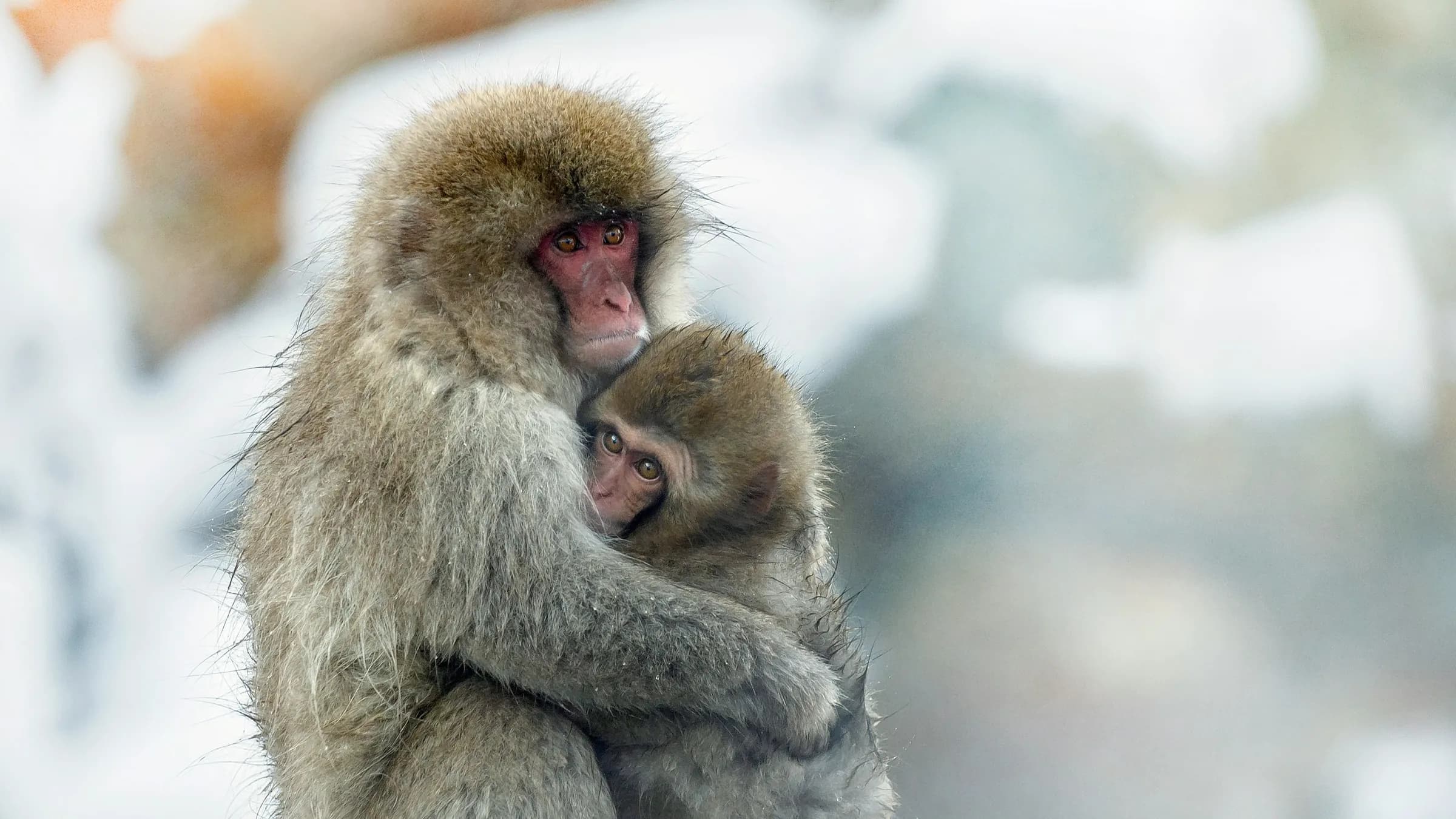
Harder than the photographs suggest, and this is the single most common surprise on a winter Japan trip. Jigokudani Monkey Park is reached on foot from Kanbayashi Onsen: 1.6 km each way, taking 20–25 minutes in green season and 30–40 minutes in winter, on a narrow forest track that in December to March is densely packed snow over hidden ice, at temperatures that sit below freezing and can reach 14°F.
It is not accessible to wheelchairs or strollers, and rolling luggage is impossible on it. Footwear with real grip is not optional; ice spikes are sold near the trailhead for around ¥1,350 and snow boots rent for about ¥1,000 a day. There is a shorter approach of 10–15 minutes from an upper paid parking lot, which is the route to use with anyone unsteady on their feet.
The other honest caveat: the monkeys are wild and free to leave. There are days with no monkeys in the pool, and days when they are around but not bathing. The park posts current conditions, and an online ticketing system launched in late August 2026 with advance purchase encouraged for peak winter dates.
Logistics: admission is ¥800, winter hours are 09:00 to 16:00 from November to March, and the park has no closing days. Buses run from Nagano Station to the Snow Monkey Park stop in about 40 minutes for around ¥2,000, hourly in winter. From Tokyo, Nagano is about 90 minutes on the Hokuriku Shinkansen — whether the JR Pass pays for that depends entirely on the rest of your route.
Niseko, Hakuba or Nozawa Onsen?
| Resort | Annual snowfall | Terrain | From Tokyo | Who it suits |
|---|---|---|---|---|
| Niseko United, Hokkaido | 12–15 m, deepest in January | Four linked resorts on one pass; opens Nov 28, 2026, closes May 5, 2027; night skiing Dec 12–Mar 22 | About 4–4.5 hrs: flight to New Chitose plus 2.5–3 hrs by road | Skiers chasing the deepest, driest snow; travelers who want English spoken everywhere and international dining |
| Hakuba Valley, Nagano | Around 11 m | Ten resorts on one lift pass, about 200 trails and 135 lifts, 1,071 m vertical | About 3 hrs: Shinkansen to Nagano plus 60–90 min bus | Strong skiers who want terrain variety, families with teenagers, anyone who wants dining and nightlife choice |
| Nozawa Onsen, Nagano | Around 11 m | 36 trails, about 300 hectares, 16 lifts, 1,085 m vertical | About 2.5 hrs: Shinkansen to Iiyama plus 25 min bus | Travelers who want a Japanese snow town rather than a ski resort; families with younger children; the best onsen culture of the three |
The short version: Niseko has the snow, Hakuba has the terrain, Nozawa has the town.
Niseko is genuinely exceptional and genuinely international — if that matters to you either way, know it going in. Hakuba is a valley you explore, with the flexibility to move between resorts as conditions change. Nozawa is a working onsen village with thirteen free public bathhouses that has a ski hill attached, and the daily rhythm of ski, soak, eat is the reason to choose it.
For most first-time winter visitors combining skiing with Tokyo and Kyoto, Nozawa or Hakuba is the better call purely on transit: both are day-trip-adjacent to the snow monkeys and reachable without a domestic flight.
When is the Sapporo Snow Festival in 2027?
February 4 to 11, 2027, across three sites, all free to enter.
- Odori Park is the main site: about a dozen large sculptures, some over 25 m wide and 15 m tall, plus more than 100 smaller ones, illuminated to 22:00.
- Susukino, one subway stop south, holds roughly 100 ice sculptures, lit to 23:00 and to 22:00 on the final day.
- Tsudome is the family site — snow slides, snow rafting, indoor play — open 10:00 to 16:00, reached by a 15-minute walk from Sakaemachi Station or a ¥200 shuttle.
The catch is accommodation. Sapporo's hotel stock is finite and the festival week is the busiest of the Hokkaido year; rates rise sharply and availability tightens well before Christmas. If Sapporo and Niseko are both on your list, do them in one Hokkaido leg rather than flying in twice.
What is a ryokan with a private onsen, and is it worth it?
Two different things, and the distinction matters when you book.
A kashikiri-buro is a private bath that guests reserve in time slots — often an outdoor cypress or rock tub used by one party at a time. Many ryokan now include reservations at no extra charge as standard. A room with its own rotenburo is a guest room with a private open-air bath on its balcony or terrace, available whenever you want it. That is the premium product, and the price gap between an ordinary room and one with a private bath at the same ryokan is the largest single line item in most Japanese hotel decisions.
Is it worth it? In winter, more than any other season — sitting in water in the low 100s Fahrenheit while snow falls on you is the specific thing people remember from a Japan trip twenty years later. It is also the answer to the tattoo question: many public onsen still refuse visible tattoos, and a private bath removes the problem entirely.
Two things to know. Ryokan rates are almost always per person and include dinner and breakfast — usually multi-course kaiseki served at a fixed time, which means you are committing your evening. And rooms with private baths are the first to sell in any ryokan, typically several months ahead for winter weekends.
Which dates should you avoid?
December 28 to January 4. This is Japan's largest domestic travel movement of the year, and it is not a matter of it being busy — it is a matter of things being closed and seats not existing.
- Government offices close December 29 to January 3 by statute; bank counters close December 31 to January 3.
- Most department stores close January 1 and reopen on the 2nd or 3rd. Many independent restaurants and shops shut for the whole block; convenience stores and chain restaurants stay open.
- The outbound rush from Tokyo is December 28–30; the return is January 3–4. Those four days are the ones to keep off the rails. December 31 to January 2 is comparatively manageable.
- Reserved Shinkansen seats release exactly one month ahead at 10:00 and popular routes are close to full by mid-afternoon the same day. Only 57 seats per Nozomi have dedicated large-baggage space, and those go first. Unreserved cars run at around 120% occupancy — standing in the aisle.
- Hatsumode shrine crowds are enormous. Meiji Jingu takes roughly 3.1 million visitors across the first three days, Sensoji about 2.83 million, Fushimi Inari about 2.7 million. Queues peak from 23:00 on December 31 to 02:00 on January 1 and again through January 1 afternoon; early mornings on January 2 and 3 are the workable window.
None of this makes New Year a bad time to be in Japan — hatsumode is one of the most interesting things a visitor can witness. It makes it a bad time to be moving between cities. Build a New Year trip that sits still.
Who this suits — and who it doesn't
Winter Japan is wrong for anyone whose mental image of Japan is cherry blossom, temple gardens in green, or eating outdoors. Kyoto in February is cold, gray more often than snowy, and many gardens are at their least photogenic. If the trip is about the classic images, come in spring or autumn and accept the crowds.
It's wrong for travelers with mobility limits who still want the snow monkeys, unless you use the upper parking approach — the standard trail is genuinely icy and genuinely unsuitable. And it's wrong for anyone who wants to move fast: the days are short, the weather cancels things, and a winter itinerary needs slack in it.
It suits skiers, obviously, and it suits them better than the Alps on snow quality and on cost per day. It suits photographers, for Fuji and for the light. It suits couples who want a ryokan with a private open-air bath in falling snow, which is the single best thing Japan sells. And it suits anyone who has been before in a busy season and wants the same country with a fraction of the people — the argument we make in Japan or South Korea applies here too.
How far ahead should you book?
Nine to twelve months for anything touching the ski season or the Sapporo festival week. Ryokan with private-bath rooms, Niseko and Hakuba lodging, and Sapporo hotels in early February are the four constraints, and they all bind before flights do.
Twelve months if your dates include December 27 to January 4 — hotels in Kyoto and Tokyo commit early for New Year, and reserved rail seats cannot be bought until exactly one month out, so the itinerary has to be built to survive a train you can't confirm yet. Six months is workable for a mid-January or late-February city trip without skiing, which is the softest and cheapest window in the Japanese year. More on the pattern in when to book 2027 travel.
Let our Japan specialist time your winter trip
Winter Japan is a timing problem more than a routing one: which mornings you stand at Kawaguchiko, which side of the New Year block your rail days fall on, whether your ryokan room has its own bath, whether the snow monkey trail is a 40-minute walk or a 15-minute one for the person in your group who needs it to be. Cherisse Liptzin, our Japan and South Korea specialist, builds those calls into the itinerary rather than leaving them to the day. Every Juniper trip to Japan is fully private and built from scratch around your dates — no group coaches, no fixed departures.
"Absolutely phenomenal experience! From beginning to end, every part of the process was seamless." — Nathaniel C., verified Google review
Japan itineraries with us typically run 10–14 days and between $5,000 and $15,000+ per person, with hand-selected ryokan and city hotels, private guides and every rail segment arranged end to end. Start with our custom Japan trips or Winter Wonderland Japan; for two people, Japan honeymoons. For timing across the whole year, read the best time to visit Japan; for the rail math, the Japan Rail Pass in 2027; and if autumn is still in the running, Japan's autumn foliage timing. When you're ready, book a free consultation — we'll check your dates against the New Year block before we quote anything.