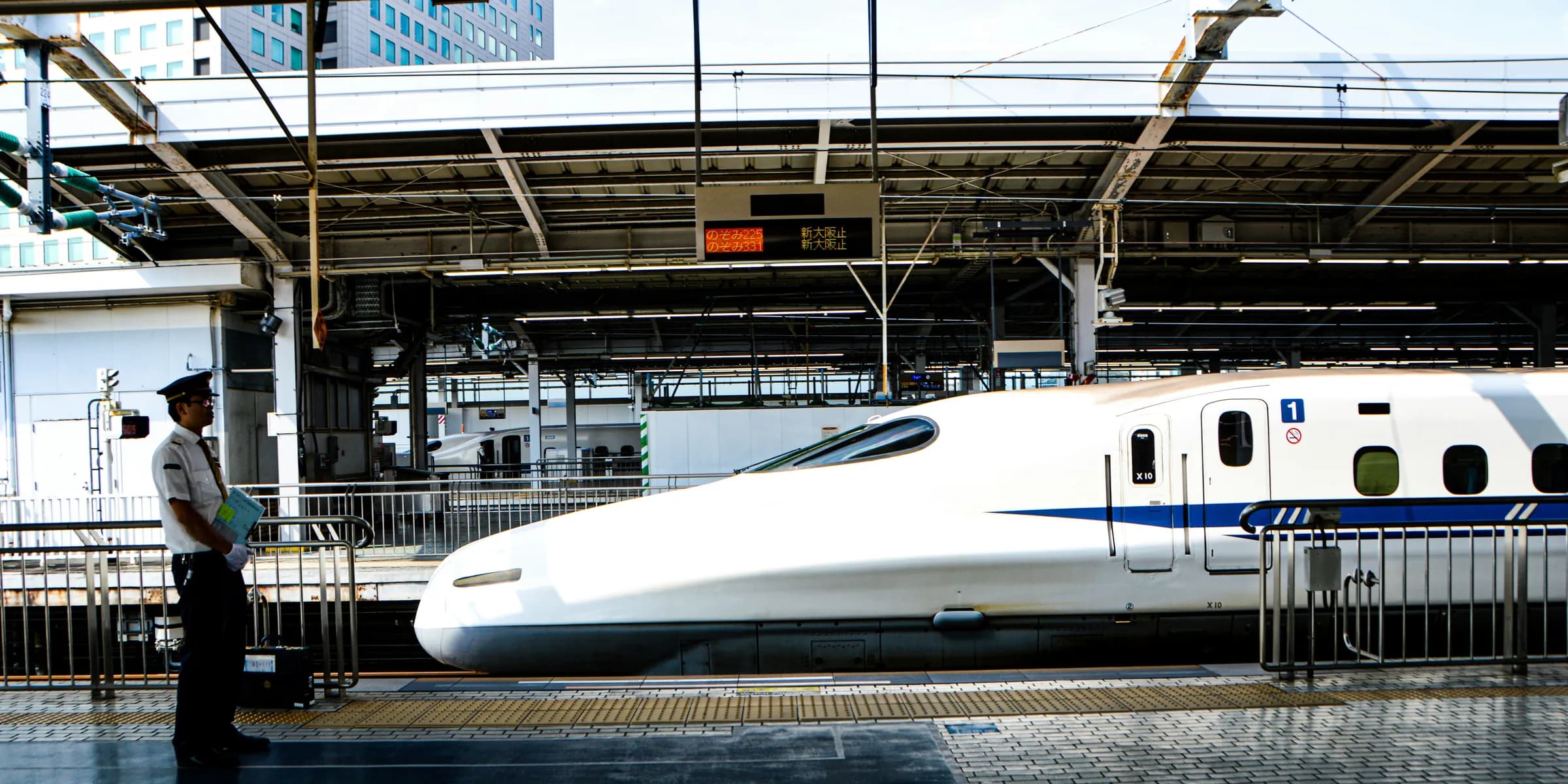
Japan is genuinely excellent with children, and it lands for reasons parents rarely predict. The trains, the vending machines, conveyor-belt sushi and the deer at Nara do more work than any temple. The single best logistics decision is luggage forwarding — ¥1,600 to ¥3,700 per bag, usually next-day between major cities. Plan for small rooms: a Japanese twin often runs 15 m². Budget $5,000 to $15,000+ per person.
Key takeaways
- Forward your luggage and the trip changes. Takkyubin costs roughly ¥1,600 to ¥3,700 per bag by size and distance, is next-day on the Tokyo–Kyoto–Osaka corridor, and takes items up to 200 cm and 30 kg. You travel with a daypack.
- Oversized bags need a Shinkansen reservation. On the Tokaido, Sanyo and Kyushu lines, luggage totalling 160–250 cm (length plus width plus height) requires a reserved oversized-baggage seat, or a ¥1,000 fee applies on board. Strollers have separate handling rules and may be exempt.
- Japanese hotel rooms are small, and a family of four does not fit in one. A standard twin can be about 15 m² and a semi-double 10.6–15 m². Book two rooms, an international-brand hotel, or a ryokan where the family sleeps on futons in one tatami room.
- teamLab Planets has the highest hit rate of any Tokyo attraction for children. Adults ¥3,800, students ¥2,800, ages 4–12 ¥1,500, free at 3 and under. You go barefoot through water and leave strollers at the entrance.
- The Ghibli Museum needs booking three months out. Overseas tickets through JTB go on sale on the first of the month for entry in the month starting three months later; Lawson tickets at 10:00 Japan time on the 10th for the following month. Adult ¥1,000, ages 7–12 ¥400, ages 4–6 ¥100.
- Long temple circuits are where children break. Two temples a day is the ceiling for most under-tens, and one should have something to do rather than something to look at.
- Station elevators exist and are not where you expect. Add 15 minutes to every stroller transfer.
Is Japan good with kids?
Yes, and better than most parents expect — but not for the reasons in the brochures. What delights children is the ordinary infrastructure. The trains are the trip: a Shinkansen pulling in at exactly the advertised second, the cleaning crew bowing on the platform, seats that rotate to face the direction of travel. That is a thrilling twenty minutes for a six-year-old, and it happens four or five times on a normal itinerary. Vending machines dispensing hot corn soup are, to a child, a form of magic, and convenience stores with a wall of onigiri become a nightly ritual. Japan is also unusually safe and orderly in ways that reduce parental load, and a less vigilant parent is a better travelling companion.
What does not land is the thing most itineraries are built from. A day of five temples in Kyoto is a bad day for a nine-year-old. Temples are beautiful and largely undifferentiated to a child: gravel, a hall, a rope, a bell, more gravel. Two per day, and pick the two with something happening.
What actually delights children in Japan?
- Trains, especially the Shinkansen. Reserve the ocean side for the Fuji view between Tokyo and Kyoto, and buy an ekiben — a station bento — on the platform. That is the meal children remember.
- Conveyor-belt sushi. Children choose their own food and eat immediately, and the whole thing is a game with a plate-counting scoreboard at the end.
- The deer at Nara. Free-roaming deer that bow for crackers. Buy shika senbei from a licensed vendor and expect the deer to be pushier than the photographs suggest — a small child should feed with a parent's hands over theirs. Nara Park is flat and wide, which also makes it one of Japan's best sites for a grandparent.
- teamLab. teamLab Planets in Toyosu is the more physical of the two Tokyo venues — barefoot through knee-deep water and across soft floors, a better fit for children than a gallery. Under-13s must be accompanied by an adult over 18.
- Studio Ghibli. The Ghibli Museum in Mitaka is small, magical and strictly timed: ¥1,000 adults, ¥700 ages 13–18, ¥400 ages 7–12, ¥100 ages 4–6, free under 4. Ghibli Park near Nagoya is larger and more walkable. Both sell out.
- Vending machines and convenience stores. Give each child a daily allowance in ¥100 coins — one of the best-value decisions of the trip.
- Ryokan and onsen towns. Futons in one room, yukata to dinner, and a private family bath — book one if anyone is shy about communal bathing or has a tattoo.
What does not land, honestly: long temple circuits, the Imperial Palace grounds, most gardens for under-eights, and any museum without English signage.
Why is luggage forwarding the single best trick for families?
Because it turns the hardest hour of a Japanese trip into an easy one: a family of six changing cities, with nine bags, a stroller, a station with stairs, a platform with a two-minute stop, and an overhead rack that will not take a large suitcase. Takkyubin — door-to-door delivery, most visibly Yamato Transport's black cat — removes it. At the hotel desk on the morning you leave Tokyo you fill in a form per bag and pay; the bags arrive at your Kyoto hotel the next afternoon.
| Detail | Figure |
|---|---|
| Cost per bag | Roughly ¥1,600–¥3,700, by size and distance |
| Standard 26-inch checked bag | About ¥2,000–¥2,300 |
| Large suitcase | About ¥2,850–¥3,700 |
| Tokyo to Kyoto, Osaka or Nagoya | Next day |
| Hokkaido / Okinawa | 2 days / 2–3 days |
| Maximum size and weight | 200 cm total dimensions; 30 kg per item |
| Drop-off points | Hotel desks, convenience stores (7-Eleven, FamilyMart, NewDays), airport counters |
| Airport counter surcharge | About ¥660 |
For a family of six with six bags that is roughly ¥12,000 to ¥18,000 — less than one airport taxi. Two rules: send bags the morning before you need them, since next-day means next day; and keep a one-night bag with medication, pajamas, chargers and a change of clothes for every child, because the bags and the family travel separately.
The related rule, even if you forward everything: on the Tokaido, Sanyo and Kyushu Shinkansen lines, a bag totalling 160 cm to 250 cm is oversized and needs a reserved oversized-baggage seat booked in advance, or a ¥1,000 fee applies on board. Strollers and sports equipment have separate rules and may be exempt, but reserving space is still easier with a family.
How small are Japanese hotel rooms, really?
Small enough that room configuration is the most consequential booking decision of the trip. A standard twin can be around 15 m², and a "semi-double" — a category with no American equivalent — runs 10.6 m² to 15 m² with a bed 120 to 140 cm wide. An American mid-tier room is typically well over 25 m². Two suitcases open on the floor of a 15 m² room leave no floor. The other trap is occupancy: maximum occupancy is not the number of fixed beds, and a room advertised for four may be using a sofa bed or a bed-sharing rule for a child.
- Two connecting or adjacent rooms. The default. Ask for adjacent explicitly; genuinely connecting doors are rarer in Japan than in Europe.
- A Western-brand or international five-star. Tokyo and Kyoto properties of international groups are built to international dimensions and often have genuine family rooms — where a meaningful share of the budget defensibly goes.
- A ryokan with a large tatami room. Futons laid out for the whole family after dinner. For four or five this is both cheapest and best. Two nights, not five.
- A serviced apartment in Tokyo. A washing machine and a kitchen, which over 14 nights is worth more than a view.
Our guide to what a Japan trip costs breaks down where the room budget goes.
How do you navigate stations with a stroller?
Every major Japanese station has elevators, and accessibility is genuinely good by global standards. The problem is position: in Tokyo, Shinjuku or Kyoto the elevator serving your platform may be at one end of a 400-metre platform, up a different concourse from the ticket gates, signposted as though you already know. A transfer the app calls eight minutes is twenty with a stroller.
- Add 15 minutes to every station transfer and never book a connection tighter than 20.
- Use an umbrella-fold stroller, not a travel system. It has to go up an escalator, into a taxi trunk and past a turnstile.
- Ask a station attendant. They will walk you to the elevator, and it works without shared language.
- Avoid Tokyo rush hour — roughly 7:30 to 9:30 a.m. and 5:30 to 7:30 p.m. A stroller in a rush-hour Yamanote carriage is not a manageable situation.
Which Japan activities suit which ages?
| Activity | Young kids (3–8) | Teens | Adults | Grandparents with limited mobility |
|---|---|---|---|---|
| Shinkansen ride with an ekiben | Excellent | Excellent | Excellent | Excellent — level boarding, reserved seats |
| Kaiten (conveyor-belt) sushi | Excellent | Excellent | Good | Good — seated, quick, no menu negotiation |
| Nara Park and the deer | Excellent with adult help | Excellent | Good | Good — the park is flat and wide; Todai-ji has steps |
| teamLab Planets | Excellent | Excellent | Excellent | Difficult — barefoot, water, uneven soft floors |
| Ghibli Museum, Mitaka | Excellent | Good | Good | Mixed — small spaces and a spiral staircase |
| Ghibli Park, near Nagoya | Excellent | Excellent | Good | Better than the museum — larger and more walkable |
| Long Kyoto temple circuit (4–5 sites) | Poor | Fine | Excellent | Poor — gravel, steps, distance |
| Fushimi Inari torii gates | Good for the first 15 minutes | Excellent | Excellent | Lower gates only; the full loop is a long climb |
| Onsen (communal bathing) | Fine | Often refused | Excellent | Excellent — book a private family bath |
How do meals work with children and grandparents in Japan?
Timing is a genuine advantage. Japanese restaurants open early by European standards — a 6 p.m. dinner is normal, and many family restaurants and department-store dining floors run continuously through the afternoon. A jet-lagged five-year-old who wants to eat at 5:30 is not a problem here the way they are in Italy or Greece.
Group size is the real constraint. Many of Japan's best restaurants have eight to twelve seats total and cannot take a party of six at all. Assume the highest-end dining is a two- or four-person activity done in shifts: grandparents and children eat early at a department-store dining floor or a kaiten place, two adults take the counter at 8.
- Allergies are the hard part. Dashi, which contains fish, is in almost everything savory, including dishes that appear vegetarian. Carry an allergy card in Japanese and treat "no fish" as a serious constraint.
- Depachika — department store basements — solve the group that cannot agree: everyone chooses something different and you eat it at the hotel.
- Book special dinners well ahead and confirm children are admitted; some counter restaurants and ryokan dining rooms have age policies.
Where should a family base itself, and for how long?
Two bases in fourteen nights, three at most. Tokyo and Kyoto is the correct spine: five or six nights in Tokyo, the Shinkansen to Kyoto with luggage forwarded, then five or six in Kyoto as a base for Nara, Osaka and Himeji. What breaks families is Tokyo, Hakone, Kyoto, Hiroshima and Osaka in twelve nights: each move is a packing day even with takkyubin, and Hiroshima is a long leg for a payoff that means little to a child under twelve. Cherry blossom and autumn foliage are the most beautiful and most crowded seasons; late March, early April and the second half of October are worth it, while August is hot and humid enough to be genuinely difficult with a stroller. Our guide to the best time to visit Japan works through the trade-off.
Who this suits — and who it doesn't
Japan with children is wrong for you if you want a trip that requires no preparation. It rewards booking — Ghibli tickets three months out, restaurant and seat reservations, timed entries — and punishes improvisation more than any other major destination. A family that likes to decide over breakfast will find Japan frustrating and will miss several of the best things in it.
It is wrong if mobility needs are significant and the itinerary is Kyoto-heavy. Kyoto's great temple sites are gravel, steps and distance, and a day of them is genuinely hard for someone using a walker. Tokyo is unusually good — modern, elevatored and flat in most places you go — so a Tokyo-weighted trip with Kyoto as a short visit is the accessible version.
It is wrong with a child under about three: the flight is long, the rooms are small, the walking distances are large, and the things that make Japan land start working at five or six.
And it is wrong if your itinerary is a temple list. That is the version that gets sold and the version that produces a nine-year-old sitting on a step refusing to move.
How far ahead should you book?
For 2027, nine to twelve months, with specific items on their own clocks. Hotels are the binding constraint in cherry blossom and autumn foliage season — the good Kyoto properties for late March and November sell out ten to twelve months ahead, and family-sized rooms go first because there are few of them.
The Ghibli Museum runs on a fixed monthly cycle you cannot rush: overseas tickets through JTB go on sale on the first of the month for entry in the month starting three months later, and Lawson tickets at 10:00 Japan time on the 10th for the following month. Put the date in a calendar. Ghibli Park tickets follow their own monthly sale process.
teamLab and other timed-entry attractions are typically bookable one to two months ahead and sell out on weekends and holidays. Shinkansen reserved seats, including oversized-baggage spaces, open one month before departure. Book in this order: flights, hotels, Ghibli, then everything else.
Let our Japan specialists plan your family's trip
Cherisse Liptzin was raised in one of the country's largest Japanese-American communities, has explored 21 countries, and designs itineraries around food — which, with children, is more useful than it sounds. Allison Tucker is a dual US–UK citizen who spent years travelling Asia, with Japan among her favorites. Between them they will tell you which two temples are worth your nine-year-old's patience and which twelve are not. Every Juniper trip is fully private and built from scratch — no group coaches, no fixed departures.
"This trip is fantastic! Excellent pace for the whole family and the sights are spectacular!" — Timothy H., Custom Trip
Start with custom Japan tours and our Best of Japan itinerary, the two-base Tokyo and Kyoto spine described here. If the trains are the draw, our Japan rail journey shows the routing. For timing read the best time to visit Japan, and for budgeting how much a trip to Japan costs. Couples travelling either side of the family should see Japan honeymoons. For the same mixed-age problem elsewhere, see Ireland with kids and grandparents and Costa Rica for multigenerational families. When you want a real answer for your children's ages, book a free consultation.